

Service Mesh ROI: When the Sidecar Tax Actually Pays for Itself
Almost every platform team running more than a dozen microservices has evaluated a service mesh. Far fewer can name the dollar figure it returns. The install is a weekend. The bill arrives quietly for years afterward, spread across latency budgets, control-plane upkeep, and the two or three engineers who now own a distributed proxy fleet nobody outside the platform team fully understands.
The gap between the pitch and the invoice is wide. A mesh is sold as free capability: mutual TLS everywhere, golden-signal metrics for every service, retries and traffic splitting without touching application code. All of that is real. What the pitch omits is that the mesh is itself a production system with its own failure modes, its own upgrade treadmill, and a per-request tax paid on every hop for the life of the platform. We have watched teams adopt a mesh to solve a problem three services had, then carry the cost across three hundred. The question worth answering before install is not "can a mesh do this" but "what does it return, in dollars, against what it costs."
What the mesh actually costs
Start with the side of the ledger the vendor slides skip. The dominant model, the sidecar, injects a proxy container next to every application pod. Every request in and out of that pod now passes through two extra proxy hops. That is not free.
Istio's own performance and scalability documentation reports that the sidecar proxy consumes roughly 0.35 vCPU per 1,000 requests per second and adds on the order of 2.65 ms to 90th-percentile latency per hop. For a latency-sensitive API doing several internal calls per external request, that overhead stacks. A single user action that fans out to five downstream services can accrue 10 to 15 ms of pure proxy latency before any business logic runs. For a batch or analytics workload, nobody notices. For a checkout path with a 200 ms budget, it is a real line item.
The compute tax is just as concrete. At 0.35 vCPU per 1,000 requests per second, a fleet handling 50,000 requests per second across its services is spending on the order of 17 vCPU purely on proxies, plus the memory each sidecar reserves. On a large estate that is a five-figure monthly cloud bill for the privilege of running the data plane, before the control plane, before observability storage, and before a single engineer's salary.
Then there is the part that never shows up in a benchmark: people. A production mesh needs owners. Someone has to run control-plane upgrades without dropping traffic, tune proxy resource limits, debug why a specific route returns 503 only under load, and keep current with a project that ships breaking changes on a fast cadence. In our engagements the honest number is one to two dedicated platform engineers once a mesh crosses into real production use, and their time is the most expensive part of the whole system.
The three things a mesh actually returns
A mesh earns its keep through three capabilities. The discipline is asking, for each, whether you have the problem badly enough to justify the tax, and whether something cheaper already solves it.
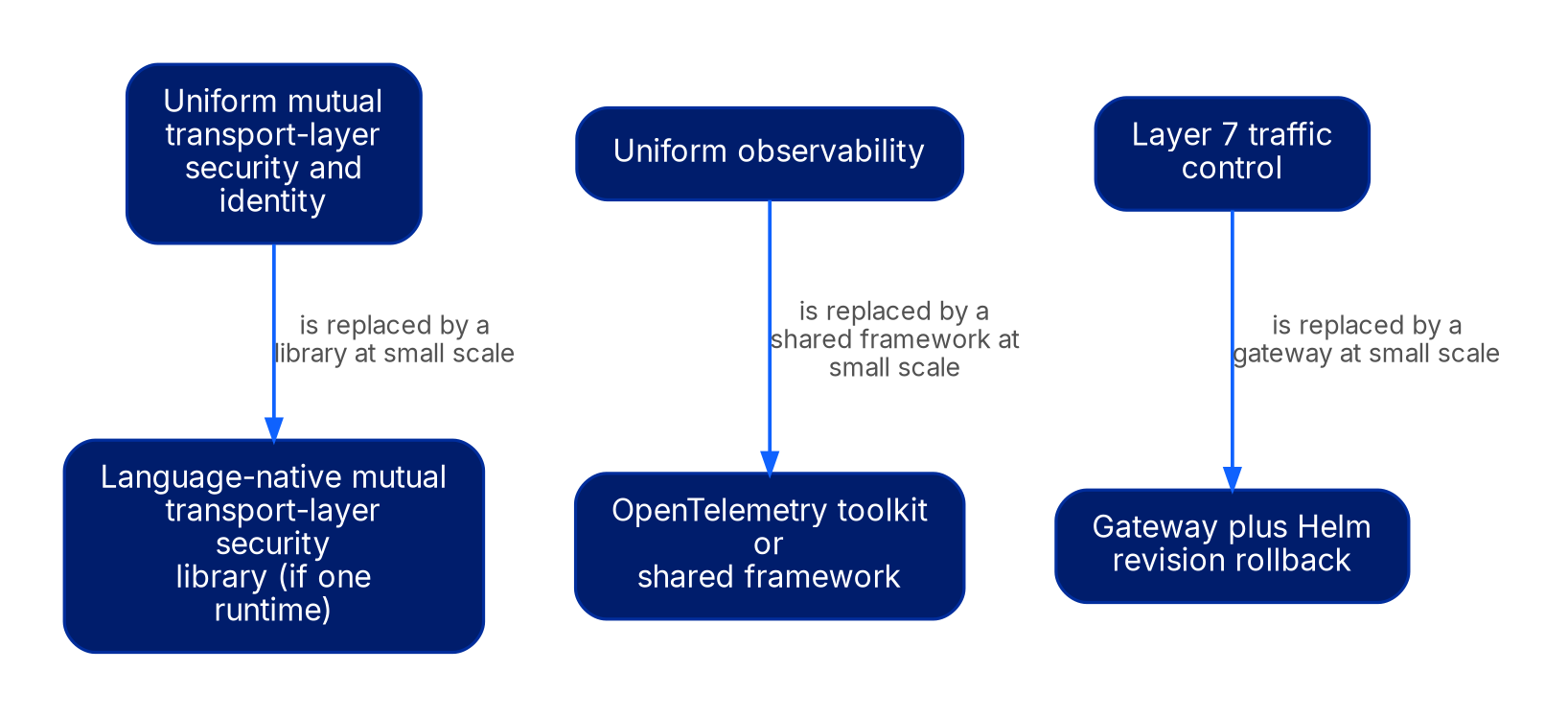
Uniform mutual TLS and identity. This is the strongest argument. A mesh gives every service a cryptographic identity and encrypts service-to-service traffic without application changes, which maps directly onto the zero-trust model that NIST SP 800-207 describes: no implicit trust based on network location. If you are under a regulatory mandate to encrypt internal traffic and prove per-service identity, doing that in a library across ten languages is a nightmare, and the mesh is genuinely the cheapest path. If you have one runtime and a hard compliance driver, though, a language-native mTLS library may cost less than a mesh over three years.
Uniform observability. A mesh emits consistent request metrics, distributed traces, and access logs for every service without per-service instrumentation. That uniformity has real value when you run 40 services across five teams and three languages, because it collapses five inconsistent observability stories into one. It has almost no value when your services already emit good telemetry through a shared framework, which many modern stacks do by default. Buying a mesh mainly for dashboards you could get from an OpenTelemetry SDK is paying data-plane latency for a control-plane feature.
Layer 7 traffic control. Canary releases, traffic mirroring, per-route retries, circuit breaking, and fault injection, all configured declaratively and applied fleet-wide. This is powerful for teams doing frequent progressive delivery across many services. For teams that deploy weekly and roll back with a Helm revision, most of it goes unused. We regularly find meshes installed for canary deployments that the org performs four times a year.
The break-even is a service count, not a feature list
Here is the reframe most mesh evaluations miss. The alternative to a mesh is not "nothing." It is a set of libraries, a gateway, and some glue: an mTLS library, an OpenTelemetry SDK, a smart client or an ingress controller for traffic rules. That alternative has a real cost too, and critically, its cost scales with the number of languages and the number of services, because every capability must be re-implemented or re-integrated per runtime and maintained per team.
The mesh has a high fixed cost and a low marginal cost per service. The library-and-gateway approach has a low fixed cost and a marginal cost that climbs with heterogeneity. Those two curves cross. Below the crossover, the do-it-yourself path is cheaper. Above it, the mesh is.
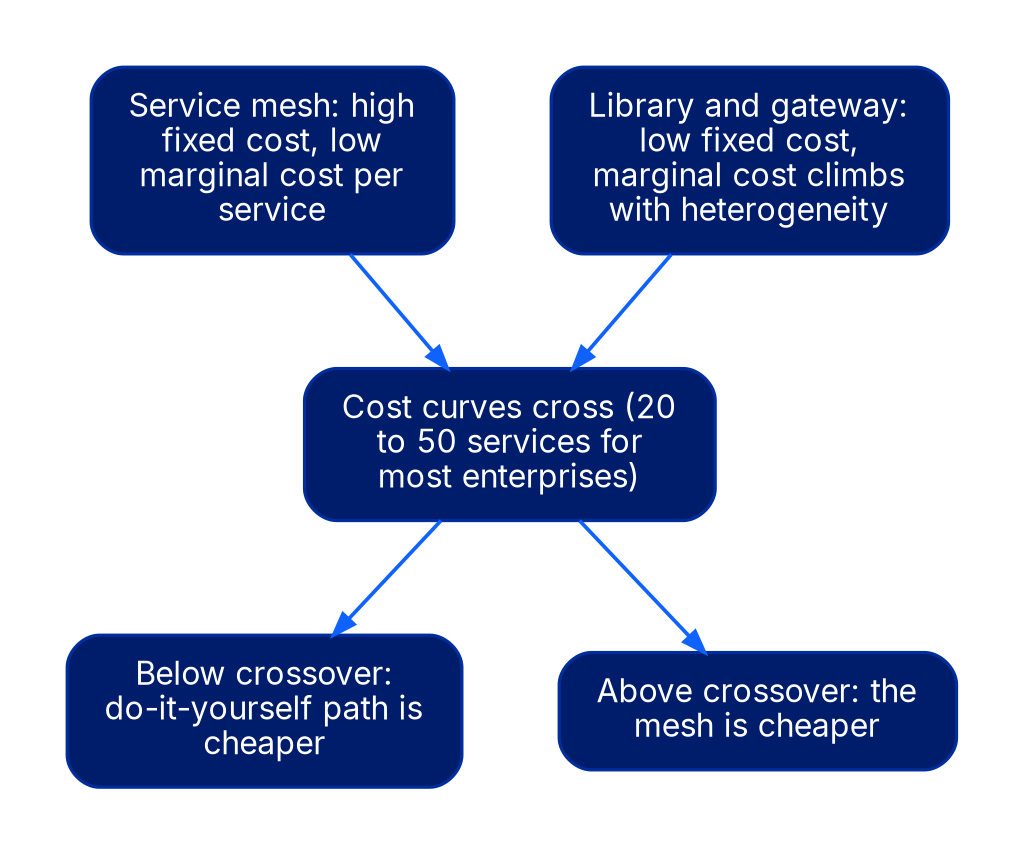
In our experience the crossover for most enterprises sits somewhere between 20 and 50 services, and it moves based on language diversity. A shop with 60 services all in one language and one framework can push the mesh decision out a long way, because a single shared library amortizes across everything. A shop with 25 services in Java, Go, Python, and Node hits the crossover early, because maintaining mTLS and telemetry libraries in four ecosystems is four times the work and four times the drift. The variable that moves the break-even is not how many services you have. It is how many distinct runtimes those services span.
This is why "we're doing microservices, so we need a mesh" is a category error. Ten services in one language do not need a mesh. Forty services in four languages under a zero-trust mandate almost certainly do. The service count alone tells you little; the count multiplied by runtime diversity, weighted by your compliance and progressive-delivery requirements, tells you most of what you need.
A counter-take: most teams should start sidecarless, or not at all
Conventional platform advice treats a service mesh as an inevitable stop on the microservices journey. We disagree for the median team. The default should be to defer the mesh until the break-even math clearly favors it, and when you do adopt, to prefer the architectures that shrink the tax.
The sidecar model is no longer the only option, and the newer ones directly attack the cost side of the ledger. Istio's ambient mode removes the per-pod sidecar in favor of a shared per-node proxy for mTLS and telemetry, which cuts the proxy count from one-per-pod to one-per-node and takes the L7 processing off the hot path unless a workload needs it. Linkerd built its data plane on a purpose-built Rust micro-proxy specifically to hold per-hop latency and memory far below a general-purpose Envoy sidecar. Cilium pushes identity and policy into the kernel with eBPF, avoiding a user-space proxy for a large class of traffic. None of these is free, but each changes the numbers in the cost model above, and a 2026 evaluation that only benchmarks classic Istio sidecars is pricing an architecture the market has already moved past.
The unfashionable position is that for a lot of teams the right answer is a gateway plus libraries for another two years, then a sidecarless mesh when the service and runtime counts actually justify it. That sequence carries less operational risk and less latency tax than installing a full sidecar mesh the day the third microservice ships. The teams getting the most from a mesh are not the ones who adopted earliest. They are the ones who adopted latest that they could get away with, and skipped straight to the lower-overhead data plane.
How to run the numbers honestly
The right evaluation is a written comparison of two annualized costs over a three-year horizon, not a feature checklist. On one side, the fully loaded cost of the mesh: proxy compute, control-plane compute and storage, and the one to two engineers who own it, which in most markets lands north of $400k per year in salary alone once you load it. On the other side, the fully loaded cost of the library-and-gateway alternative: engineering time to build and maintain mTLS, telemetry, and traffic capabilities across each runtime you support.
We push clients to write both numbers down with real figures. "We need a mesh for security" is not an input. "We must encrypt and identity-tag all east-west traffic to satisfy our auditor, we run 4 language runtimes, and building that in libraries is roughly 1.5 engineers ongoing versus 1 engineer to run a mesh" is an input. Once both sides are quantified, the decision usually makes itself, and it frequently comes out against the mesh for teams under the service-and-runtime threshold, and clearly for it above.
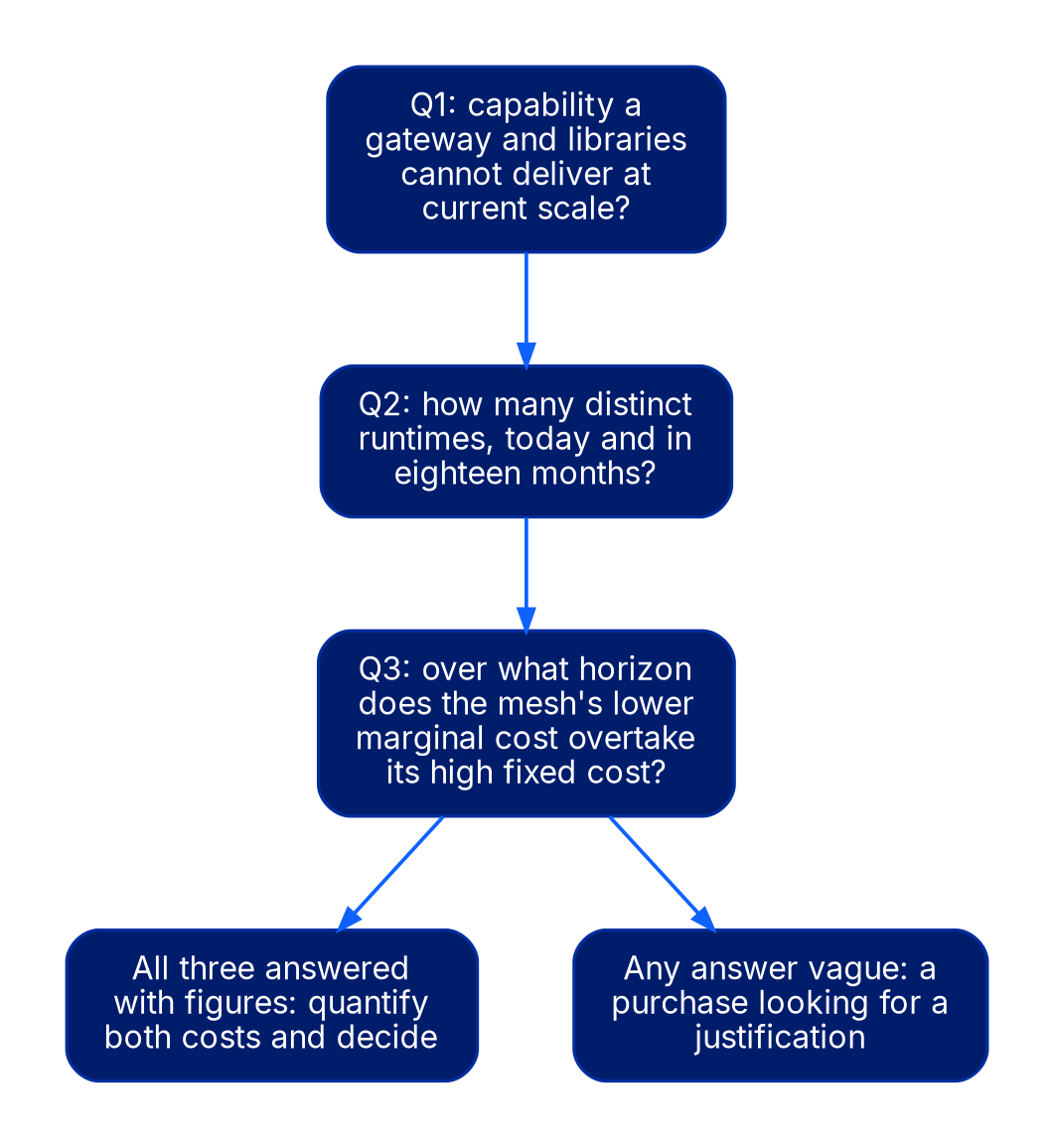
Three questions force the honesty. What specific capability do you need that a gateway and libraries cannot deliver at your current scale? How many distinct runtimes must that capability cover, today and in eighteen months? And over what horizon does the mesh's lower marginal cost per service overtake its high fixed cost, given your actual service growth rate? If any of those answers is vague, the mesh is a purchase looking for a justification.
Where to start
- Count what actually drives cost. Inventory your services by runtime, not just by number. The count that predicts mesh ROI is services multiplied by distinct languages and frameworks, not services alone.
- Name the one capability you are buying. Mutual TLS under a mandate, uniform observability across heterogeneous runtimes, or fleet-wide progressive delivery. If you cannot name which of the three is the driver, you are not ready to install.
- Price the alternative before the mesh. Cost out the gateway-and-library path for your specific runtimes over three years. A mesh only wins if it beats that number, and below the crossover it usually does not.
- If you adopt, skip the classic sidecar. Evaluate ambient, Rust-proxy, and eBPF data planes first. They attack the exact latency and compute tax that erodes mesh ROI, and adopting the older architecture in 2026 leaves money on the table.
- Assign an owner and a unit-cost metric before go-live. A mesh with no accountable owner and no proxy-overhead-per-request number on a dashboard will drift into a latency and cost liability within two quarters. Fund the ownership or do not start.
Continue reading
Cloud Carbon Accounting: Why the Vendor Dashboard Won't Survive Your Audit
Almost every enterprise on a hyperscaler now has a cloud carbon number. Few have one that an auditor will accept. The provider dashboards make the fir…
Multi-Cloud Disaster Recovery Architecture: When the Second Cloud Earns Its Keep
Nearly every regulated enterprise now carries a multi-cloud disaster recovery line in its resilience plan. Far fewer have ever failed a production wor…
Kubernetes vs. ECS: A decision framework that actually holds up in production
Most engineering teams treat the Kubernetes vs. ECS question as a technical puzzle. Architecture blog posts compare control planes, IAM integrations, …