

Multi-Cloud Disaster Recovery Architecture: When the Second Cloud Earns Its Keep
Nearly every regulated enterprise now carries a multi-cloud disaster recovery line in its resilience plan. Far fewer have ever failed a production workload over to the second cloud under real load. The plan exists. The runbook exists. The standby environment is provisioned and billed every month. What does not exist, in most cases, is evidence that the thing would work when the primary cloud is on fire and the clock is running.
This is the quiet failure mode of multi-cloud DR. A board approves it as insurance, finance funds it, and engineering builds a warm copy of the estate on a second provider that is never exercised. The result is a costly architecture whose central claim, that it will recover the business during a regional or provider-level outage, has never been tested against the one scenario it was bought to handle. We have walked into more than one of these and found a standby that could not have come up: stale credentials, an unreplicated database, a DNS cutover nobody had rights to execute at 3 AM.
The gap between a DR plan and a DR capability
Most disaster recovery programs measure the wrong thing. They track whether a plan document exists, whether the standby is provisioned, whether the last audit passed. None of that tells you the system will recover. A DR capability is defined by one question only: when the primary fails, how fast do you serve customers again, and how much data did you lose getting there?
NIST Special Publication 800-34, the federal contingency planning guide, makes the distinction explicit. It separates the recovery time objective, how long you can be down, from the recovery point objective, how much data you can afford to lose. Those two numbers, set per workload by the people who own the business risk, are the entire specification. Everything else, the choice of provider, the replication topology, the failover mechanism, follows from them. Teams that start with the architecture instead of the objectives build something that recovers, but not on any schedule the business agreed to.
The contrarian point we press on every engagement: a DR architecture you have not failed over to is not a DR architecture. It is a hypothesis. Until you have moved live traffic to the second environment and served real requests from it, you do not know your true recovery time, and the number in your plan is fiction.
What recovery actually has to deliver
Disaster recovery is a spend-to-speed curve. You buy faster recovery with more standing infrastructure and more continuous replication, and each step up the curve costs more to run. The major providers document the same four-tier pattern, and the AWS disaster recovery guidance lays it out cleanly. The tiers, from cheapest and slowest to most expensive and fastest:
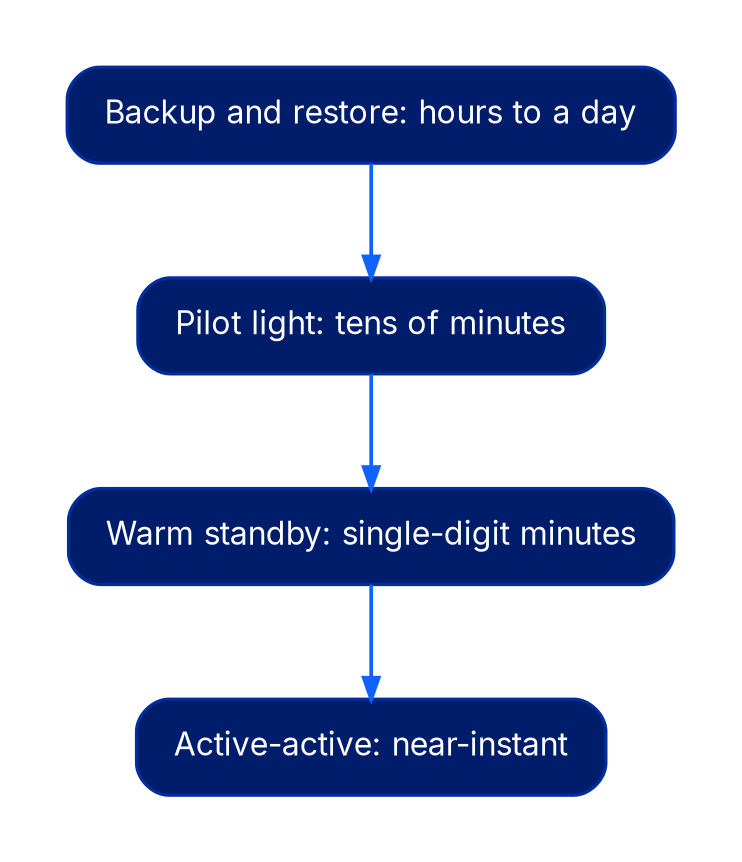
- Backup and restore. You keep backups in a second location and rebuild from them after a failure. Recovery time runs hours to a day. Cheap to hold, slow to recover. Right for workloads that can tolerate a long outage.
- Pilot light. Core data is replicated continuously to a minimal always-on footprint; the rest of the stack is dormant and scaled up on failover. Recovery time drops to tens of minutes. You pay for replication and a small standby, not a full second estate.
- Warm standby. A scaled-down but running copy of the whole system takes over on failover and scales to full size. Recovery time is single-digit minutes. This is where most regulated workloads land.
- Active-active. Both environments serve live traffic at all times. Recovery is near-instant because there is nothing to start. It is also the most expensive and the hardest to operate, because every change must be correct in two places at once.
The mistake we see most often is buying active-active language and funding pilot-light reality, then discovering the gap during an incident. Pick the tier each workload's RTO and RPO actually require, and fund that tier honestly. A payments service with a 15-minute RPO and a sub-hour RTO needs warm standby. An internal analytics tool that can be down for a day does not, and paying for active-active there is waste dressed as prudence.
When the second cloud earns its keep
Here is where multi-cloud DR specifically, as opposed to multi-region within one cloud, has to justify itself. Multi-region single-cloud DR is dramatically simpler: one IAM model, one networking model, one set of tools, and a provider whose composite multi-AZ SLA of 99.99 percent already implies roughly 52 minutes of permitted downtime a year. For most enterprises that is the right DR architecture, and a second provider adds operational tax without adding resilience the business can use.
Three conditions move the math. When at least one holds, multi-cloud DR can earn its keep.
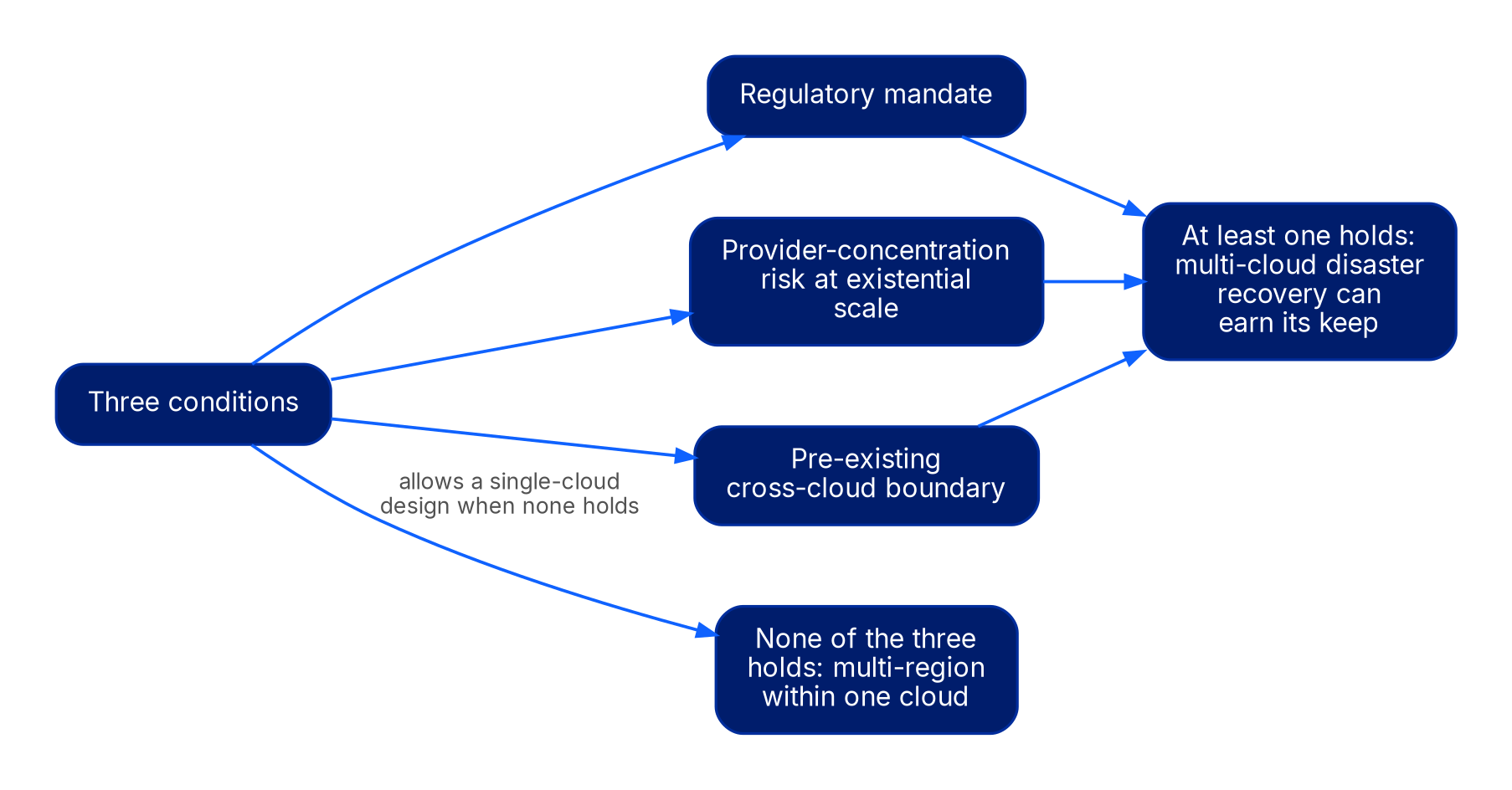
The first is regulatory mandate. The EU Digital Operational Resilience Act, enforceable since January 2025, requires financial institutions to manage concentration risk in critical ICT third parties and to hold a credible exit strategy. A supervisor who has rejected single-provider multi-region as sufficient evidence leaves you with a documented reason, and an external one, to run recovery on a second provider.
The second is genuine provider-concentration risk at a scale where a multi-hour outage of one hyperscaler is an existential event for the business, not merely an expensive one. Provider-level failures are rare, but they happen, and a single control plane is a single correlated failure domain no amount of multi-region design inside that provider removes.
The third is a capability or sovereignty boundary that already splits the estate across clouds for non-DR reasons, in which case cross-cloud recovery is an extension of an architecture you are already paying to operate, not a new one.
If none of the three holds, the honest recommendation is multi-region within one cloud. We have talked more clients out of multi-cloud DR than into it, and the ones we talked out of it kept the money and the simplicity.
A counter-take on lock-in and resilience
Conventional resilience advice treats a second provider as strictly safer than a first. We disagree, and the reason is operational. A recovery path you exercise twice a year on infrastructure your team uses daily is more reliable than a recovery path on a second cloud your team touches only during drills. Familiarity is a resilience property. The marginal engineer on a two-cloud team is materially less fluent in each environment than a single-cloud engineer is in one, and that fluency gap shows up precisely when you can least afford it, mid-incident.
So the counter-take we offer is this: for the median enterprise, deeper investment in multi-region recovery inside one cloud, rehearsed often, buys more real resilience than a second cloud that sits cold. Multi-cloud DR is correct when an external mandate or a concentration threshold forces it. It is rarely correct as a hedge against a risk you have not quantified.
The architecture that survives a real failover
When the three conditions do warrant a second cloud, four design choices separate a DR capability from a DR hypothesis.
Replicate data continuously, and own the lag. Your RPO is your replication strategy. Asynchronous replication across providers introduces lag, and that lag is your worst-case data loss. Measure it, alert on it, and make sure the number stays under the RPO you committed to. Cross-cloud egress runs 5 to 9 cents per gigabyte at typical commit tiers, so continuous replication of a large dataset is a real and continuous line item. Budget it openly rather than discovering it on the bill.
Keep the recovery control plane independent. The most common reason a failover stalls is a dependency on the thing that failed. If your deployment pipeline, secrets store, DNS, or identity provider lives only in the primary cloud, the outage that takes the primary also takes your ability to recover. The recovery path must be able to run when the primary is fully dark. That means independent credentials, an out-of-band way to execute the DNS cutover, and a secrets copy the standby can reach.
Make traffic redirection deliberate and authorized. Failover is a decision, not an accident. Decide in advance who is authorized to declare a disaster, what the cutover mechanism is, and how traffic moves, whether through DNS with a low time-to-live, a global load balancer, or a manual switch. Automatic failover is attractive until a false positive sends you into a worse state than the outage. Most regulated teams we work with choose a fast manual trigger with a named on-call authority over full automation.
Rehearse on a schedule, with real traffic. A DR plan decays the moment it is written, because the estate keeps changing under it. The only defense is regular game-day exercises that move live traffic to the second cloud and serve from it. Quarterly is a reasonable floor for a critical workload. The first such test almost always fails in an instructive way, and that is the point: you want to find the stale credential during a drill, not during the outage.
Where to start
The discipline here is the same one that kills lazy multi-cloud proposals: write the numbers down before you build. Resilience is not a recovery architecture; a 15-minute RPO with a sub-hour RTO and a named failover authority is.
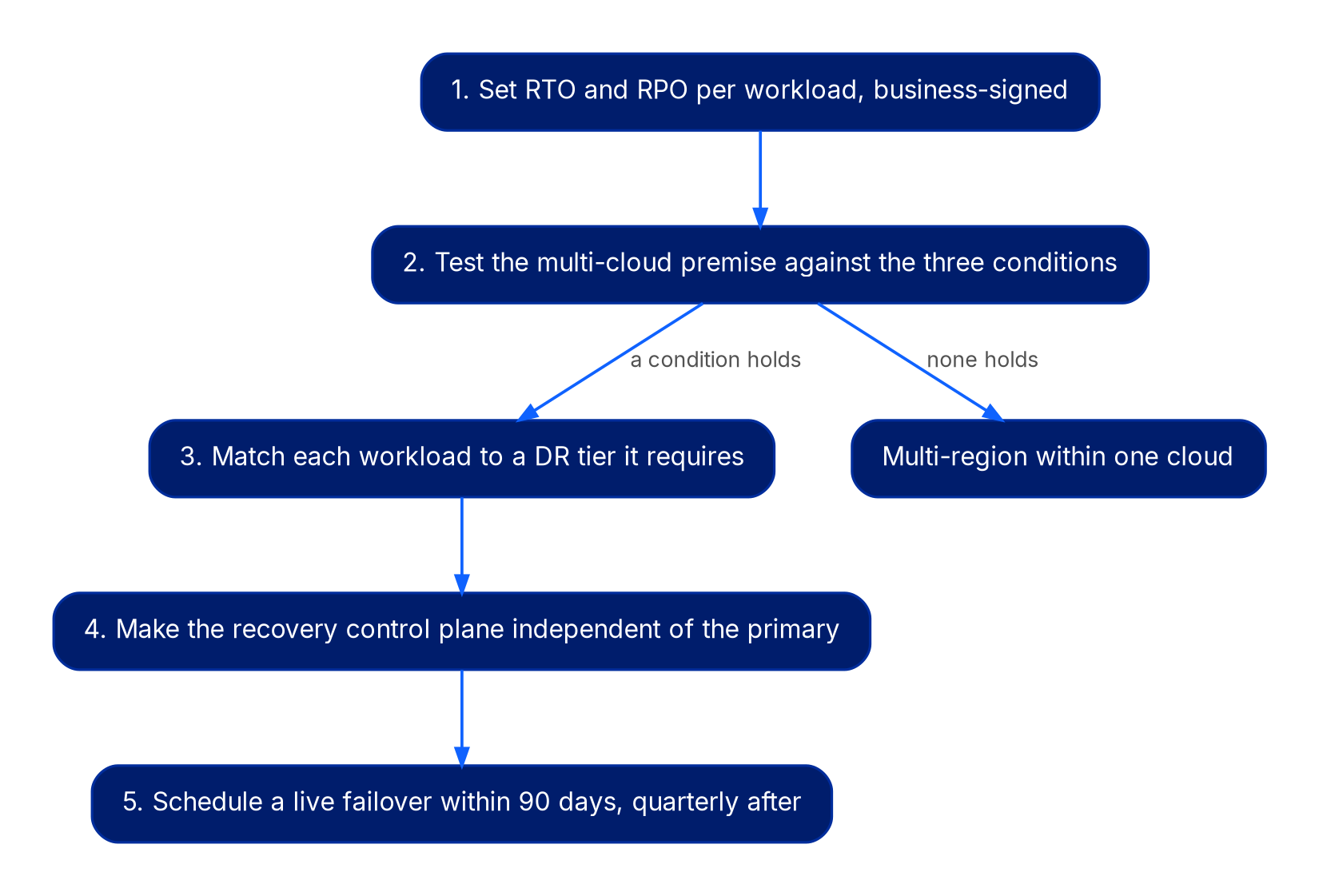
- Set RTO and RPO per workload first, signed by the business owner who carries the risk, before any architecture discussion. The objectives are the specification.
- Test the multi-cloud premise against the three conditions. If no regulatory mandate, concentration threshold, or pre-existing cross-cloud boundary applies, choose multi-region within one cloud and redirect the savings into rehearsal.
- Match each workload to a DR tier (backup and restore, pilot light, warm standby, or active-active) that its objectives actually require, and fund that tier rather than the tier on the slide.
- Make the recovery control plane independent of the primary cloud, including identity, secrets, deployment, and DNS cutover authority.
- Schedule a live failover within 90 days and quarterly thereafter, measure the real recovery time and data loss, and treat the gap between the measured number and the committed objective as the only DR metric that matters.
A disaster recovery architecture is worth exactly what its last successful failover proved. Build for the test, not the audit, and the audit takes care of itself.
Continue reading
Cloud Carbon Accounting: Why the Vendor Dashboard Won't Survive Your Audit
Almost every enterprise on a hyperscaler now has a cloud carbon number. Few have one that an auditor will accept. The provider dashboards make the fir…
Kubernetes vs. ECS: A decision framework that actually holds up in production
Most engineering teams treat the Kubernetes vs. ECS question as a technical puzzle. Architecture blog posts compare control planes, IAM integrations, …
AWS to Azure Migration Cost Benchmarks: What the Numbers Actually Show
Most AWS-to-Azure migration budgets are wrong before the project starts. Not because the engineers are bad at their jobs. They are wrong because the c…