

Kubernetes vs. ECS: A decision framework that actually holds up in production
Most engineering teams treat the Kubernetes vs. ECS question as a technical puzzle. Architecture blog posts compare control planes, IAM integrations, and networking models at length. The real question is simpler and harder: how much operational surface area can your team sustain, and does your workload actually need what Kubernetes offers?
We have seen teams make this decision badly in both directions. The Kubernetes-first default frequently loads a four-person platform team with the equivalent of running a distributed operating system. The ECS-first default periodically strands teams at capability ceilings they did not anticipate when their system was half its current size. Neither failure is inevitable. Both are common, and both are avoidable with a cleaner decision framework.
The framing that most teams get wrong
The standard framing treats this as a capability question: which orchestrator supports more features? That framing leads teams toward Kubernetes almost every time, because Kubernetes does support more features. It is a more expressive, more powerful system. The problem is that you pay for that expressiveness continuously, whether or not you use it.
A healthier framing is operational cost versus capability return. What does each option cost to run at your current team size and scale, and what capabilities does it return at that same scale? The cost side of that equation is where teams routinely underestimate Kubernetes and overestimate ECS.
Conventional advice in platform engineering communities says that Kubernetes is the default correct choice for any serious containerized workload. We disagree. Kubernetes is the correct choice for a specific profile of team and workload. For teams outside that profile, it is an operational liability dressed up as infrastructure credibility.
What Kubernetes actually costs you
Kubernetes is not a service. It is a platform for building platforms. That distinction matters because platforms require platform engineers, and platform engineers are expensive and scarce.
A minimal production Kubernetes cluster on Amazon EKS runs a managed control plane at $0.10 per cluster per hour, roughly $73 per month before a single node is attached. That is the cheap part. The real cost is operational overhead: certificate rotation, role-based access control management, network policy configuration, cluster upgrades (typically 3 to 4 per year on EKS before support windows close), and the ongoing work of keeping add-ons like CoreDNS, kube-proxy, and the VPC CNI plugin current.
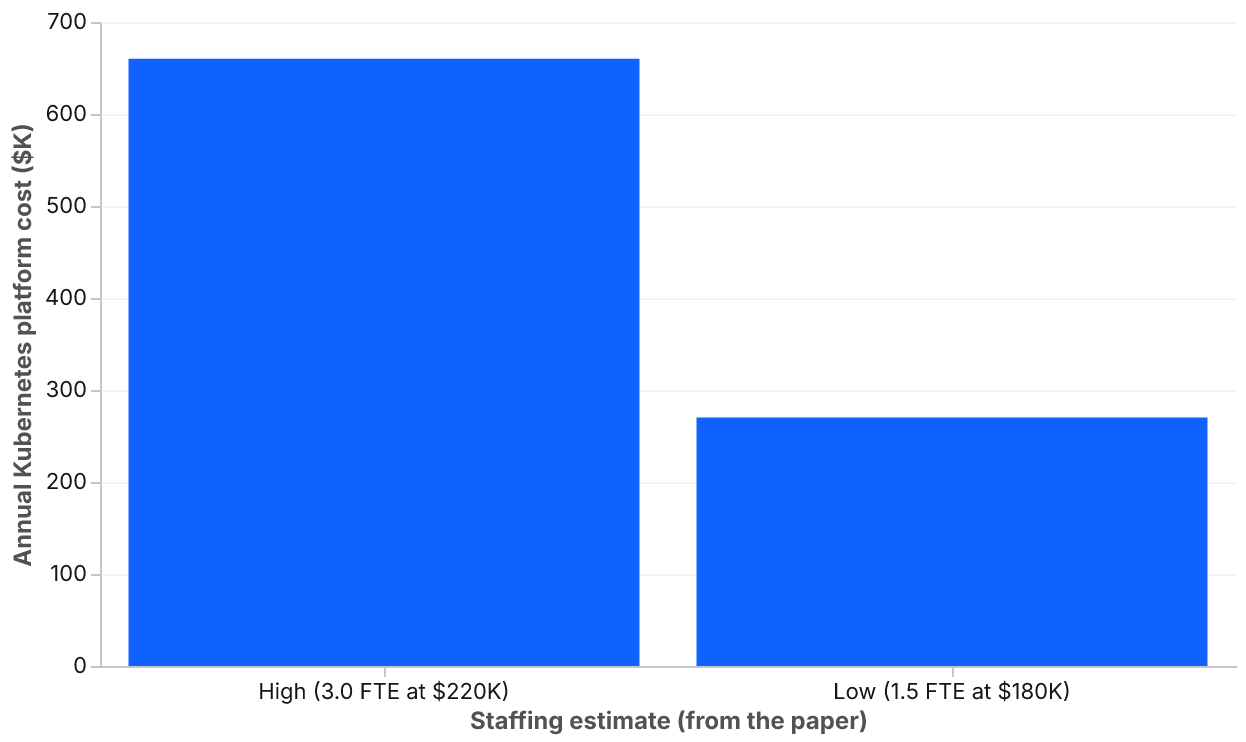
Our estimate, confirmed across dozens of engagements, is that a Kubernetes cluster run at production quality requires 0.5 to 1.0 full-time equivalent engineers per cluster to maintain properly. Not to build features. To maintain. A team running three clusters for dev, staging, and production needs between 1.5 and 3.0 FTEs whose primary job is keeping the platform operational. At $180,000 to $220,000 in fully-loaded engineering cost per FTE, that is a $270,000 to $660,000 annual commitment before a single business workload is deployed.
Kubernetes also slows down developer experience in the short term. First-time deployments require understanding namespaces, resource requests and limits, readiness and liveness probes, ingress controllers, and service mesh considerations, even for simple web services. We routinely see 4 to 8 weeks of productivity loss per engineer when a team migrates from simpler runtimes to Kubernetes, as developers rebuild mental models for debugging, logging, and deployment.
None of this makes Kubernetes the wrong answer. It makes it a choice with a specific price that should be compared explicitly against the alternative.
What ECS actually costs you
Amazon Elastic Container Service has a narrower capability surface than Kubernetes. The operational model, in exchange, is far lighter. AWS manages the control plane entirely, with no operator involvement. Task definitions are simpler than Kubernetes YAML. IAM integration via task roles is cleaner than Kubernetes service accounts for AWS-native workloads. With AWS Fargate, node management disappears entirely.
The costs of ECS are not operational; they are architectural. Teams that start on ECS frequently hit capability gaps as their systems grow. Custom scheduling is limited. Multi-cluster federation does not exist natively. The ecosystem of operators, custom resource definitions, and service meshes that Kubernetes has accumulated over a decade has no ECS equivalent. Service discovery works cleanly within a single cluster but becomes awkward at the boundaries of multiple ECS clusters or hybrid deployments.
ECS is also effectively AWS-only. If your roadmap includes running workloads on Azure or GCP, or in on-premises data centers, ECS gives you almost no portable knowledge or tooling. That is not a fatal argument against it. But it is a real consideration for teams with acquisition exposure or multi-cloud commitments.
A third cost is less obvious: engineering hiring and retention. Engineers who have worked at larger organizations increasingly expect Kubernetes fluency to be part of their job. Teams running ECS sometimes find themselves competing for candidates who want to build those skills at work. We have seen this influence hiring outcomes at companies where total compensation was comparable to Kubernetes shops.
The five decision variables that actually matter
Neither system dominates the other across all dimensions. We use five questions to structure the decision:
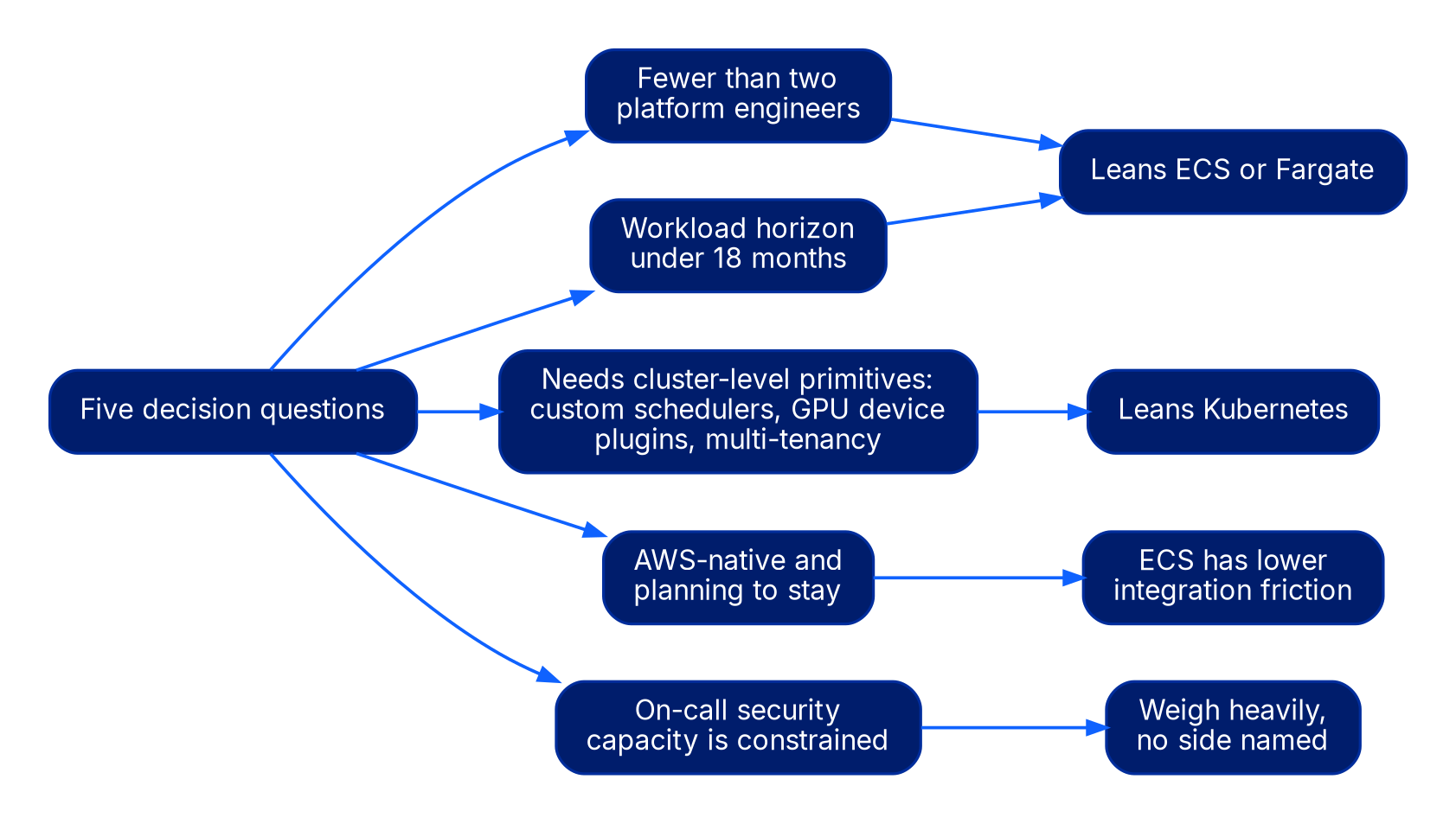
How many engineers will own the platform? Fewer than two dedicated platform engineers almost certainly means ECS or Fargate, unless the team carries unusually deep Kubernetes expertise. Part-time attention from developers primarily focused on product work is a reliable path to a degraded cluster.
What is the expected lifetime of this workload? Short-horizon workloads, under 18 months, rarely benefit from the upfront Kubernetes investment. The learning curve and setup cost do not amortize. ECS Fargate can have a containerized workload running in days rather than weeks.
Do you need cluster-level primitives? Custom schedulers, topology-aware placement, GPU device plugins, multi-tenant isolation with namespace-level access controls, and advanced service mesh policies are Kubernetes-native capabilities. If your workload needs them, you need Kubernetes.
Are you AWS-native and planning to stay? ECS integrates more cleanly with AWS services than Kubernetes does. ECS task roles, CloudWatch Container Insights, and Application Load Balancer integration are all simpler to configure on ECS than on EKS. If your security model, observability, and networking are already built around AWS primitives, ECS has meaningfully lower integration friction.
What is your on-call security capacity? Kubernetes adds attack surface. More components mean more failure modes, more CVEs to patch, and more blast radius in a security incident. The NSA and CISA Kubernetes Hardening Guide spans more than 60 pages for a reason. Teams with constrained security capacity should weight this heavily in their evaluation.
When Kubernetes is the right call
We recommend Kubernetes when at least four of the following are true: the team runs more than 15 microservices with different scaling profiles; there is dedicated platform engineering capacity of at least two full-time engineers; the workload has a multi-year horizon; the system requires advanced scheduling, hardware accelerators, or multi-tenancy; the engineering team already has Kubernetes fluency; and portability across environments is a real, near-term requirement.
Large-scale batch and machine learning workloads are a strong Kubernetes case. GPU scheduling, node affinity rules, and tools like Kubeflow or Apache Spark on Kubernetes deliver resource utilization for heterogeneous compute that ECS cannot match. If training jobs run at any real scale, Kubernetes is almost always the right answer, regardless of team size.
Organizations operating across more than one cloud, or running workloads that must eventually exit to on-premises, also belong in Kubernetes despite its portability limitations. Kubernetes gives you at least a shared mental model and toolchain across environments. ECS gives you neither.
When ECS is the right call
ECS wins when simplicity and AWS integration are the binding constraints. A team of eight engineers building a SaaS product on AWS, with two or three services that need containers, will spend more time managing Kubernetes than building product. ECS Fargate with CodePipeline, CloudWatch, and ALB routing delivers a complete, production-grade platform with almost no operational overhead.
ECS is also correct for teams coming from a serverless background. The conceptual distance between AWS Lambda and ECS Fargate is small; both operate as managed compute with IAM, CloudWatch, and VPC integration. The conceptual distance between Lambda and Kubernetes is large. Teams that have built their operational practices around AWS managed services should stay in that abstraction layer until they have a specific forcing function to leave.
Finally, ECS wins when speed to production is the primary constraint. Three weeks of Kubernetes setup versus three days of ECS Fargate setup matters when the business has a delivery date that cannot move.
Counter-take: portability is mostly a theoretical benefit
The most common argument for Kubernetes over ECS is portability. Kubernetes runs on AWS, Azure, GCP, and bare metal. The argument is that choosing Kubernetes keeps future options open.
We find this argument mostly unconvincing for mid-market teams. Kubernetes is a portable compute abstraction; it is not a portable cloud platform. Storage classes, load balancer integrations, IAM bindings, secrets management, and network policies all embed cloud-specific behavior deeply into application manifests and operator configurations. A Helm chart that runs on EKS will not run on GKE without real changes, and those changes are not cosmetic.
The portability argument also assumes you will eventually need to run on a second cloud. For most teams, that assumption has no grounded roadmap behind it. Choosing an orchestrator based on a multi-cloud scenario you cannot articulate is speculative investment in operational complexity.
The right counter-question is: what would it actually cost to migrate from ECS to Kubernetes if your requirements change? For most containerized workloads, the answer is 4 to 8 weeks of platform work. That is a bounded, finite cost. It is cheaper than paying the Kubernetes operational tax for three years while the portability requirement remains theoretical.
A narrow set of cases make portability matter from day one. Regulated industries with documented exit-strategy requirements, as the EU Digital Operational Resilience Act now mandates for financial services ICT providers, need to demonstrate credible exit plans. For those teams, Kubernetes's portability story is genuinely valuable. For a SaaS startup building its first scalable backend, it is not.
Start here: five questions before you commit
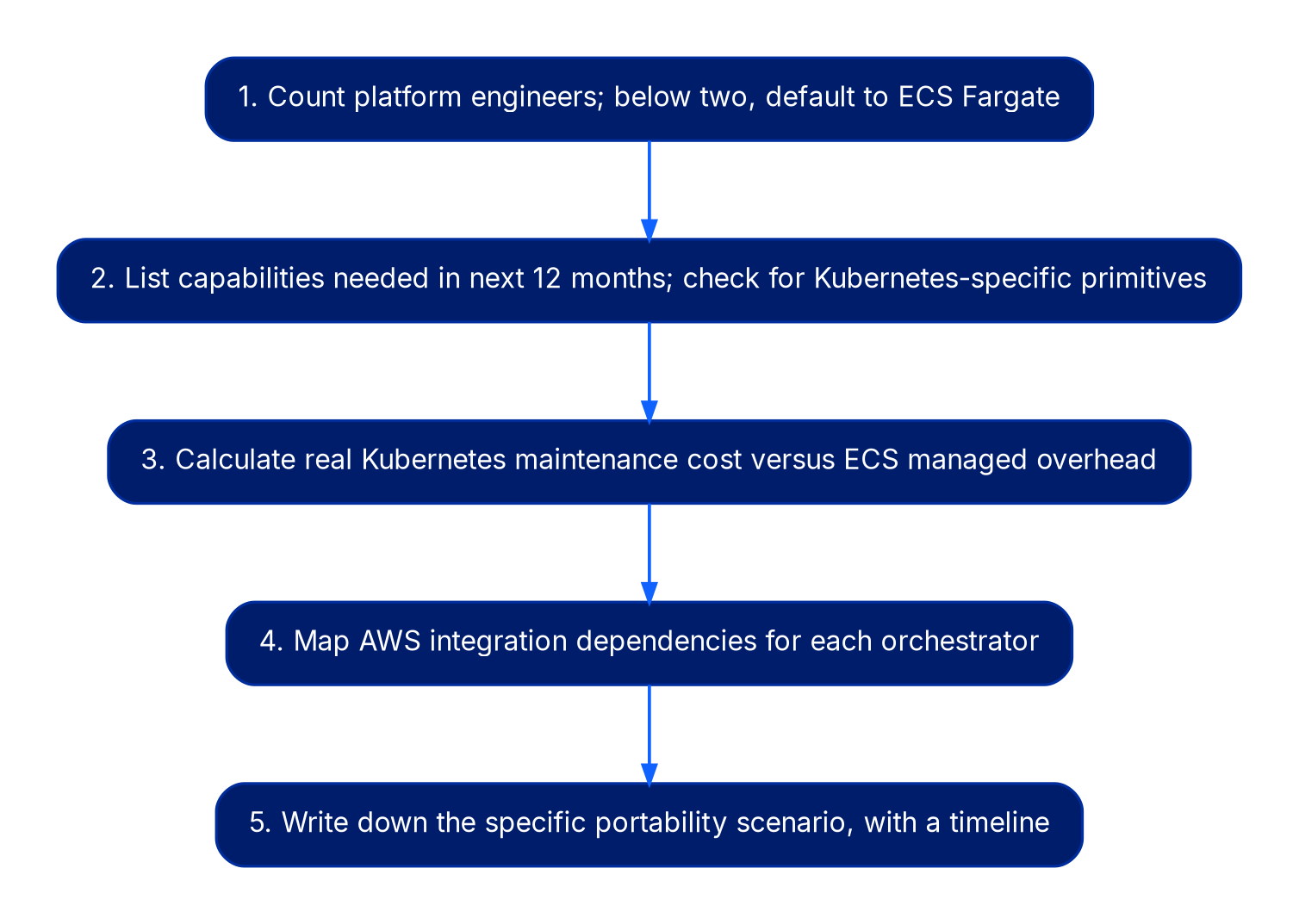
- Count your dedicated platform engineers. If the number is below two, default to ECS Fargate until team capacity changes.
- List the capabilities your workload will need in the next 12 months. If none of them require Kubernetes-specific primitives, the operational complexity is not justified.
- Calculate the real cost of Kubernetes maintenance for your team size, including FTE time for upgrades, incident response, and security patching. Compare that to ECS managed overhead.
- Map your AWS integration dependencies. Know which AWS services you rely on and how cleanly each integrates with each orchestrator before the engineering team has a preference to defend.
- Write down the specific scenario where portability would matter. If you cannot write a concrete scenario with a timeline, portability should not influence the decision.
The teams that get this decision right treat it as a resource allocation problem, not a technology preference. Kubernetes is not better than ECS. ECS is not simpler than Kubernetes. Each is the right tool in conditions that can be named explicitly. Naming those conditions before the engineering team has formed a camp is where the real work happens.
Continue reading
AWS to Azure Migration Cost Benchmarks: What the Numbers Actually Show
Most AWS-to-Azure migration budgets are wrong before the project starts. Not because the engineers are bad at their jobs. They are wrong because the c…
Multi-Cloud Without the Theater: Where Portability Actually Pays
Multi-cloud is one of the most overprescribed strategies in enterprise architecture. The idea sounds prudent, the slide builds itself, and the cost fa…
Cloud Cost Discipline: A 30/60/90 Plan for Mid-Market Buyers
Most mid-market cloud bills are 25 to 40 percent inefficient. A focused ninety-day plan to recover that spend without a refactor.Cloud cost optimizati…