

A vendor consolidation framework that survives the renewal
Vendor consolidation saves money in year one and quietly gives most of it back at the second renewal. A framework for deciding what to merge and what to keep competitive.
Almost every enterprise above $1B in revenue runs a vendor consolidation program every three to four years. Few produce savings that survive the second renewal. The procurement deck shows a tidy reduction from, say, 40 overlapping tools to 12, a headline discount of 10 to 20% for committing more volume to fewer suppliers, and a governance win in having fewer contracts to manage. Two years later the same categories cost more than they did before the program started. The vendors that won the consolidation know the switching cost they built, and they price accordingly. We have watched this movie enough times to argue that the standard consolidation playbook optimizes the wrong number.
Why most consolidation programs give the savings back
The mechanics are not mysterious. A consolidation program concentrates spend to earn a discount. Concentration is exactly what removes your ability to walk away later. At the first renewal the incumbent still remembers the competitive bid that won them the deal, so pricing holds. By the second renewal the alternatives have atrophied. The integrations are wired in, the staff are trained on one platform, the data model is theirs, and the realistic cost of switching is now high enough that the vendor can raise prices to just below it and keep every dollar.
That renewal uplift is the line item nobody models at kickoff. We routinely see single-sourced categories carry renewal increases of 15 to 40% once the switching cost is locked in, which swamps the original consolidation discount within two cycles. The savings were real. They were also temporary, and they were financed by handing the supplier a call option on your future spend.
The second failure mode is softer and slower. Consolidating to one suite tends to standardize on that suite's roadmap. When the vendor deprioritizes a capability your business depends on, you have no second source to route around it, and the workaround becomes a custom integration you now own forever.
The vendor count is a vanity metric
Here is the counter-take we offer. Vendor count is a vanity metric, and reducing it is not the objective. The objective is to lower total cost of ownership while keeping switching costs bounded and concentration risk inside a limit the board can defend. Those goals are frequently in tension, and a program that tracks only the number of logos on a slide will trade the second and third for a one-time win on the first.
Conventional advice says fewer vendors means less risk, because there are fewer relationships to manage, fewer security reviews, fewer contracts. We disagree in the cases that matter. Fewer vendors reduces administrative risk and raises concentration risk at the same time. For a payroll system, a core banking platform, or the identity provider that gates every login, concentration risk is the one that ends up in front of regulators. Financial regulators now name this explicitly. The European Union's Digital Operational Resilience Act requires firms to monitor and limit information and communication technology concentration risk from third parties, and the United States interagency guidance on third-party relationships treats critical-provider concentration as a governance obligation, not a procurement preference.
Score every category before you touch it
Consolidation is a portfolio decision, not a single lever. Before merging anything, we score each spending category on two axes.
The first axis is spend concentration: how much money moves through the category and how compressible it is. High-spend categories with real volume tiers are where consolidation discounts are largest. The second axis is switching cost, which combines data gravity, integration depth, staff retraining, and how substitutable the alternatives genuinely are. A category with three interchangeable suppliers and shallow integration has low switching cost. A category with one deeply embedded platform and a proprietary data model has high switching cost, regardless of how many logos appear on the invoice.
Those two axes produce four plays.
- High spend, low switching cost: consolidate hard. This is where the framework pays. Commodity infrastructure, undifferentiated SaaS, professional services, and logistics categories usually sit here. Concentrate the volume, take the discount, and keep a credible second source warm so the next bid is real. Commercial laptops, bulk cloud compute, and contingent labor are typical members.
- High spend, high switching cost: negotiate, do not marry. Core platforms live here. The discount is tempting and the lock-in is dangerous. Consolidate only with contractual protection: capped renewal uplift, exit assistance clauses, data portability in a documented format, and benchmark-repricing rights. Never single-source without them.
- Low spend, low switching cost: rationalize for hygiene. Kill the redundant tools because managing 40 point solutions has an administrative cost, not because the savings matter. This is where vendor-count reduction is a legitimate goal, precisely because the stakes are small.
- Low spend, high switching cost: leave it alone. A cheap but deeply embedded tool is not worth the migration risk. Document it and move on.
Most programs apply the high-spend-low-switching-cost play, the easy win, to every quadrant. That is the error. The play that works for laptops destroys value when applied to the identity provider.
The renewal math nobody models
Model the renewal before you sign, not after. The honest calculation compares the consolidation discount against the risk-adjusted renewal premium over the life of the relationship.
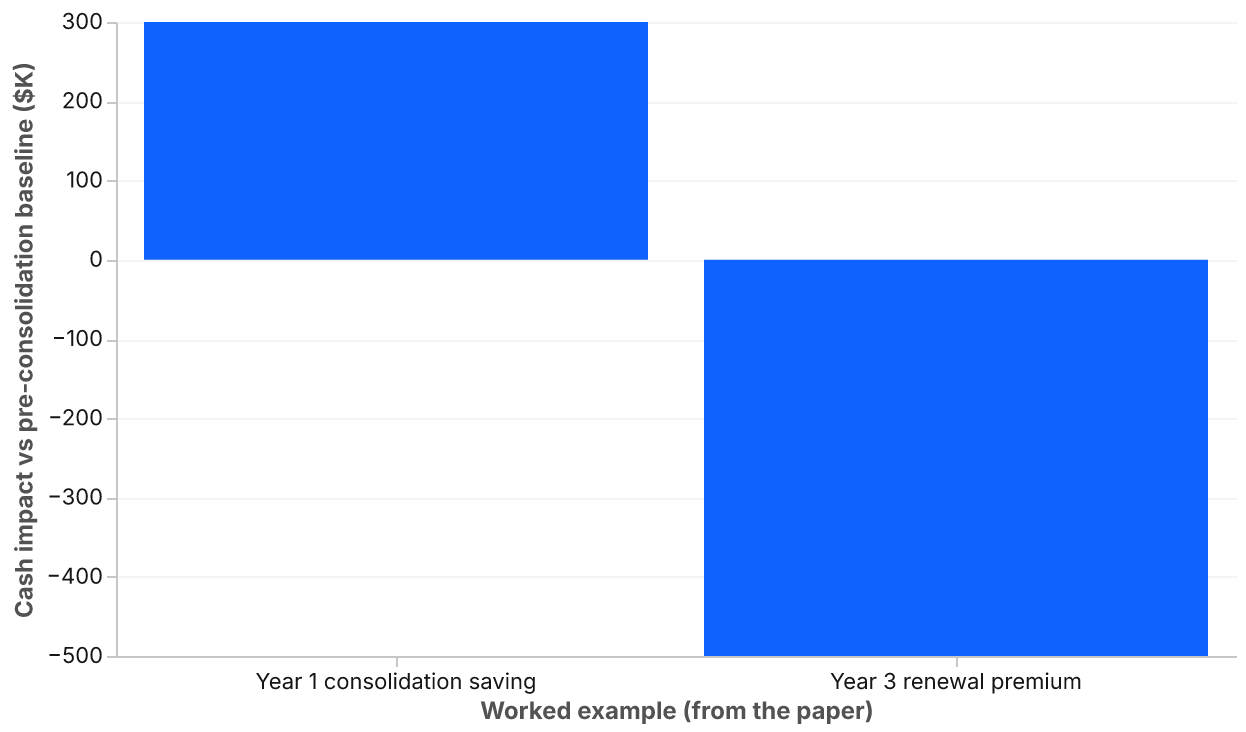
A worked example makes it concrete. Suppose consolidating a category earns a 15% discount on $2M of annual spend, a saving of $300K in year one. If single-sourcing raises the switching cost enough that the vendor drops the discount and resets the price 25% above the original baseline in year three ($2M becomes $2.5M), you pay roughly $500K more that year against the pre-consolidation baseline, and every year after. The three-year picture is a $300K gain followed by compounding losses. The discount was a loan, and the interest rate was set by the switching cost you volunteered to create.
The fix is not to avoid consolidation. It is to price the switching cost as a real liability at signing and to buy it down with contract terms. A capped renewal uplift of 5 to 7% for the contract term, negotiated while you still hold a competitive bid, is worth more than another two points off the year-one price. We advise clients to spend their negotiating position on the renewal, not the signing, because the signing discount is the number the vendor most expects to give.
Concentration risk is a board-level number
Set explicit concentration limits and report them like any other risk. Two thresholds are enough to start. No single vendor should exceed a defined share of spend within a critical category, and no single vendor should sit on the critical path of more than a defined share of revenue-generating workloads. When a proposed consolidation would breach either limit, it goes to the risk committee, not the procurement approver.
This reframes consolidation as a resilience decision as much as a cost one. A supplier that carries 60% of your critical workloads is a single point of failure whether or not its uptime is excellent, because the failure you are pricing is not only an outage. It is insolvency, acquisition by a competitor, a breach, a sudden license change, or a geopolitical restriction that removes the vendor overnight. Diversification has a carrying cost. So does a concentration you cannot unwind.
Governance that keeps competition alive
The durable programs share one discipline: they keep a second source credible even after consolidating. That does not mean splitting volume evenly, which forfeits the discount. It means preserving the ability to switch. Maintain a qualified alternative in each high-switching-cost category, run a benchmarking bid every 24 to 36 months even when you intend to renew, and keep at least a token workload portable enough to prove the exit path works.
Ownership matters as much as method. A consolidation program run purely by procurement optimizes for the signed discount and books the renewal premium as someone else's problem two years out. A program owned jointly by procurement and the platform or architecture function keeps switching cost and concentration risk on the same scorecard as unit price. In our engagements the single change that most improves outcomes is putting the three-year total cost, including modeled renewal risk, in front of the same committee that approves the year-one discount.
Where to start
Consolidation is worth doing. It is worth doing as a portfolio decision priced against the renewal, not as a race to the fewest logos. The sequence that works:
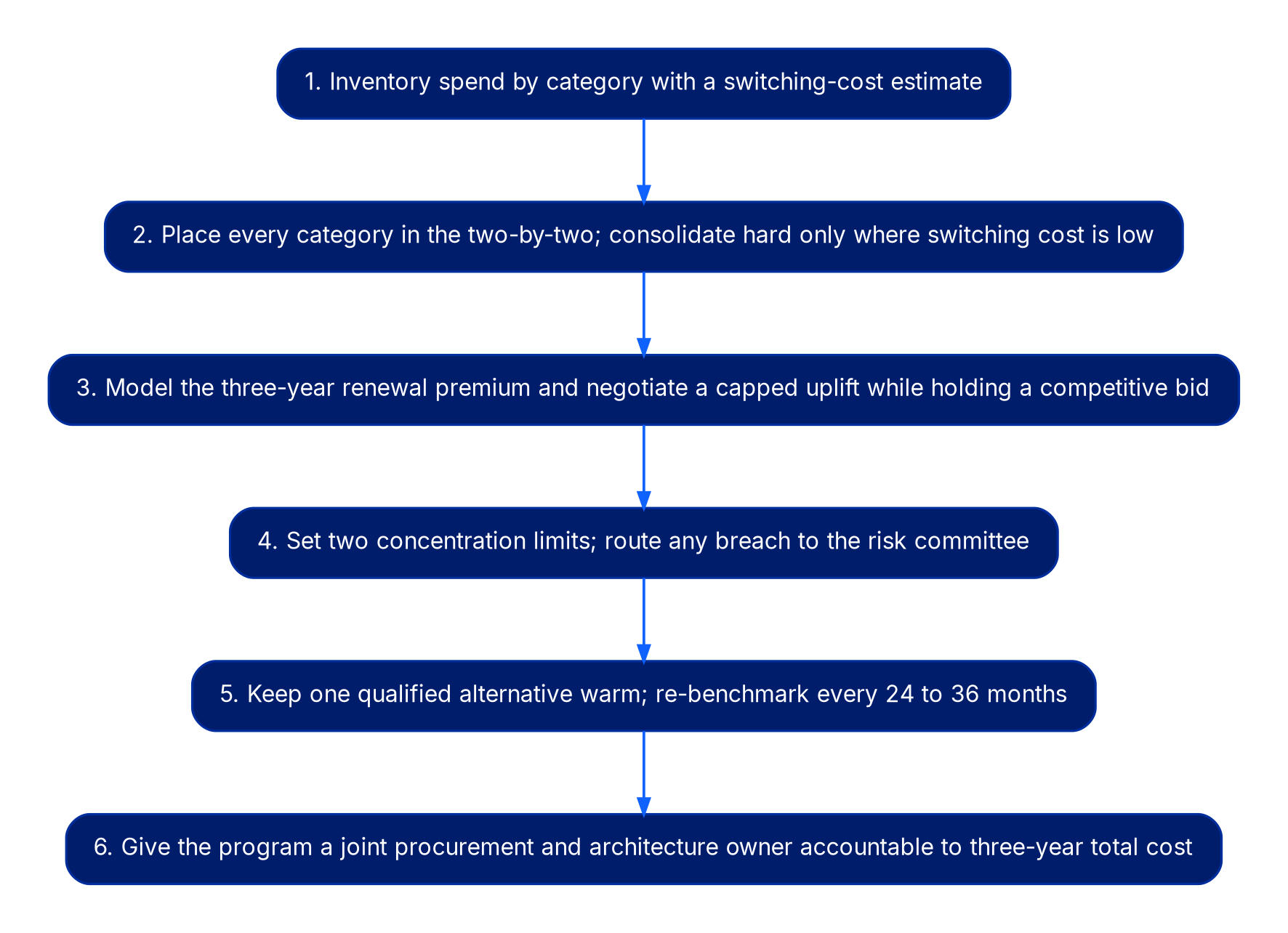
- Inventory spend by category and tag each with its annual amount and a switching-cost estimate. Expect the real category count to run higher than procurement's list, because departmental SaaS hides.
- Place every category in the two-by-two. Consolidate hard only where switching cost is low.
- For high-switching-cost categories, model the three-year renewal premium before signing and negotiate a capped uplift while you still hold a competitive bid.
- Set two concentration limits, by category spend and by critical-workload share, and route any breach to the risk committee.
- Keep one qualified alternative warm in every critical category and re-benchmark every 24 to 36 months, even on renewals you expect to sign.
- Give the program a joint procurement and architecture owner accountable to three-year total cost, not the year-one discount.
The firms that consolidate well are not the ones with the fewest vendors. They are the ones that still have somewhere to go when the renewal quote arrives.
Continue reading
The Enterprise Architecture Review Board Charter That Earns Its Meetings
Most review boards drift into either a rubber stamp or a bottleneck. The charter decides which, and a sharper one keeps the board out of the way.…
The Carve-Out IT Separation Playbook: Sequencing the Work That Actually Frees You
IT separation is where carve-out value is realized or quietly lost. The workstream order, not the cutover date, decides which one you get.…
Technology due diligence checklist for private equity: what the standard template misses
Every private equity sponsor runs some form of technology due diligence before close. Almost none of it answers the questions that will determine whet…