

The Enterprise Architecture Review Board Charter That Earns Its Meetings
Most review boards drift into either a rubber stamp or a bottleneck. The charter decides which, and a sharper one keeps the board out of the way.
Almost every large enterprise has an architecture review board. Few have one that engineers route toward willingly rather than around. The board was chartered to keep the estate coherent, and within a year it has become the thing teams schedule their projects to avoid. The charter is where this is won or lost, and most charters are written as if the board's job is to approve things. That framing is the original defect. A review board that exists to grant approvals will be measured by throughput, will fall behind, and will be bypassed by anyone with a deadline. The boards that survive are chartered to do something narrower and more useful: make the small number of decisions that are expensive to reverse, and stay out of everything else.
The discipline of architecture governance is well documented. The Open Group's TOGAF standard describes an architecture governance framework with explicit roles, a compliance process, and a repository of decisions, and the ISO/IEC/IEEE 42010 standard for architecture description defines how concerns, stakeholders, and rationale should be recorded so a decision can be understood later. Both are useful. Neither tells you the thing that actually breaks boards in practice, which is scope. A charter that copies the standard's process without ruthlessly bounding what the board touches produces a body that reviews everything, decides slowly, and earns the contempt of the engineers it governs.
Why most review boards become a tax
Three failure patterns recur across the engagements we run, and all three trace back to the charter.
The first is undifferentiated scope. The charter says the board reviews "significant architectural decisions" and never defines significant, so every team brings everything to be safe. The agenda fills with database-engine choices that affect one service and nobody else. The genuinely consequential decisions, the ones that lock in a vendor for a decade or set a pattern 40 teams will copy, get the same 15-minute slot as a logging-library swap. When everything is reviewed, nothing is reviewed well.
The second is approval-gate framing. When the board's output is a yes or a no, the board becomes a queue, and queues have wait times. We routinely see review backlogs of three to six weeks at enterprises with a single weekly board, which is long enough that teams either skip the board entirely or pre-build the solution and treat the review as a formality. A gate that arrives after the work is done governs nothing.
The third is membership by seniority rather than by decision right. The charter seats the most senior architect from each domain, the meeting becomes a status forum for people who do not write the code, and the engineers who own the consequences are in the room as supplicants. Decisions made this way are slow, political, and frequently wrong, because the people with the most context have the least authority.
The counter-take we offer is blunt. Conventional governance advice says a review board should see more, earlier, to catch problems sooner. We disagree. The board should see less, and most architectural decisions in a healthy organization should never reach it at all. The board's value is concentrated in a handful of decisions per quarter that are expensive to reverse and broad in blast radius. Everything else belongs with the teams, governed by published standards and patterns rather than by a meeting. A charter that does not say this out loud will drift toward reviewing everything, because reviewing everything feels responsible and costs the board nothing. The cost lands on the delivery teams instead.
What the charter is actually for
A charter is not a mission statement. It is a set of operating rules precise enough that two reasonable people reading it agree on whether a given decision needs the board. If the charter cannot answer "does this change need to come here?" without a debate, it has failed before the first meeting.
A working charter answers six questions without ambiguity. What decisions must come to the board, and what is explicitly out of scope. Who sits on it, and what decision authority each seat carries. How a decision is requested, and what the requester must bring. How fast a decision is returned. How a decision is recorded so it binds future work. And how the board itself is measured, so it can be told when it is failing. Miss any one of these and the gap fills with politics.
The scope rule that keeps the board small
The single most important clause in the charter is the one that defines what reaches the board. We recommend a reversibility-and-blast-radius test, stated as a short list of triggers rather than the word "significant."
A decision comes to the board only if it meets at least one trigger: it commits the organization to a vendor or platform that would take more than 6 months to unwind, it establishes a pattern that more than 10 teams are expected to adopt, it crosses a regulatory or data-residency boundary, or it exceeds a defined spend threshold, often $250k in committed cost. Everything that meets none of these triggers is delegated to the team, governed by the published reference architectures and the standards catalog. A team choosing between two managed queue services for one service, with no new vendor and no cross-team pattern, does not need a meeting. It needs a documented standard to check against.
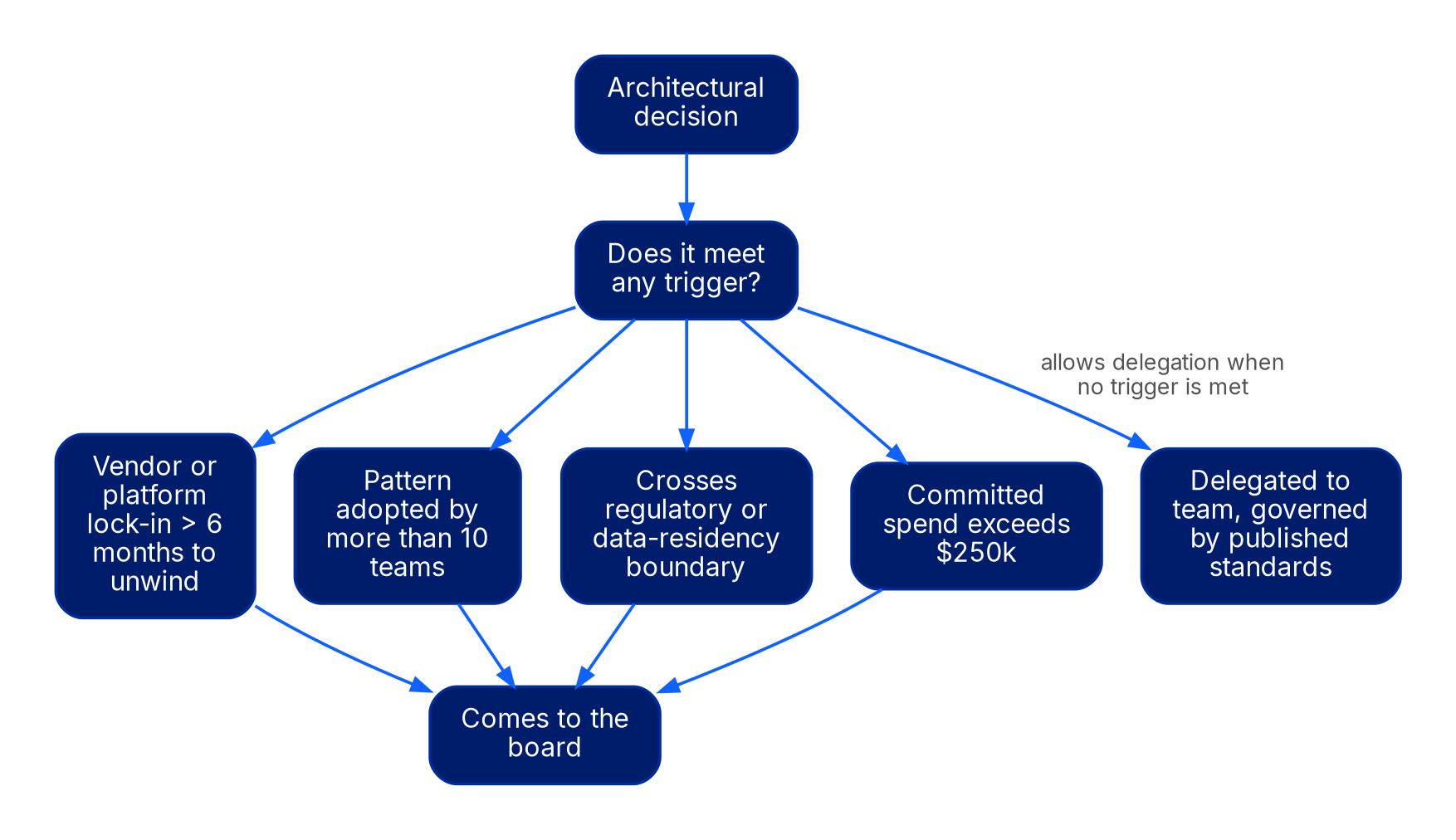
This is the clause that most charters lack and the one that determines whether the board stays useful. When 80% of what used to come to the board is delegated, the board can give the remaining 20% the time it deserves. Reversibility is the right axis because cheap-to-reverse decisions do not need committee scrutiny; if a team gets one wrong, they change it next sprint. The board exists for the decisions that a team cannot easily walk back.
Membership, quorum, and decision rights
A board that cannot reach a decision in the room is not a board. The charter must seat people who hold decision authority, not just people who hold titles.
We keep core membership small, typically 5 to 7 voting seats covering the domains where the expensive decisions actually live: data, security, platform and infrastructure, integration, and the application domains under active change. Each seat carries a named owner and a named alternate, because a board that loses quorum loses its calendar slot. Quorum should be a simple majority of voting seats, and the charter should state that a quorate board can decide. The most damaging clause we remove from existing charters is the one requiring unanimous consent or full attendance, because it hands a veto to whoever fails to show up.
Subject-matter experts attend by invitation for specific items and do not vote. The requesting team is always in the room, and the charter should give them the right to present their own recommendation rather than having it relayed. The board's job is to pressure-test a recommendation the team already owns, not to invent one on the team's behalf.
Cadence, service levels, and the fast path
Cadence is a service-level commitment, not a recurring calendar invite. The charter should publish the turnaround the board guarantees, because an unbounded turnaround is what drives teams to bypass governance.
We recommend two tracks. A standing board that meets every 2 weeks for the decisions that benefit from live discussion, with an agenda capped at 6 substantive items so each gets real attention rather than a rushed slot. And an asynchronous fast path for decisions that are in scope but uncontroversial, where any voting member can approve against an existing standard within 5 business days and only escalate to the full board on dissent. Most in-scope decisions should clear the fast path. The standing meeting is reserved for the genuinely contested calls.
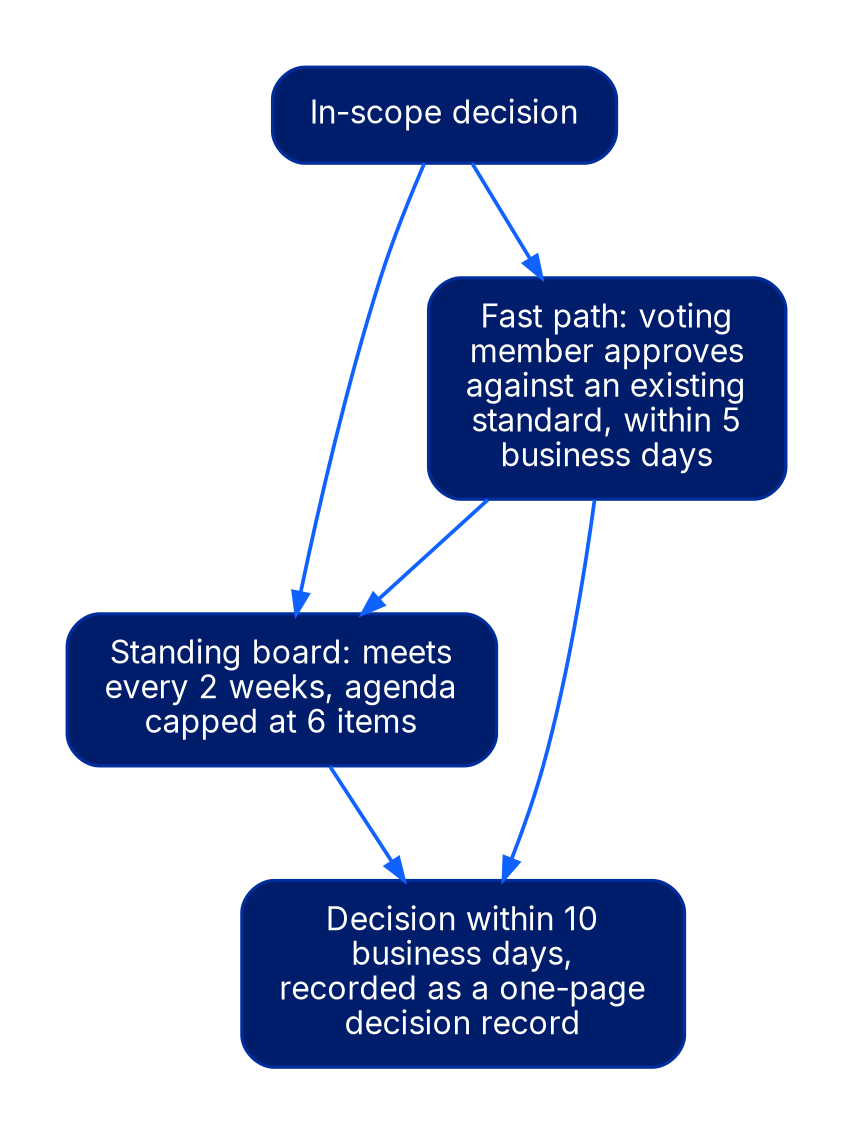
Put a clock on it. The charter should commit that a complete submission receives a decision within 10 business days, and that the board reports its own adherence to that number. A board that misses its own service level is a board that is failing, and the charter should make that visible rather than letting the backlog become invisible background pain.
The artifacts that make a decision stick
A decision nobody can find is a decision that will be relitigated. The charter should require that every board decision is captured as a lightweight architecture decision record: the context, the options considered, the decision, and the consequences, in roughly one page. ISO/IEC/IEEE 42010's emphasis on recording rationale exists for this reason. The record is not bureaucracy; it is the thing that stops the same debate from recurring in 18 months when the original participants have moved on.
The charter should also require that the submission arrive complete. We define a minimum intake: the problem statement, the options with rough cost, the recommendation, the reversibility assessment against the scope triggers, and the standards the proposal complies with or deviates from. An incomplete submission is returned, not reviewed. This single rule does more to protect the board's calendar than any other, because it pushes the analysis back to the team that owns the decision and arrives ready to be decided.
How we measure whether the board is working
A review board should be governed by metrics the same way it governs everyone else. We track four. Decision latency, measured as calendar days from complete submission to recorded decision, with a target at or under the 10-day commitment. Delegation rate, the share of architectural decisions resolved by teams against standards without reaching the board, which should rise over time toward 80% or higher. Reversal rate, how often a board decision is overturned within 12 months, which flags decisions made with too little context. And bypass rate, the share of in-scope decisions that shipped without coming to the board at all, which is the truest signal that the board has lost legitimacy.
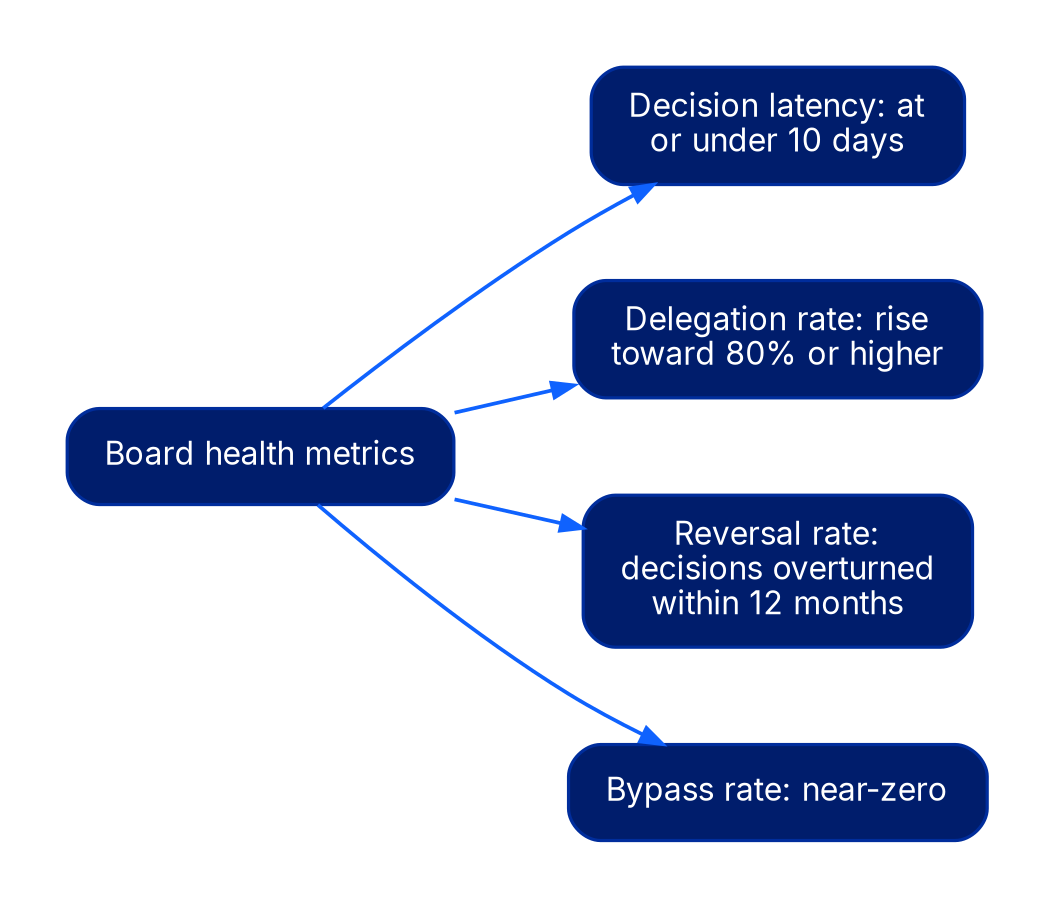
A board with low latency, high delegation, and near-zero bypass is healthy. A board with a long backlog and a high bypass rate is already dead; people have stopped pretending it matters. The charter should name an owner for these numbers and a quarterly review of the charter itself against them.
Where we see charters fail
Two patterns are worth naming because they survive even good intentions.
The first is scope creep through the back door. A board chartered narrowly starts adding standing agenda items, security wants every change reviewed, finance wants every cloud spend approved, and within two quarters the board is back to reviewing everything under a different name. The charter needs an explicit clause that scope changes are themselves a board decision, recorded and reversible, so creep is visible rather than ambient.
The second is the board that confuses standards-setting with case-by-case review. The highest-leverage thing a board does is publish the patterns and standards that let teams decide without it. A board that spends its time adjudicating individual cases it could have prevented with a published standard is treating the symptom. Every recurring case is a missing standard, and the charter should make turning repeated decisions into reusable standards an explicit responsibility of the board, not an afterthought.
What to put in place this quarter
If your board is drifting toward bottleneck or rubber stamp, four moves change the trajectory.
- Rewrite the scope clause first. Replace "significant decisions" with the reversibility-and-blast-radius triggers, and publish the list of what is explicitly delegated to teams. Aim to push at least 60% of current agenda volume out of the board within the quarter.
- Add the fast path and the 10-business-day decision commitment, and start reporting adherence at the top of every meeting.
- Fix membership and quorum. Seat decision-holders, name alternates, and strike any clause requiring unanimity or full attendance.
- Stand up the decision record and a complete-submission gate, then start measuring latency, delegation, reversal, and bypass from the next meeting forward.
The boards that earn their meetings are the ones that decide little and decide it well. The charter is the instrument that holds them to that, and it is worth rewriting before the next backlog forms rather than after the next team has quietly stopped showing up.
Continue reading
The Carve-Out IT Separation Playbook: Sequencing the Work That Actually Frees You
IT separation is where carve-out value is realized or quietly lost. The workstream order, not the cutover date, decides which one you get.…
Technology due diligence checklist for private equity: what the standard template misses
Every private equity sponsor runs some form of technology due diligence before close. Almost none of it answers the questions that will determine whet…
Building an Internal Developer Platform Your Engineers Will Use
Internal developer platforms are having a moment. Backstage adoption is up, "platform engineering" is the title du jour, and most large enterprises no…