
Shadow AI: Discovery and Policy Enforcement That Actually Holds
Most enterprises have an AI acceptable-use policy. Few can name the AI tools their own employees used last week.
Almost every large enterprise has published an acceptable-use policy for artificial intelligence. Ask the same organization to name the AI tools its staff actually pasted customer data into last week, and the room goes quiet. That gap between the policy on the intranet and the traffic leaving the network is what we call shadow AI, and it is now the most common governance failure we find on the ground. The signed policy exists. The visibility does not. When a legal team asks which systems processed regulated data through a third-party model, the honest answer in most firms is a shrug followed by three weeks of forensic work.
We want to be precise about the stakes. Shadow AI is not a hypothetical. In our assessments we routinely discover 40 to 60 distinct AI services in active use inside companies whose official policy sanctions three or four. A marketing analyst runs client contracts through a free summarizer. An engineer wires a personal API key into a build script. A finance manager drops a board deck into a consumer chatbot to reword it. Each act is individually reasonable and collectively ungoverned.
Why the block list fails on contact
The reflex response is a block list and a stern email. Security adds the popular consumer AI domains to the web proxy, HR sends a reminder about the policy, and everyone declares the problem handled. It is not handled. It has moved.
Blocking the ten domains everyone knows about pushes usage onto the forty you have not heard of yet, onto personal laptops, onto phones on the cellular network, and into browser extensions that tunnel through domains you cannot afford to block. New AI features now ship inside tools your staff already use and you already permit: the note-taker, the CRM, the code editor, the PDF reader. You cannot block your way out of a capability that arrives as an update to software you bought on purpose.
Here is the contrarian framing we bring to every engagement: shadow AI is a demand signal, not a security incident. People reach for these tools because the tools make them measurably faster at real work. Treating that demand as misconduct guarantees two outcomes. The usage goes further underground, and your best people learn that the security function is an obstacle to route around rather than a partner to consult. The goal is not zero shadow AI. The goal is zero unseen shadow AI, with a sanctioned path good enough that the risky detour stops being worth it.
You cannot govern what you cannot see
Discovery has to come before enforcement, and no single sensor sees the whole picture. In our practice we insist on at least four independent lenses, because each catches what the others miss.
- Network and egress telemetry. Your secure web gateway, firewall, or cloud access security broker already logs outbound connections. Aggregating requests by destination and flagging known and newly registered AI endpoints surfaces the browser-based usage. This is the widest net and the coarsest; it sees that traffic went to a model provider, not what was in it.
- Identity and OAuth grants. The most durable signal is often the consent screen. When staff sign in to an AI SaaS tool with a corporate Google or Microsoft identity, they grant OAuth scopes, sometimes read access to the entire mailbox or drive. Auditing third-party application grants in your identity provider finds tools that never touch the corporate network at all.
- Financial and procurement records. Expense reports and corporate card statements are an underused source. A recurring 20 dollar monthly charge to a model vendor is a sanctioned-tool candidate that skipped procurement. Finance data catches the paid usage that free-tier network filters miss.
- Code and secrets. For engineering populations, scan repositories and CI configuration for model provider SDKs and hard-coded API keys. This is where the highest-risk usage hides, because an API key in a pipeline moves data at machine scale, not human scale.
Run all four and reconcile them into one inventory. The overlap is the point: a tool that appears in egress logs, OAuth grants, and an expense report is real and material, while a single hit in one lens might be one curious employee. We keep this inventory living, not a one-time audit, because the population of tools turns over every quarter.
Enforcement is routing, not denial
Once you can see the usage, the temptation is to swing the other way and block all of it. This is the second mistake, and it is more expensive than the first because it destroys trust you will need later.
The counter-take we offer is that enforcement should be routing, not denial. For every category of shadow usage you discover, the question is not "how do we stop this" but "where should this go instead." A sanctioned tool, a private model endpoint, an approved enterprise tier with a data processing agreement, a redaction proxy in front of the model. Blocking is the last resort you apply to the narrow set of flows that have no safe path, not the default you apply to everything.
Three moves make routing work in practice.
First, bind policy to data, not to tool names. A policy that lists forbidden products is obsolete the day a new one launches, and it never actually answers the question that matters. What matters is whether regulated or confidential data left your control. Classify data into a small number of tiers, then state plainly which tiers may flow to which class of AI system. Public marketing copy through a consumer chatbot is fine. Customer records or source code through the same tool is not. This is the approach the NIST AI Risk Management Framework encourages when it ties controls to context of use rather than to specific technologies, and it is the only formulation of an AI policy we have seen survive contact with a fast-moving vendor market.
Second, enforce at the data egress, not at the person. Data loss prevention rules on the sanctioned path can redact secrets and flag regulated identifiers before a prompt ever reaches a third party. Modern browser-based controls can allow an employee to use an AI tool while stripping the 16-digit card number or the national ID out of the prompt in transit. The control targets the sensitive field, not the human, which keeps the fast path fast for the more than 90% of prompts that carry nothing sensitive.
Third, make the sanctioned path the fast path. If getting an approved model into a workflow takes a 6-week procurement cycle and the consumer alternative takes 6 seconds, people will choose the 6 seconds every time. We push clients to stand up an enterprise AI gateway with pre-cleared providers so that a new use case can go live in days. Governance that is slower than the shadow alternative is a subsidy for shadow AI.
Graduated response beats the kill switch
Not every finding deserves the same reaction, and a policy that treats a reworded press release like an exfiltrated customer database has no credibility. We map discovered usage onto a graduated response.
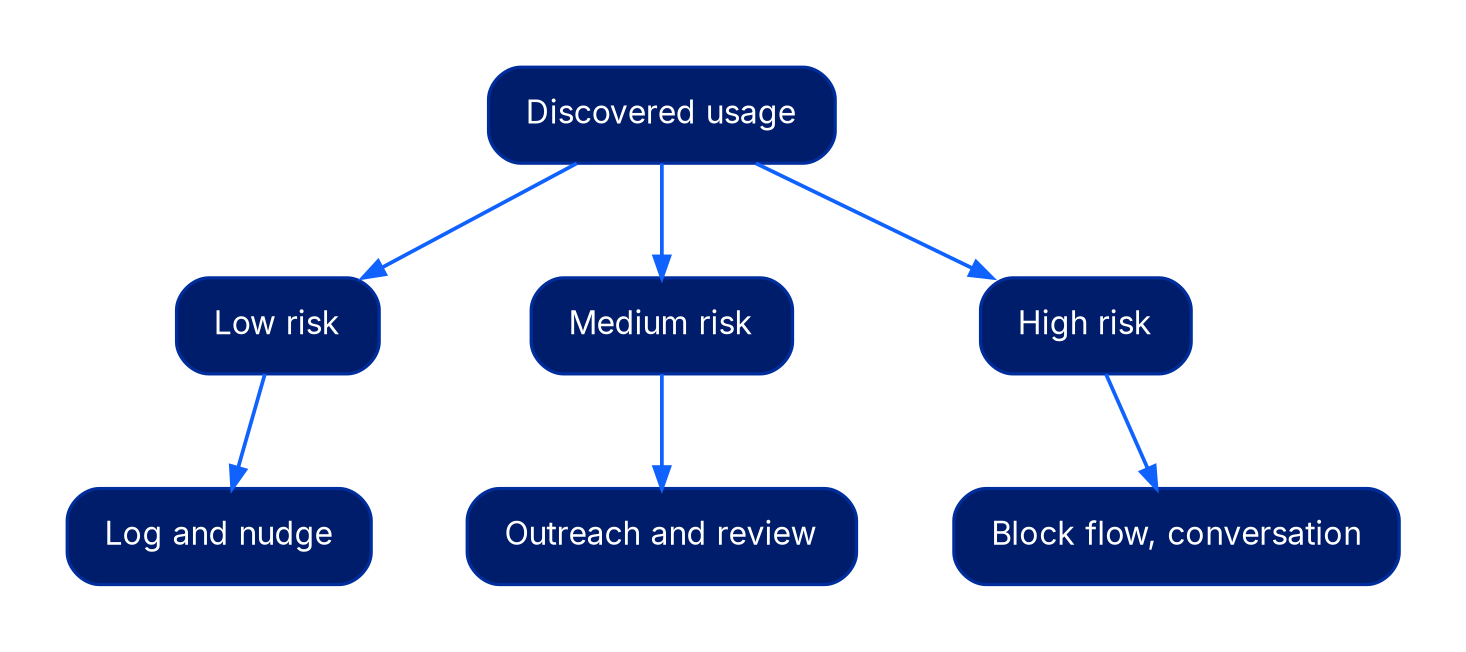
Low-risk usage, public data through a low-sensitivity tool, gets logged and left alone, or nudged toward the sanctioned equivalent with a one-click migration. Medium-risk usage, internal data or an unvetted vendor, triggers an outreach to the team and a fast-tracked review of the tool for the approved catalog. High-risk usage, regulated data, hard-coded keys moving data at scale, or a vendor whose terms claim training rights over your inputs, gets an immediate, specific block on that flow plus a conversation, not a company-wide lockdown.
This graduation is also what makes the regime defensible to a regulator. The EU AI Act, whose obligations for high-risk systems begin applying in August 2026, expects organizations to know where AI touches consequential decisions and to control it proportionately. A blanket ban you cannot enforce is not a control. A tiered response tied to a live inventory is. The failure mode regulators punish is not the presence of AI. It is the absence of any credible account of where it runs and what it touches.
We should name the cost of getting this wrong. Gartner has projected that at least 30% of generative AI projects will be abandoned after proof of concept by the end of 2025, with weak governance and data concerns among the cited causes. Shadow AI sits on both sides of that statistic. Ungoverned tools create the incidents that get programs cancelled, and heavy-handed bans create the frustration that drives talented teams to give up on the sanctioned program entirely.
The operating model in one line
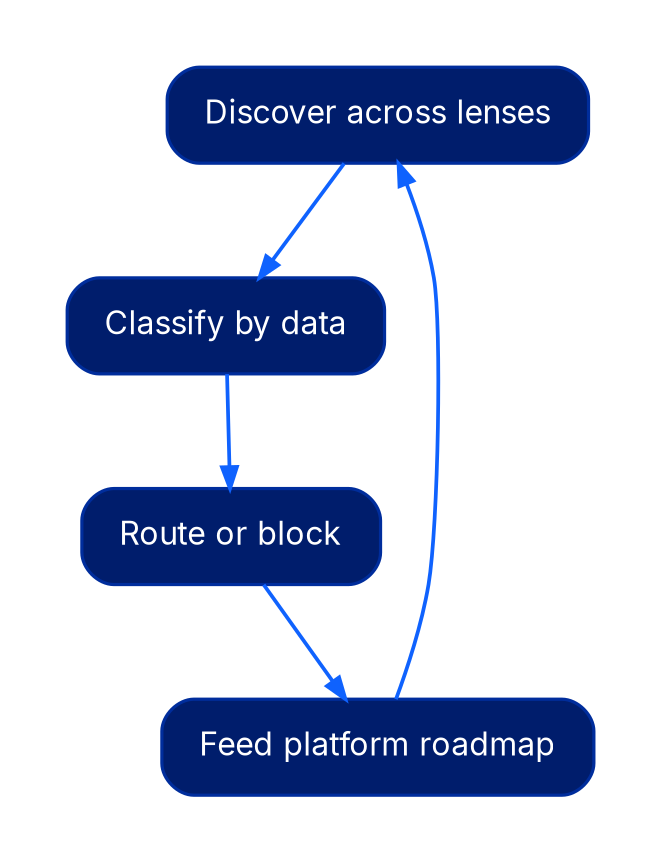
A shadow AI program that works is a loop, not a project: discover continuously across the four lenses, classify each finding by the data it moves, route it to a sanctioned path or block the specific flow, and feed what you learn back into which capabilities the platform team should offer next. The demand you discover this quarter is the roadmap for the sanctioned tooling you build next quarter. Discovery without a place to route the demand is surveillance. Routing without discovery is guesswork.
What to put in place this quarter
If you are starting near zero, five steps deliver most of the value.
- Stand up the discovery inventory from data you already have. Pull 90 days of egress logs, third-party OAuth grants, and card statements this month, reconcile them, and publish the count. Naming the real number, often 10 to 15 times the sanctioned list, is what unlocks executive attention.
- Write a data-tiered policy, not a tool blocklist. Three or four sensitivity tiers, a clear statement of which tiers may reach which class of AI system, and a named owner for the boundary. Keep it to two pages.
- Stand up one sanctioned fast path before you block anything. An enterprise gateway or an approved tool with a data processing agreement, reachable in days, so that enforcement offers a destination and not just a wall.
- Put data loss prevention on that path. Redact secrets and regulated identifiers in transit so the common case stays frictionless and the dangerous field never leaves.
- Adopt a graduated response and rehearse it once. Walk a real discovered finding through classify, route, and block within 60 days, so the team learns the loop on a live case before an incident forces it.
Shadow AI is not a sign your people are careless. It is a sign they are ahead of your platform. Close that gap by seeing the demand clearly and giving it somewhere safe to go, and the shadow shrinks on its own.
Continue reading
AI Use Case Intake and Prioritization: The Process That Says No
Most AI intake processes are built to capture demand. The ones that work are built to refuse it. A practical design for triage under fixed capacity.…
AI Red Teaming in Regulated Industries: Why Most Programs Fail the Exam
Most large financial institutions and healthcare systems have run at least one AI red team exercise. Few have run one their compliance function could …
Securing the LLM Supply Chain: Threat Models for AI-Powered Apps
Most enterprise application security programs were designed for deterministic systems. LLM-powered applications break enough of those assumptions that…