

AI Use Case Intake and Prioritization: The Process That Says No
Most AI intake processes are built to capture demand. The ones that work are built to refuse it. A practical design for triage under fixed capacity.
Almost every enterprise chasing AI has an intake form. Few have an intake process that can say no to a well-connected sponsor in under two weeks and make the refusal stick. That gap is where AI portfolios rot. Ideas pile up faster than any team can build them, so the real function of intake is not collection. It is triage. Gartner has projected that at least 30% of generative AI projects will be abandoned after proof of concept by the end of 2025, and in our engagements a large share of that waste traces back to the front door, not the model. The wrong things were let in, and nothing was told no early enough to matter.
The intake trap
The default intake process is a funnel with one open end. Business units submit ideas, a form collects them, and a committee tries to say yes to as many as headcount allows. This feels responsive. It is also the most reliable way we know to build an unshippable portfolio. When the implicit goal of intake is throughput of approvals, the process optimizes for volume of yeses rather than quality of sequencing. Sponsors learn that persistence and seniority get ideas funded. Nobody learns that most ideas should die at the door.
The reframe we push in every engagement is blunt. Intake exists to protect a fixed delivery capacity from an effectively infinite supply of ideas. Your data scientists, your evaluation harness, and the small number of business owners willing to change how their team actually works are the constraint. Ideas are not scarce. Capacity is. An intake process that does not aggressively kill and defer is not governing anything. It is a queue with good manners.
Why the scoring spreadsheet lies
Walk into most AI steering committees and you will find the same artifact: a spreadsheet that scores each use case on business value and technical feasibility, usually one to five, then multiplies or averages the two into a rank. It looks rigorous. It is theater. The numbers are guesses dressed as measurements, and the multiplication launders organizational politics into something that resembles math.
Two failures show up every time. First, the scores are not comparable across submitters. A director who rates their own idea a 5 on value is not using the same scale as a skeptical platform lead rating someone else's a 3. Second, the ranking hides the one variable that actually predicts success or failure: whether trustworthy ground-truth data exists to build and evaluate the thing. A use case can score a 5 on value and a 4 on "feasibility" in the abstract and still be undeliverable because no one can produce 500 correctly labeled examples of the outcome you are trying to predict. The spreadsheet cannot see that. It was never designed to.
The counter-take we offer is to stop scoring and start gating. Replace the weighted average with a small set of binary gates that most ideas fail. A gate is not a score. It is a yes-or-no question with a mechanical answer, and any no sends the idea to killed or deferred without a debate about whether a 3 should have been a 4.
Four gates before anything gets ranked
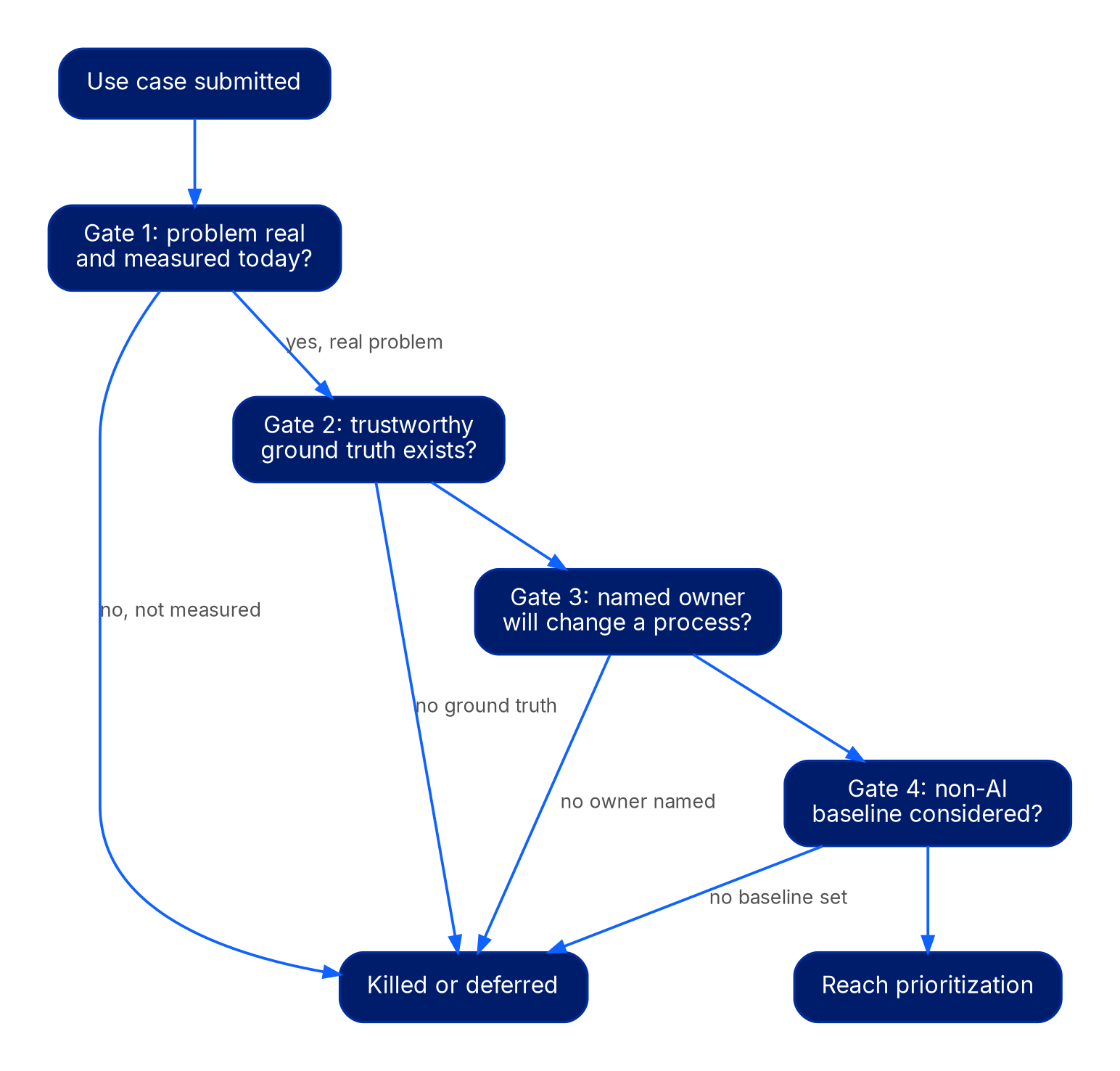
Before a use case earns a place in any prioritization at all, we make it clear four gates. Each is binary. Each has an owner who can answer it in hours, not weeks.
- Is the problem real and measured today? If the team cannot state the current baseline in a number, the handling time, the error rate, the cost per case, then there is no way to prove the AI helped. Ideas that arrive without a baseline go back to the submitter, not into the queue. Roughly half of first-time submissions in our engagements fail here, and sending them back is the single highest-leverage thing intake does.
- Does trustworthy ground truth exist, or can it be created cheaply? This is the gate that kills the most seductive ideas. Building the model is rarely the hard part. Producing a labeled evaluation set that everyone agrees represents the right answer is. If the answer is "we would need a legal review and three months of manual labeling to know if the output is correct," that cost belongs in the decision now, not as a surprise in month four.
- Is there a named owner who will change a process if this works? An AI output that no one is accountable for acting on is a dashboard nobody reads. We require a single named business owner, not a committee, who commits to changing a workflow, a staffing model, or a decision rule on success. No owner, no build.
- Was a non-AI baseline honestly considered? A surprising number of intake requests describe a reporting gap, a broken form, or a missing rule that a week of plain software solves at a fraction of the cost and risk. AI is the most expensive and least predictable tool in the box. If a deterministic solution was not ruled out on the merits, the request is not ready.
Only the ideas that clear all four reach prioritization. In practice that is a minority of what comes in, and that is the point. The gates do the heavy filtering mechanically, before any human argues about relative value, which is where politics usually wins.
Prioritizing what survives
The ideas that pass the gates are, by construction, real, measurable, deliverable, and owned. Now ranking is worth doing, because you are ranking things that could actually ship. We prioritize against the true constraint rather than against a value fantasy.
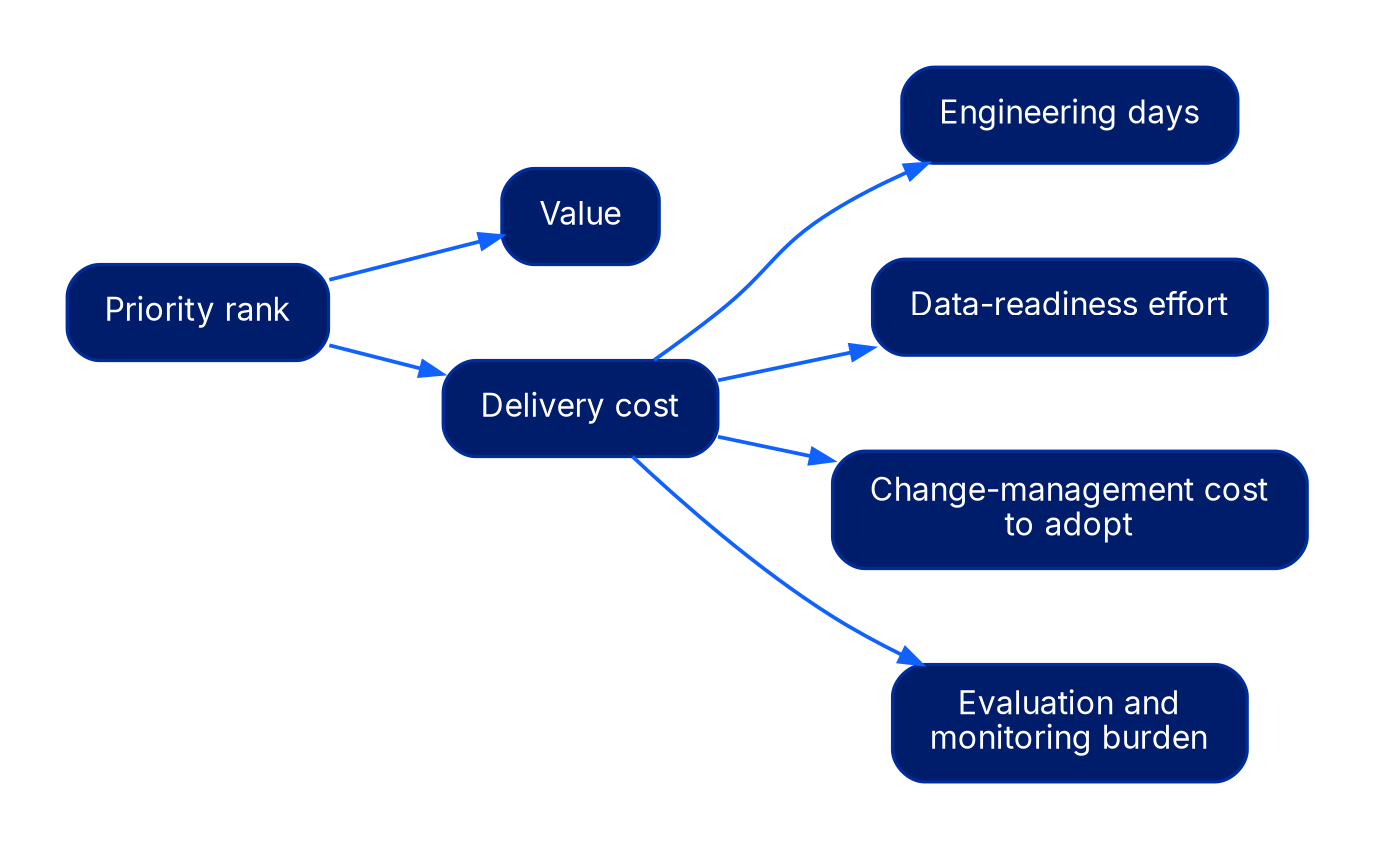
The formula we use borrows the shape of Weighted Shortest Job First: rank by value divided by the cost to deliver, but define cost honestly. Delivery cost is not just engineering days. It is data-readiness effort plus the change-management cost of getting the owning team to adopt the output plus the ongoing evaluation and monitoring burden. A use case with modest value that is cheap to deliver and trivial to adopt will, and should, outrank a glamorous one that needs a new data pipeline and a reorganization to land. This ordering runs against instinct, which is exactly why it is worth enforcing.
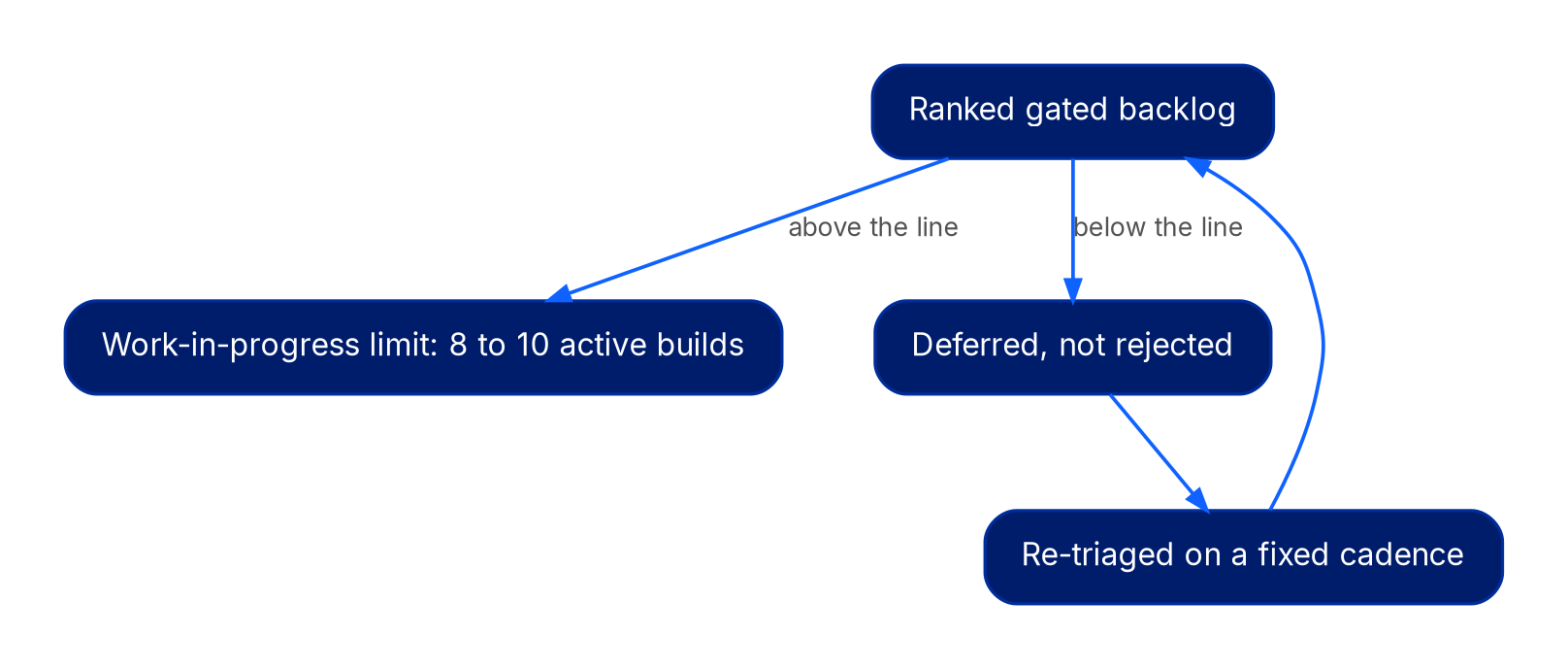
We also cap concurrency hard. In line with what we have argued elsewhere about generative AI platforms, we advise most enterprises to run no more than 8 to 10 active AI builds at once until the delivery and evaluation substrate is mature. A ranked backlog of 40 ideas and a work-in-progress limit of 8 forces the sequencing conversation to be real. Everything below the line is deferred, not rejected, and gets re-triaged on a fixed cadence rather than lobbied back in through side channels.
The operating model
Intake and prioritization need a cadence, an owner, and service levels, or they decay into an inbox. The structure we deploy has three moving parts.
A standing intake council meets every two weeks and does two things only: run new submissions through the four gates, and re-rank the gated backlog against current capacity. It does not design solutions. Membership is small, five or six people, and always includes someone who owns production reliability, because governance that ignores who carries the pager produces commitments the platform team cannot keep. The NIST AI Risk Management Framework is a useful reference for wiring a risk classification into this step so that a high-impact use case triggers heavier review automatically rather than by argument.
Intake runs on an explicit clock. We commit to an initial gate decision within 10 business days of submission. Slower than that and business units route around the process, which is how shadow AI gets funded on someone's discretionary budget. Faster gating is also a fairness mechanism: a quick, well-reasoned no respects the submitter's time more than a slow maybe.
Finally, the risk classification attached at intake should map to an external framework you will have to answer to anyway. For any European exposure, the EU AI Act's tiered obligations for high-risk systems give you a ready-made taxonomy, and classifying at the front door means the compliance work is scoped before a line of code is written, not retrofitted after.
Failure modes we watch for
Three patterns undo an otherwise sound process.
The first is gate erosion. Under pressure from a senior sponsor, a council starts waving ideas past the ground-truth gate on a promise that the data "will be sorted out during the build." It never is. The gate exists precisely for the ideas important people want to skip it for. Write the exceptions down and review them quarterly, because a pattern of exceptions is a pattern of future failures.
The second is scoring creep. Someone reintroduces a value score "just to break ties," and within two cycles the binary gates are back to being a weighted average with the same politics you removed. Ties are fine. When two use cases genuinely rank the same, pick the one with the lower delivery cost and move on. Precision beyond that is false.
The third is a dead backlog. Deferred ideas that are never re-triaged teach the organization that deferral means rejection, and submitters respond by inflating urgency on everything. A deferred idea must have a real review date, and the council must actually promote from the backlog when capacity opens, or the whole triage loses credibility.
Where to start this quarter
If your AI intake today is a form and a hopeful committee, four steps will change the trajectory inside a single quarter.
- Replace your value-times-feasibility spreadsheet with the four binary gates and route every no to killed or deferred with a written reason. Measure how many first submissions fail the baseline gate; that number tells you how much noise you were about to fund.
- Set a published intake service level of 10 business days to first decision and hold to it, so business units stop building workarounds.
- Impose a work-in-progress limit of 8 to 10 active builds and make the deferred backlog visible, with a real re-triage date on every item.
- Stand up a small intake council that includes production reliability ownership, meets every two weeks, and maps each admitted use case to a risk tier from NIST or the EU AI Act before build starts.
The organizations that get AI value are not the ones that said yes to the most ideas. They are the ones that built a front door strong enough to say no early, cheaply, and often, so the few things that got through were the few things worth doing.
Continue reading
AI Red Teaming in Regulated Industries: Why Most Programs Fail the Exam
Most large financial institutions and healthcare systems have run at least one AI red team exercise. Few have run one their compliance function could …
Securing the LLM Supply Chain: Threat Models for AI-Powered Apps
Most enterprise application security programs were designed for deterministic systems. LLM-powered applications break enough of those assumptions that…
From RPA to Agentic Automation: When to Graduate, When to Stay
Every major RPA vendor, UiPath, Automation Anywhere, Blue Prism, is repositioning around agentic AI. Their message: deterministic RPA is yesterday; LL…