

Kubernetes Cost Allocation by Team: Who Pays for the Idle Half of Your Cluster
Almost every platform team running a shared, multi-tenant Kubernetes cluster can produce a per-team cost dashboard. Almost none of them can make those numbers reconcile to the cloud invoice. The gap is not rounding error. On the clusters we assess, 40 to 60 percent of the bill sits in a bucket that no single team recognizes as theirs, and how you split that bucket is the entire game.
This paper is about that split. Not the tooling that measures pod-level consumption, which is largely solved, but the design decision the tooling cannot make for you: who pays for the capacity nobody used.
Why the cluster bill never divides cleanly
A cloud provider bills you for nodes, not pods. You rent an m6i.4xlarge, you pay for the whole node whether your pods fill it or leave it 70 percent empty. Kubernetes then packs pods from many teams onto that shared node, and the scheduler places them based on the resource requests each pod declares, not on what it actually consumes. The Kubernetes documentation on managing resources for containers is explicit: a request is a reservation the scheduler honors, and unused reserved capacity is capacity no other pod can claim.
That single fact is the source of the whole problem. Three costs live on every node that do not map to any application team:
- System overhead. The kubelet, the container runtime, log and metrics agents, the CNI, and the daemonsets your platform team runs on every node. On a typical node this is 10 to 30 percent of capacity before a single application pod schedules.
- Idle headroom. The difference between what pods reserve and what the node can hold, plus the slack you keep so the cluster survives a node failure or a traffic spike.
- Shared services. Ingress controllers, service mesh sidecars, the observability stack, and the control plane itself. Real spend, no natural owner.
Add those up and you routinely find that under half the invoice traces directly to a nameable team's workloads. A showback tool will report the pod-level half accurately and label the rest "unallocated" or "idle." Finance sees a dashboard where the team numbers sum to 45 percent of the actual bill and stops trusting the whole exercise.
The contrarian part: this is not a measurement problem
The instinct, once a CFO asks "what does each team cost," is to buy a Kubernetes cost tool and stand up dashboards. OpenCost, the CNCF specification for Kubernetes cost monitoring, does this well and is free. We recommend it. But installing it and declaring victory is where most programs go wrong, because the precision it adds was never the binding constraint.
The counter-take we offer is this: allocating Kubernetes cost by team is 20 percent measurement and 80 percent deciding who owns the idle half. If you allocate only what pods actually used, the reconciled total falls 30 to 50 percent short of the invoice, the shortfall becomes a platform-team line item, and every application team is quietly subsidized by a cost center with no incentive or ability to make them stop. The teams that over-reserve pay nothing for it. The waste is invisible precisely because it landed in the one bucket that does not send anyone a bill.
So the real question is not "how accurately can we measure pod consumption." It is "which allocation rule changes behavior." Those are different objectives, and the second one is the one that matters.
Bill on requests, not on usage
Here is the decision that does more than any dashboard: charge each team for what its pods reserve, not for what they burn.
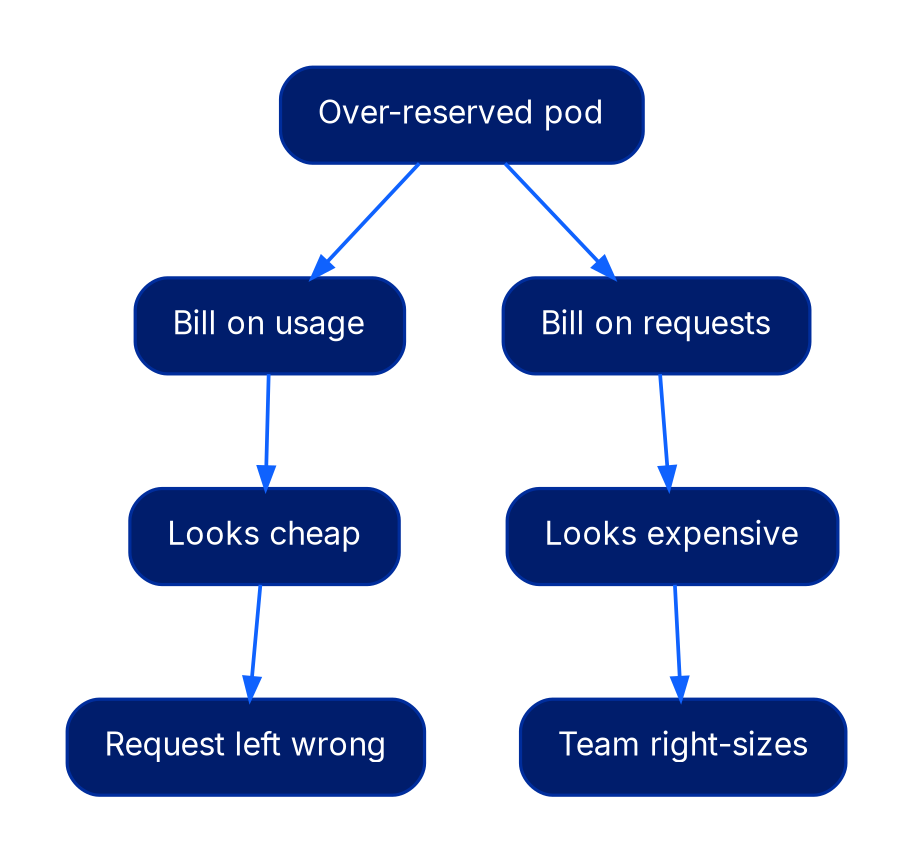
This feels wrong to engineers at first, because usage feels fairer. It is not. Requests are what consume schedulable capacity. A pod that requests 4 cores and uses 0.5 has taken 4 cores away from the cluster's packing math; those 3.5 idle cores are why you are paying for another node. If you bill on usage, that pod looks cheap and its owner has no reason to fix the request. If you bill on requests, the same pod looks expensive on day one, and the team right-sizes it that week. The metric you charge on is the behavior you get.
The evidence for this is not subtle. Actual CPU utilization against requested CPU on the clusters we review commonly runs 15 to 25 percent. That ratio is a direct readout of over-reservation, and it is where the idle headroom comes from. Bill on requests and that number climbs within a quarter, because now someone loses budget by leaving it low. We have watched a single billing-rule change recover 20 to 30 percent of cluster spend inside 90 days with no re-architecture, purely because teams tightened requests they had set once and forgotten.
Two guardrails keep this fair. Charge on the higher of request or actual usage, so a team cannot game the system by setting a tiny request and bursting past it. And exempt memory from the aggressive version of this rule at first, because memory limits that are set too low get the pod killed, and you do not want a cost policy causing outages.
An allocation model that reconciles to the invoice
The test of any allocation scheme is simple: do the team numbers plus the shared numbers equal the cloud bill, to the dollar. If they do not, someone will use the discrepancy to dismiss the whole program. Here is the model we deploy, and it reconciles.
Split the invoice into three layers and allocate each on its own rule:
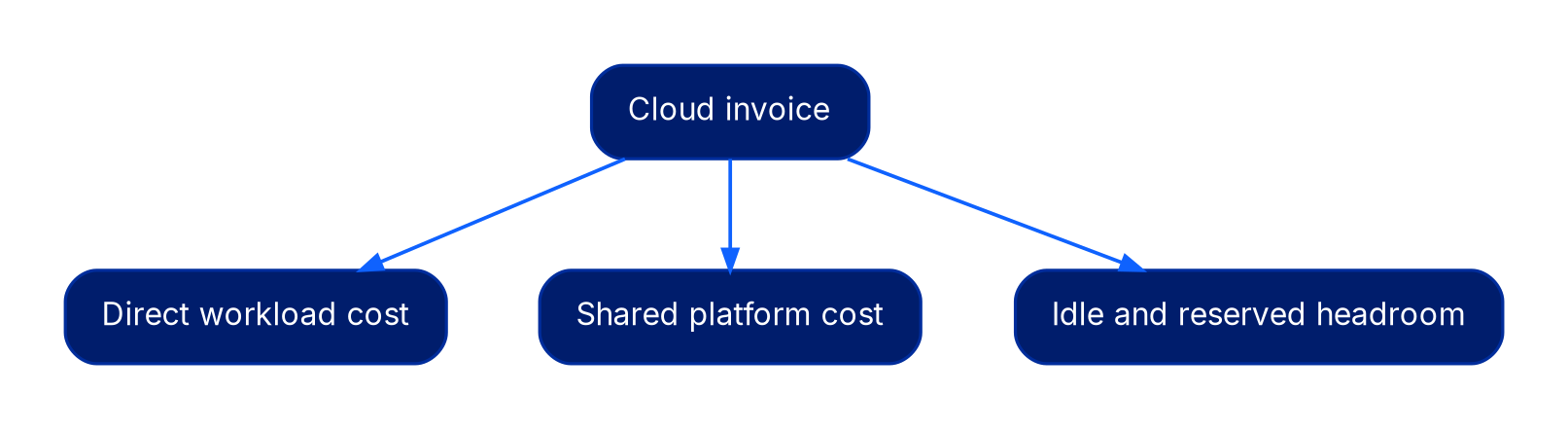
- Direct workload cost. The request-based cost of each team's pods, computed as described above. This is the layer every tool already gives you. It typically lands at 40 to 55 percent of the bill.
- Shared platform cost. Ingress, mesh, observability, DNS, the control plane. Allocate this proportionally to each team's direct cost. A team running 30 percent of the workload cost carries 30 percent of the shared platform cost. It is not perfect, but it is defensible and it sums correctly.
- Idle and reserved headroom. The gap between provisioned nodes and honored requests. This is the political one, and the right answer depends on why the idle exists.
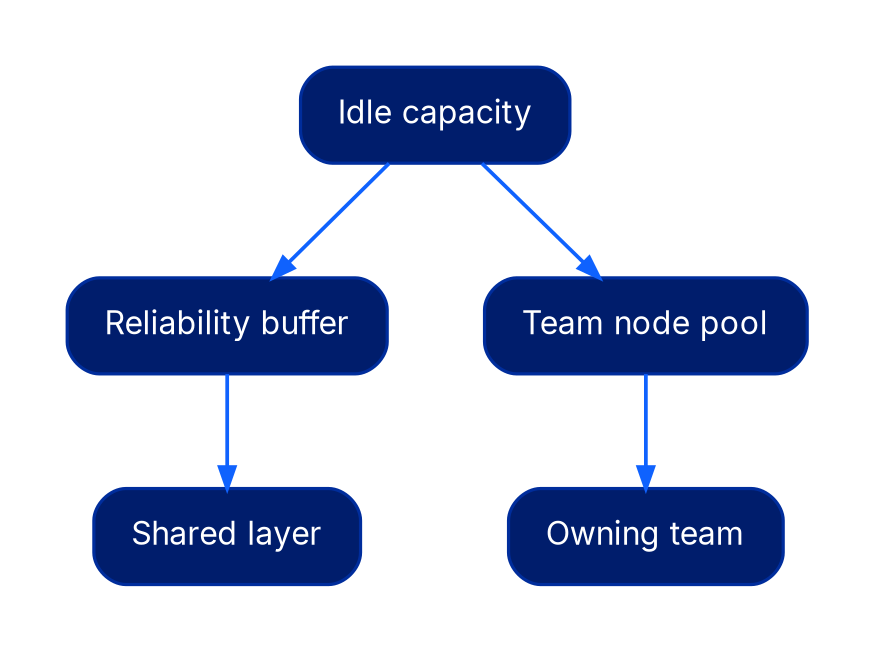
For that third layer, the allocation rule should follow accountability for the decision that created the idle capacity. If the platform team sets an aggressive over-provisioning buffer for reliability, that buffer is a platform cost and belongs in the shared layer. If a specific team demanded a dedicated node pool with anti-affinity rules and then ran it at 20 percent, that idle belongs to them, in full. The mistake is spreading all idle capacity evenly across teams as if it were a tax, because that punishes the disciplined team and rewards the team that reserved a node pool and walked away.
Namespaces are the team boundary, until they are not
Almost every Kubernetes cost model assumes namespace equals team. It is the cleanest available boundary, it maps to RBAC, and OpenCost and its commercial cousins key off it by default. Use it. But know its two failure modes before you build reporting on top of it.
First, shared namespaces break the model. A platform or shared-services namespace holds pods from several teams and shows up as one giant unallocated blob. The fix is label-based allocation, using a consistent team or cost-center label applied by admission policy so a pod without the label cannot schedule. Namespaces get you 80 percent of the way; labels close the rest.
Second, one team often owns many namespaces, one per service or per environment. Cost allocation by team then requires a mapping layer from namespace to team that lives outside the cluster and stays current as teams reorganize. That mapping is the single most neglected artifact in every Kubernetes cost program we inherit, and a stale one quietly misattributes six figures a year.
Making it stick past the first dashboard
Cost allocation is not a report you generate once. It is a control you run continuously, and it decays the moment nobody owns it. The FinOps Foundation framework frames cost management as an ongoing operating discipline shared between engineering and finance, and the Kubernetes case is the sharpest version of that: the numbers change every deploy.
The programs that hold up share three practices. The allocation rules are written down and versioned, so "who pays for idle" is a documented decision rather than an argument that reopens every quarter. The per-team unit cost sits in the engineering operating review next to latency and error rate, not in a finance dashboard nobody opens between budget cycles. And one named owner reconciles the allocation to the invoice monthly, with authority to fix the namespace-to-team mapping when it drifts.
Where those three are present, allocation drives right-sizing and the cluster grows with the product. Where they are missing, the dashboard exists, the idle half stays orphaned, and cloud spend outruns the business by the second quarter.
Where to start
You do not need a six-month program to make this real. Start here, in order.
- Measure your requested-to-used ratio for the whole cluster this week. If it is below 30 percent, over-reservation is your dominant cost driver and the request-based billing rule will move more money than anything else you could do.
- Deploy OpenCost or an equivalent and pull the current split of direct, shared, and idle cost. Confirm the three layers sum to the invoice before you show anyone a per-team number.
- Enforce a
teamlabel through admission policy so no pod schedules without an owner, and build the namespace-to-team mapping as an external, version-controlled file. - Switch team billing to the higher of request or usage, memory exempted at first, and socialize the change a full billing cycle before it counts against budgets.
- Assign one owner to reconcile allocation to the invoice monthly and to defend the idle-capacity rule when a team disputes it.
- Put per-team unit cost in the engineering review, on the same screen as reliability metrics, so the people who set the requests see the price of leaving them wrong.
Continue reading
The Cloud Landing Zone Redesign Checklist: Fix What Blocks Teams, Not the Diagram
Almost every enterprise that has been on a hyperscaler for more than three years has a landing zone that no longer fits. It was built once, by a small…
Service Mesh ROI: When the Sidecar Tax Actually Pays for Itself
Almost every platform team running more than a dozen microservices has evaluated a service mesh. Far fewer can name the dollar figure it returns. The …
Cloud Carbon Accounting: Why the Vendor Dashboard Won't Survive Your Audit
Almost every enterprise on a hyperscaler now has a cloud carbon number. Few have one that an auditor will accept. The provider dashboards make the fir…