

The real ROI of an internal developer platform
Almost every large engineering organization is now funding an internal developer platform, or about to. Few can tell you what it returns. Gartner projects that 80% of large software engineering organizations will have established platform engineering teams by 2026, up from roughly 45% in 2022. The budgets are real, the headcount is approved, and the business case slide almost always shows a tidy payback inside a year. Then the platform ships, adoption climbs, and the finance partner asks the one question the slide never survives: where is the money.
We have sat in that meeting more times than we would like. The answer is rarely that the platform failed. The answer is that the return was measured against the wrong baseline, credited to the wrong line item, and booked before it had a chance to appear. The technology works. The arithmetic is where these programs lose credibility.
Why most platform ROI cases are fiction
The standard business case multiplies a per-developer time saving by the number of developers, annualizes it, and declares victory. A typical version reads: "we save each of our 500 engineers 4 hours per week, that is 2,000 hours weekly, roughly $9M a year at a loaded rate of $90 per hour." The number is enormous, it is precise, and it is almost entirely fictional.
The error is not the math. It is the assumption that recovered hours convert to value at full loaded cost. They do not. An engineer who saves 4 hours of provisioning toil does not return 4 hours of feature throughput. Some of that time is absorbed by context switching, some by work that was never on the critical path, and some by the simple fact that the bottleneck was elsewhere. The DORA State of DevOps research is blunt on this point: lead time and deployment frequency improve when the constraint moves, and the constraint is frequently not the toil the platform removed. If your slowest step is a weekly change-approval board, shaving provisioning from 3 days to 15 minutes barely moves the headline metric.
The counter-take we offer is uncomfortable for platform sponsors: a developer-platform business case built on recovered hours is not an ROI case at all. It is a productivity hypothesis wearing a spreadsheet. The hours are real, the conversion rate to business value is unknown, and pretending otherwise is what gets the whole program audited eighteen months later when the promised millions never reach the P&L.
The denominator nobody wants to write down
ROI is a ratio. Most platform cases lavish attention on the numerator and wave at the denominator. The true cost of an internal developer platform is larger and longer than the headline build budget, and naming it honestly is the first thing we do on any engagement.
A credible platform for a mid-large enterprise runs 6 to 12 engineers, plus a product manager and a designer, for 12 to 18 months before all the core capabilities reach a usable state. At a fully loaded $200k per head, that is $2.4M to $4.2M before the platform serves its first production workload at scale. Then comes the part the build budget forgets: a platform is a product, and products require permanent staffing. Plan for a steady-state team of 4 to 8 engineers indefinitely, not a project team that disbands at launch.
A second cost rarely appears on the slide: the migration tax on every consuming team. When a service moves onto the paved road, that team pays in re-platforming hours, in temporary velocity loss, and in the cognitive cost of learning a new workflow. We typically see a 3 to 6 week productivity dip per team during migration. Multiply that across 40 teams and the adoption cost alone can rival the build cost. A business case that omits it is understating the denominator by a wide margin and will overstate ROI by the same.
Metrics that actually hold up
If recovered hours are a weak numerator, what replaces them? We anchor platform ROI to outcomes a CFO already trusts, measured against a baseline captured before the platform existed.
- Change lead time, measured end to end. From first commit to production, not from pipeline start to pipeline finish. This is the number DORA validates and the one that correlates with delivery throughput. A move from 9 days to under 1 day is defensible because it is observed, not modeled.
- Cloud cost per service, attributed. A platform that wires in cost visibility and sane defaults routinely cuts per-service infrastructure spend 15 to 30 percent, because engineers optimize what they can see. This return lands in the cloud bill, a place finance can verify without trusting a productivity model.
- Incident recovery time. Standardized observability and deploy tooling shrink mean time to recovery. A drop from 4 hours to 45 minutes on a revenue-bearing service has a dollar value the business already knows how to compute.
- Onboarding time for new engineers. Time from a new hire's first day to their first production deploy is a clean, observable proxy for developer experience. Cutting it from 3 weeks to 5 days is real money at enterprise hiring volumes, and unlike recovered-hours math, the saving is bounded and checkable.
Notice what these share. Each is observed rather than projected, each lands somewhere finance can audit, and none requires believing that a saved hour becomes a shipped feature. The weakest ROI arguments lean hardest on the metrics that cannot be checked.
When the honest answer is "don't build one"
Conventional advice says every serious engineering organization needs a platform team. We disagree, and the dividing line is scale. Below roughly 150 engineers, a dedicated platform of 8 people is a poor trade. The fixed cost of the team is spread across too few consumers, payback stretches past 3 years, and the same outcomes are usually reachable with a small set of well-chosen managed services and a couple of opinionated templates.
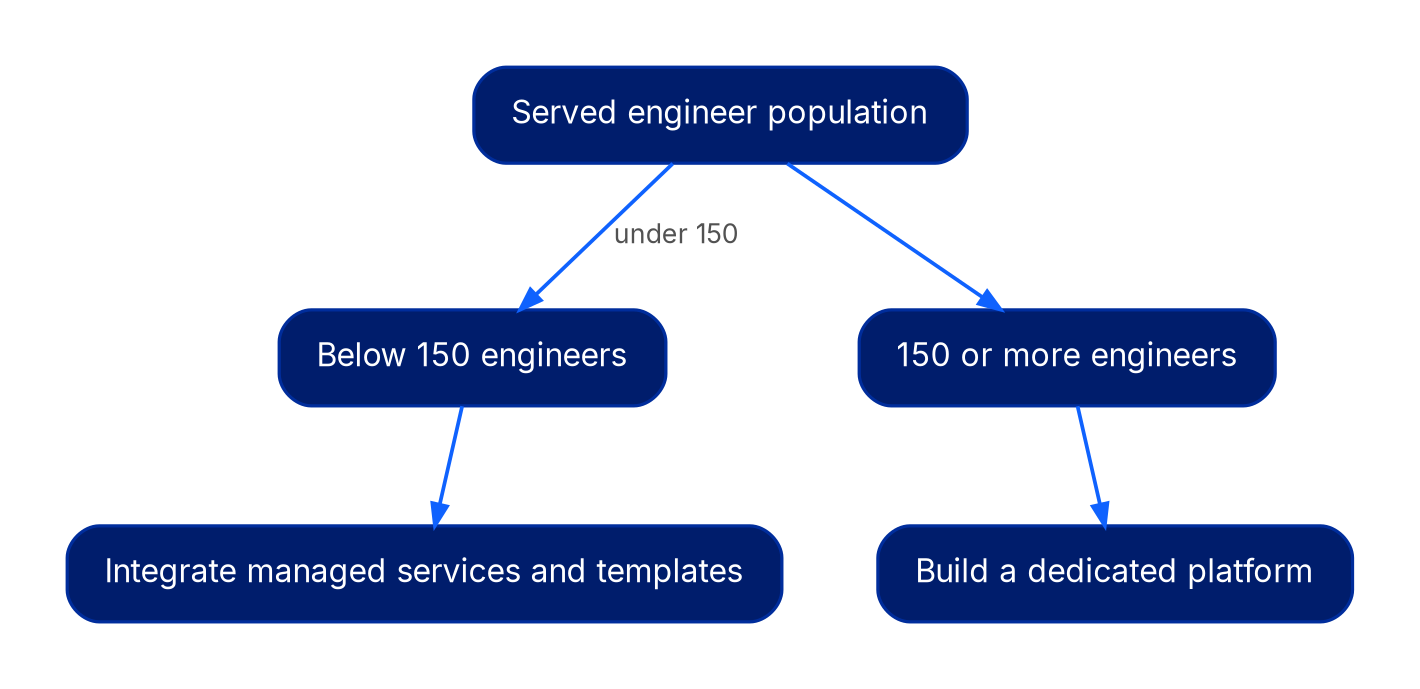
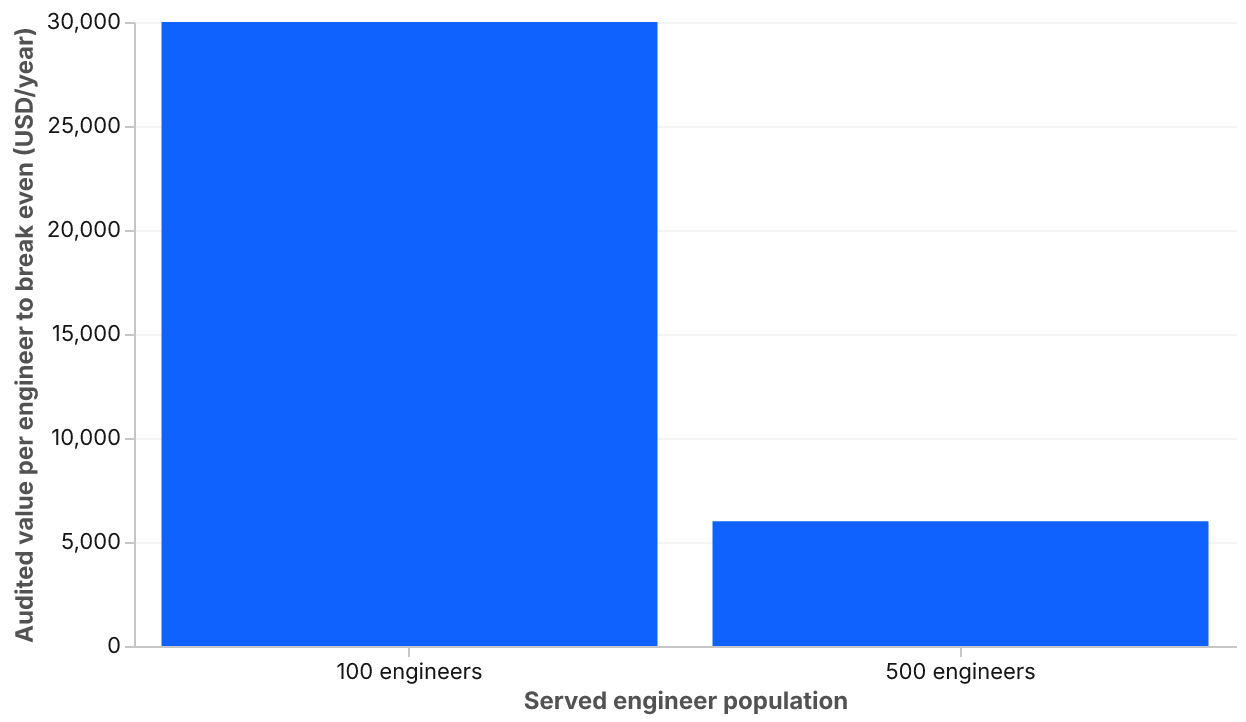
The break-even is a function of how many engineers the platform serves and how much toil it genuinely removes per engineer. We model it directly: annual platform cost divided by the number of served engineers gives a per-engineer cost the platform must clear in verifiable savings. At 500 engineers and a $3M annual run rate, the platform needs to deliver $6,000 of audited value per engineer per year to break even, a bar that cloud-cost attribution and lead-time gains can clear. At 100 engineers and the same team, the bar is $30,000 per engineer, which almost nothing clears. Buy and integrate at that size. Build when the served population makes the fixed cost rational.
A related trap follows. Some organizations build a platform to enforce standards rather than to deliver value, then reverse-engineer an ROI story to justify it. If governance is the real goal, fund it as governance and defend it on risk terms. Dressing a control function as a productivity investment invites exactly the financial scrutiny it cannot withstand.
A payback model that survives the CFO
Here is the structure we put in front of finance, and it is deliberately conservative. We discount recovered engineering hours to a fraction of loaded cost, typically 30 to 40 percent, to reflect the real conversion of saved time into delivered value. We count only the returns that land in an auditable system: the cloud bill, incident records, hiring and onboarding data. We add the migration tax to the denominator explicitly. And we phase the return, because a platform that serves 20 percent of services in year one cannot book the full-adoption saving in year one.
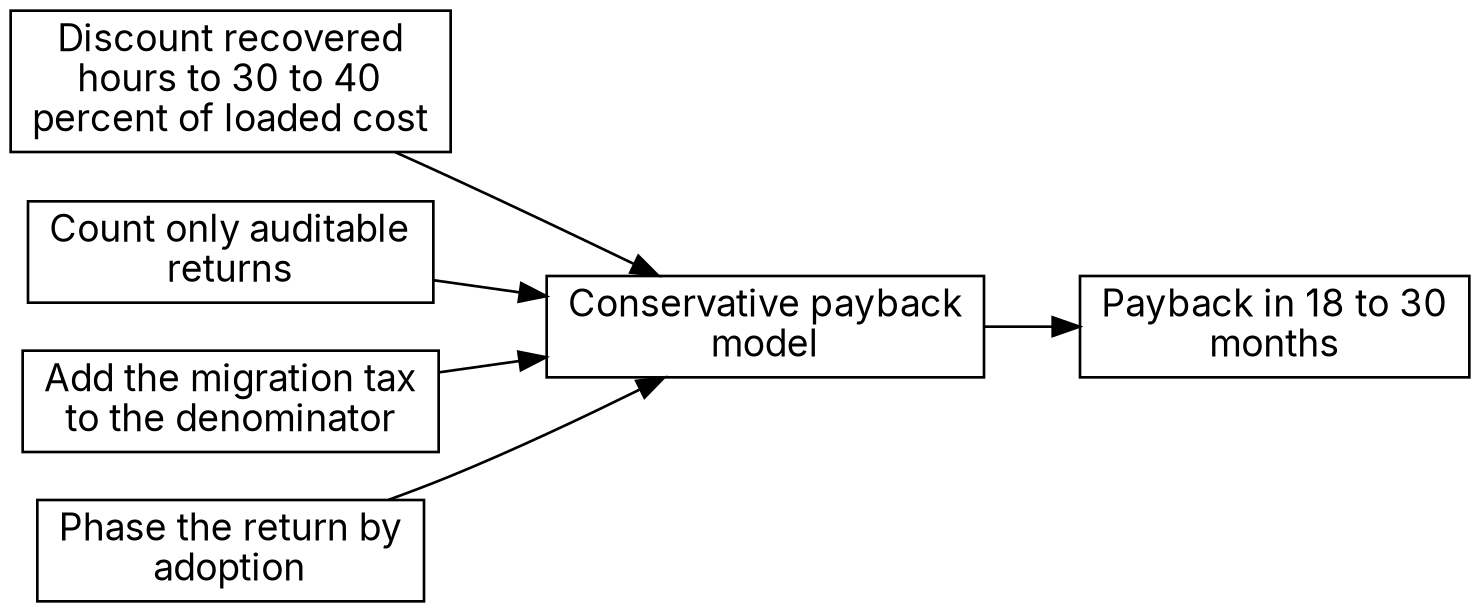
Run that way, a well-built platform at a 500-engineer organization tends to reach payback in 18 to 30 months, not the 9 the optimistic slide promised, and it sustains a positive return after that because the steady-state team is far cheaper than the build. That is a defensible number. It survives the audit. It is also less than half the return the recovered-hours fantasy advertised, which is precisely why the conservative model is the one that keeps the program funded when the first enthusiastic projection fails to materialize.
The leading indicator we watch is the gap between projected and realized return in the first two quarters after launch. If the realized return is tracking within 20 percent of a conservative projection, the model is sound and the program is healthy. If realized return is a small fraction of an aggressive projection, the problem is rarely the platform. It is that the business case was never measurable in the first place, and the correction is to re-baseline against observable outcomes before the credibility runs out.
What to do next
If you are funding or defending an internal developer platform, the work is to make its return measurable before you make it large. In order of priority:
- Capture the baseline now, before the platform changes anything. Lead time, cloud cost per service, incident recovery time, and onboarding time, measured this quarter, are the only honest comparison you will get.
- Rewrite the business case to count only auditable returns and to discount recovered hours to no more than 40 percent of loaded cost. If the case still works, it is real. If it collapses, you learned that cheaply.
- Put the migration tax in the denominator. Estimate the per-team productivity dip and multiply it across your adoption plan. A platform that ignores this cost will miss its payback date and lose the room.
- Set the build-versus-buy line by served population, not by ambition. Below 150 engineers, integrate managed services and templates first, and revisit a dedicated platform when the math changes.
- Review realized return against projection every quarter for the first year, and re-baseline the moment the gap exceeds 20 percent. The platforms that keep their funding are the ones whose sponsors caught the drift early and corrected the model, not the ones that defended an indefensible forecast to the end.
Continue reading
The real cost of composable commerce migration
Most budgets for composable commerce migrations are wrong before the program kicks off. Not modestly off. Wrong by a factor that regularly drives prog…
Composable Commerce Migration Without the Replatform Tax
Composable commerce is the dominant architectural pattern in mid-to-enterprise digital commerce in 2026. It is also one of the most expensive migratio…
Carve-Out Day-1 Tech Playbook: From Signing to Standalone in 90 Days
Tech separation determines whether a carve-out hits its alignment targets or stalls under TSA dependency. The 90-day path that works.Carve-outs are an…