

The real cost of composable commerce migration
Most budgets for composable commerce migrations are wrong before the program kicks off. Not modestly off. Wrong by a factor that regularly drives programs past their original spend by 40 to 70 percent. The reason is structural: the TCO models vendors provide anchor on license fees, and license fees are rarely the dominant cost in a composable migration. Integration labor is.
In our work with mid-to-large commerce organizations, we have reviewed more than a dozen composable migration programs from kickoff through go-live. The pattern is consistent. A $3M to $5M initial budget, grounded in software contract totals and a vendor-supplied implementation estimate, expands to $5M to $9M by the time the program reaches functional cutover. The expansion is not caused by scope creep in the traditional sense. It is caused by a systematic failure to cost the integration work that composable architecture demands.
This paper is not an argument against composable commerce. The architectural benefits are real and we recommend it regularly. It is an argument for costing it correctly.
Why vendor TCO models undercount real spend
When a commerce platform vendor presents a migration cost estimate, the document typically covers platform licensing for years one through three, implementation services from a preferred systems integrator, and a line for "integration." That integration line is almost always a six-figure placeholder covering API connectivity work. It rarely covers what integration in a multi-vendor composable stack actually requires.
The MACH Alliance defines composable architecture around four principles: microservices-based, API-first, cloud-native, and headless. Each principle sounds like a simplification. In practice, each principle multiplies integration surface area. A stack built on five best-of-breed vendors, one for catalog, one for cart and checkout, one for CMS, one for search, one for order management, has at least 25 integration pairs to design, build, test, and monitor. Each pair requires a data model translation, an authentication handshake, an error handling contract, and an observability hook. Vendor estimates account for the happy path. They rarely account for the exception paths, and exception handling is where the labor concentrates.
Gartner has reported that 70 to 80 percent of digital commerce replatforms either run over budget or fail to deliver the originally projected revenue lift within 24 months. The composable programs we have reviewed track roughly with that figure when they adopt full big-bang sequencing. Staged programs track materially better, but even staged programs routinely undercount integration labor by 30 to 50 percent at kickoff.
The four cost buckets vendors don't show you
We break composable migration costs into four buckets. Vendors show you one.
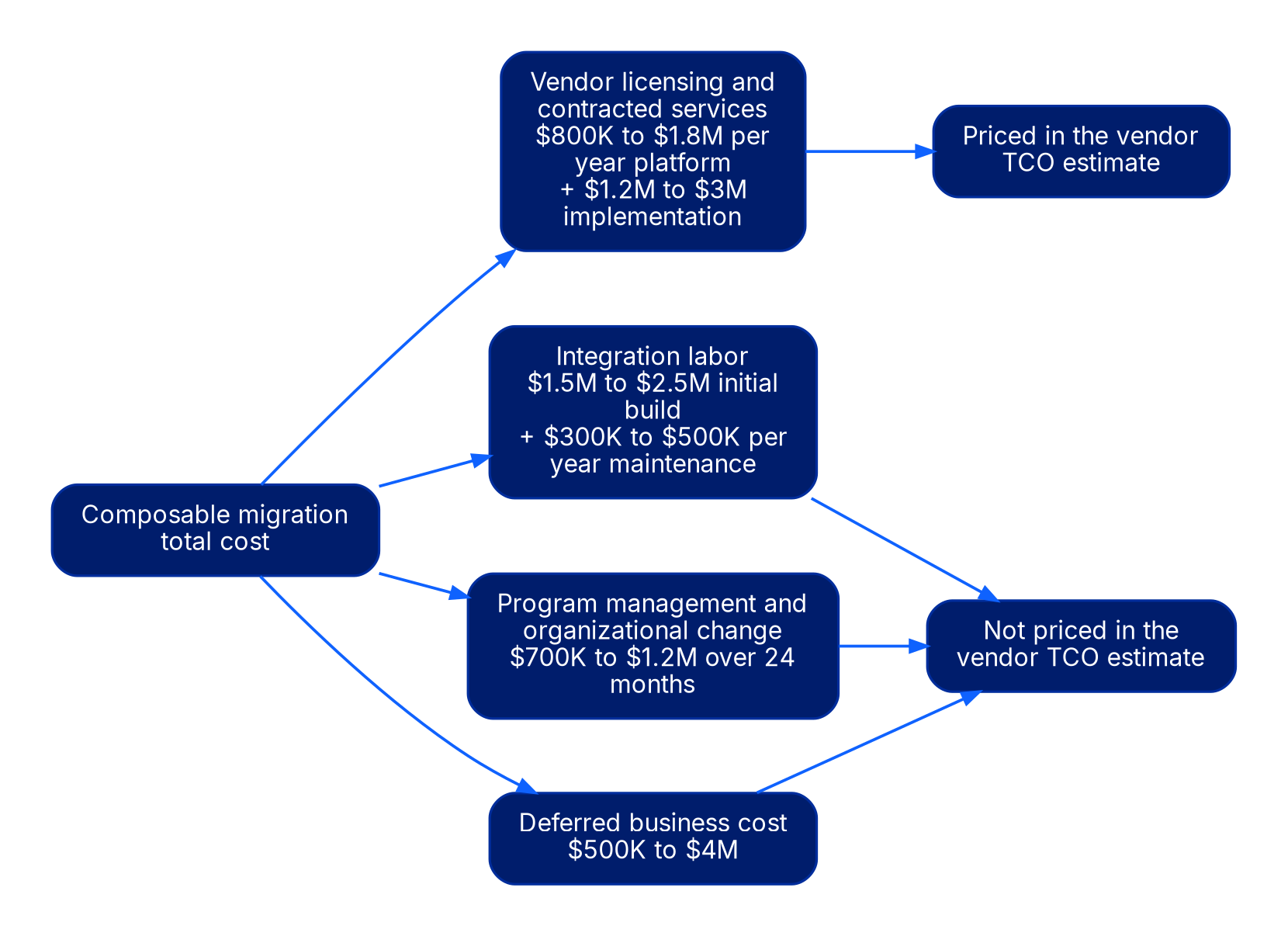
Vendor licensing and contracted services. This is the bucket vendors price. For a mid-enterprise retailer in the $200M to $500M digital revenue range, annual platform costs for a five-vendor composable stack land between $800K and $1.8M per year, including headless CMS, search, catalog, checkout, and order management. Implementation fees from a systems integrator add $1.2M to $3M depending on program scope. These numbers vary widely by vendor and negotiating leverage.
Integration labor. This is the bucket that surprises. Building and maintaining the integration layer for a five-vendor stack requires 3 to 5 senior engineers for 18 to 24 months of initial build, then 1.5 to 2 FTE of ongoing maintenance. At fully loaded engineering costs, that is $1.5M to $2.5M for the initial build and $300K to $500K per year in steady state. Most vendor estimates include two to four weeks of "integration support." They are not describing the same work.
Program management and organizational change. A composable migration spanning multiple vendors, a new frontend framework, and an organizational shift from monolith to distributed ownership requires a program structure to match. A program manager, a solution architect, and an internal product lead working full time for 24 months represents another $700K to $1.2M in fully loaded internal cost. When this role is skimped on, integration coordination falls to the engineering team and expands the labor estimate above.
Deferred business cost. During any composable migration, business stakeholders face pressure to freeze enhancements on the legacy stack. That freeze compounds. A retailer with a 30-month migration timeline who defers 12 promotional features and three site redesigns is not just saving engineering time. That business is absorbing a competitive penalty against peers who are not frozen. We have seen post-program analysis place the deferred opportunity cost between $500K and $4M for mid-enterprise retailers, depending on category competitiveness and migration pace.
Where overruns actually happen
The overrun distribution in composable migrations follows a predictable pattern. Three areas cause the majority of cost growth.
First: the data model gap. Every composable vendor has a proprietary data model. None of them match the model in the existing monolith. Mapping catalog, customer, and order data to the target vendor schemas is consistently underscoped. We have seen data migration work take 4 to 8 months for a mid-enterprise catalog of 50,000 SKUs with attribute complexity, compared to the 6-week estimate in the original statement of work. At $250 to $400 per hour for senior data engineers, a 3-month overrun on that work alone adds $400K to $600K to the program.
Second: the test environment gap. Composable stacks require end-to-end integration testing across every vendor boundary. Teams that inherit a monolith testing practice, where a single staging environment exercises the whole stack, spend 6 to 10 months discovering that no equivalent environment exists in a composable model. Building distributed staging, with representative data in every vendor's sandbox, is non-trivial. AWS publishes reference guidance on multi-service testing environments, but the configuration work is always custom to the vendor mix.
Third: incident response complexity. A monolith has one support channel. A five-vendor composable stack has five. A checkout failure touching cart, payments, order management, and identity involves up to four vendors, each with an incentive to assert the failure originated elsewhere. Teams that underinvest in observability at program start spend disproportionate time in vendor escalations during the first year post-launch. We have seen post-launch incident management add $200K to $400K in unplanned labor in the first 12 months for programs that skipped distributed tracing setup.
Counter-take: the vendor count drives cost more than program size does
The conventional composable cost narrative frames spend as a function of program scope. Larger retailer, more expensive migration. The real driver is vendor count, and that relationship is nonlinear.
Moving from a monolith to a two-vendor composable stack roughly doubles the integration surface area. Adding a third vendor triples it. By the time a program reaches five or six vendors, the integration pairs approach 30, and each additional vendor increases complexity at roughly 1.5 times the previous increment rather than adding linearly.
Standard composable advice is to select best-of-breed at every capability layer. We disagree with that advice as a cost principle. A mid-enterprise retailer choosing the top-rated search vendor, the top-rated CMS, the top-rated checkout platform, the top-rated loyalty engine, and the top-rated tax service will maximize capability on paper and maximize integration cost in practice. The programs with the healthiest cost profiles cap vendor count at four to five and accept adequate performance at one or two layers rather than best-of-breed across all.
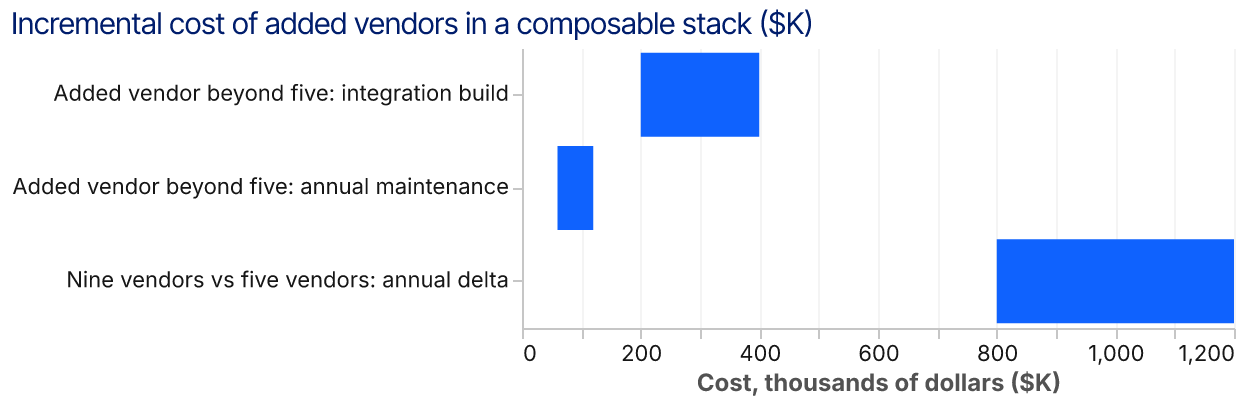
The cost implication is significant. Each additional vendor beyond five adds an estimated $200K to $400K in incremental integration build cost and $60K to $120K in annual steady-state maintenance. A nine-vendor stack costs roughly $800K to $1.2M more to build and maintain annually than a five-vendor stack with similar functional coverage. That gap never appears in any vendor comparison exercise because no single vendor is accountable for pricing the integration cost of adding their competitors to the stack.
What a credible cost model looks like
A composable migration cost model that survives contact with reality needs four estimates, not one.
The first estimate covers vendor contracts: total cost for years one through three, including usage overages, support tiers, and any success fees. Model the 75th-percentile scenario, not the base case. Vendors model the base case; your CFO needs the realistic scenario.
The second estimate covers integration labor at market rate for senior engineers, scoped to the number of vendor pairs in the target architecture. Budget 2 to 3 months of senior engineering time per integration pair for initial build, and 0.25 FTE per vendor per year for steady-state maintenance.
The third estimate covers program infrastructure: a dedicated program manager, a solution architect, and an internal product owner at fully loaded rates for the migration duration. Do not assume these roles can be filled part-time. Programs that try almost always pay twice, once when the work slips and again when they hire the dedicated roles anyway.
The fourth estimate is a deferred-cost reserve. Estimate the quarterly business value of enhancements that will be frozen during the migration, then model how many quarters the migration will run. Even a conservative $200K per quarter reserve on a 10-quarter migration represents a $2M adjustment to the ROI model. Surfacing that number early avoids the uncomfortable conversation 18 months in when executives ask why the legacy stack has not improved.
On this basis, a realistic total investment for a mid-enterprise composable migration, $200M to $500M digital revenue, five-vendor stack, 24-month timeline, runs $7M to $13M. Programs at the low end have lean engineering teams operating at sustained pace. Programs at the high end have complex legacy systems, high vendor counts, or both.
Five decisions to make before you sign the first contract
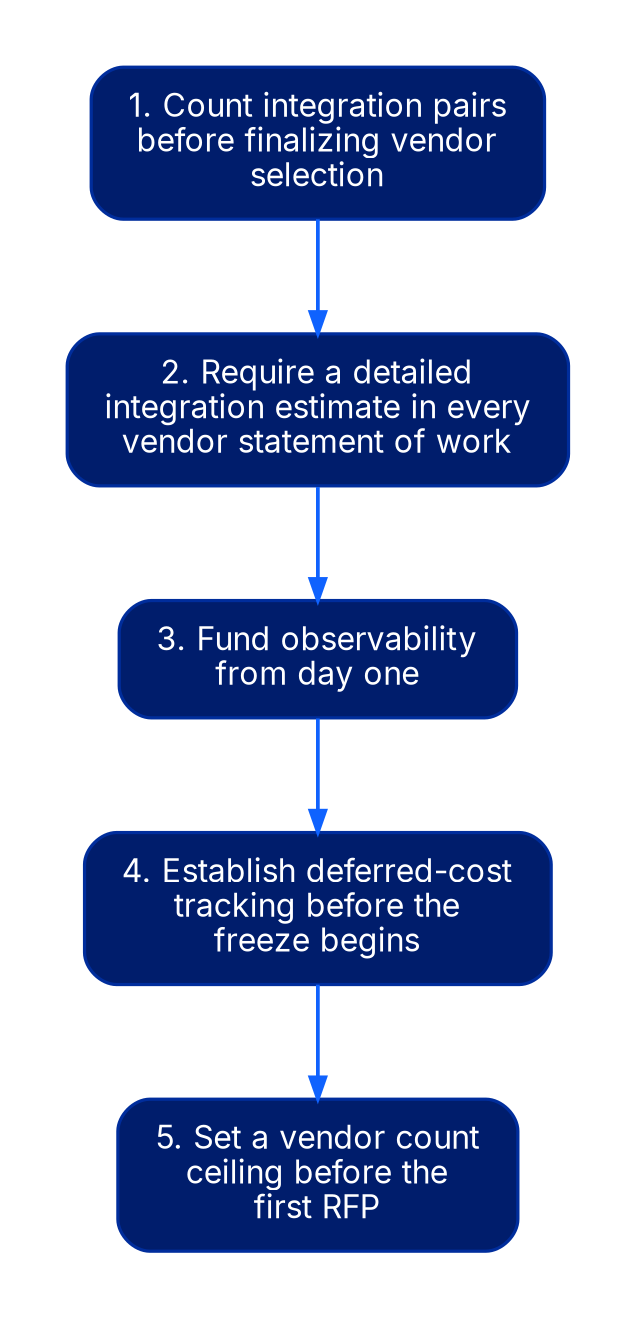
- Count integration pairs before you finalize vendor selection. If your target architecture has more than 20 integration pairs, reduce vendor count until you fall below that threshold, or add the incremental integration cost to the model explicitly before presenting the business case.
- Require every vendor statement of work to include a detailed integration estimate. Reject any SOW that covers only the happy-path API connectivity and excludes data model mapping, exception handling, and test environment setup. A vendor unwilling to scope that work in writing is implicitly telling you it will land in your engineering budget.
- Fund observability from day one. Distributed tracing across all vendor boundaries, using OpenTelemetry and a centralized backend, needs to be in the initial program scope. The cost to retrofit observability after go-live is 3 to 5 times the cost to include it at the start.
- Establish a deferred-cost tracking mechanism before the migration freeze begins. A monthly report from the product team listing enhancements deferred to the post-migration roadmap, with estimated business value per item, keeps the true program cost visible and prevents the migration from stretching indefinitely without accountability.
- Set a vendor count ceiling before you issue the first RFP. Decide in advance that the final architecture will include no more than five or six core vendors plus the frontend. Treat any proposal to add a seventh vendor as requiring a formal ROI analysis that accounts for integration labor and maintenance cost, not just license cost.
Continue reading
Composable Commerce Migration Without the Replatform Tax
Composable commerce is the dominant architectural pattern in mid-to-enterprise digital commerce in 2026. It is also one of the most expensive migratio…
Carve-Out Day-1 Tech Playbook: From Signing to Standalone in 90 Days
Tech separation determines whether a carve-out hits its alignment targets or stalls under TSA dependency. The 90-day path that works.Carve-outs are an…