

Composable Commerce Migration Without the Replatform Tax
Composable commerce is the dominant architectural pattern in mid-to-enterprise digital commerce in 2026. It is also one of the most expensive migrations to mishandle. The common pattern, "rip out the monolith, replace each capability with a best-of-breed vendor", pays full replatform cost and delivers composable benefits only at the end. A staged path exists that delivers value earlier and reduces the all-or-nothing risk.
In our work with commerce organizations across retail, B2B distribution, and direct-to-consumer brands, we've seen the same migration anti-pattern repeat: a multi-year program scoped to replace every capability simultaneously, justified by a business case that assumes the benefits compound only after full cutover. They rarely do. The benefits are sequenceable, and so is the risk.
What "composable" actually means
Composable commerce decomposes the traditional monolithic platform (Salesforce Commerce Cloud, SAP Commerce, Magento, etc.) into independent best-of-breed services for catalog, cart, checkout, search, content, payments, and order management, integrated via a thin frontend layer (often a headless storefront on Next.js or similar). The benefit is real: capability-by-capability evolution, vendor optionality, and frontend independence from backend cadence. The cost is real too: more vendors, more integrations, more accountability seams.
The MACH Alliance, the industry body promoting Microservices, API-first, Cloud-native, and Headless architectures, has codified this model and its reference principles in a way that most enterprise buyers now use as a vendor evaluation lens. The model is sound. The trouble is that vendor selection grids tend to drive program structure, and program structure drives sequencing. Buyers select all their MACH-aligned vendors at once, so they integrate them all at once, so they cut over all at once. The architecture pattern doesn't require this; the procurement pattern does.
The replatform-tax problem
A typical composable migration sequence looks like: choose a frontend framework, pick vendors for each capability, sign contracts, integrate them, build a new storefront, cut over. The total spend on this approach is comparable to a monolith replatform, the timeline is 18 to 30 months, and during that window the business is running two stacks. The composable benefits, speed of capability change, arrive only at the end, after the heaviest investment is already committed.
The economics are worse than they look on paper. Gartner has reported that 70 to 80 percent of digital commerce replatforms either run materially over budget or fail to deliver the originally projected revenue lift within 24 months of go-live. A composable migration that adopts replatform-style sequencing inherits that failure mode without earning the modularity premium that justified the architectural choice in the first place.
We've also seen a less-discussed cost: the freeze. During a multi-vendor parallel build, business stakeholders are told to defer enhancements to the legacy stack because "it's going away soon." Eighteen months of deferred merchandising features, deferred promotions logic, deferred site improvements, that opportunity cost rarely makes it into the program business case but often exceeds the program's direct spend.
The staged path that pays earlier
The migration sequence we recommend earns benefit incrementally:
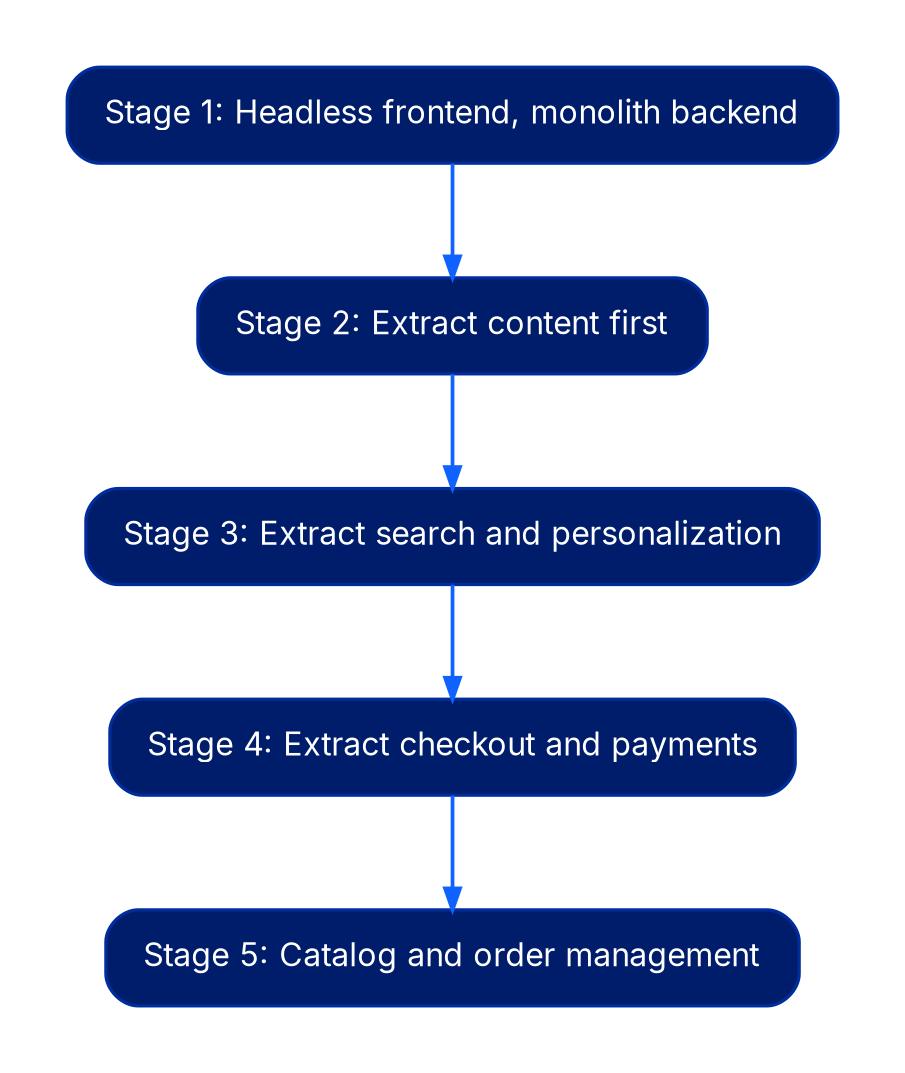
- Stage 1: Headless frontend, monolith backend. Stand up a Next.js or Remix storefront against the existing monolith's APIs. This gives you frontend velocity and modern user experience within 4 to 6 months, without touching the backend. Most of the customer-experience benefits of composable arrive here. Core Web Vitals improvements alone are meaningful, Google's research on retail sites consistently shows conversion lifts in the 8 to 24 percent range when LCP drops below 2.5 seconds, which is achievable on a modern headless frontend but rarely on a legacy monolith's server-rendered templates.
- Stage 2: Extract content first. Replace the monolith's content management with a headless CMS (Contentful, Sanity, Storyblok). Content velocity is usually the highest-ROI capability to free first, and the integration risk is lower than commerce primitives. Merchandising teams that previously waited two-week release cycles for landing-page changes can ship in hours.
- Stage 3: Extract search and personalization. Move to Algolia, Coveo, or equivalent. Search-driven discovery is typically a measurable revenue lever; on-site search users convert at roughly 2 to 3x the rate of browse-only users on most catalogs we've measured, and the migration risk is well-bounded because legacy search is rarely deeply entangled with cart and checkout logic.
- Stage 4: Extract checkout and payments. The riskier extraction, but by this stage you have integration discipline, observability, and a frontend ready to absorb the change. Vendors here are mature (Bold, Stripe, Adyen) and the seams are well-understood. Stripe's Payment Element documentation and Adyen's drop-in components have largely commoditized what used to be the most bespoke integration in the stack.
- Stage 5: Catalog and order management. The deepest integration, usually last. By this point the rest of the stack is already composable and the monolith is providing increasingly little; many teams discover the catalog work can be deferred or scoped down.
What this approach is not
It is not "stay on the monolith forever." Each stage commits to specific extractions on specific timelines. It is not "lift and shift." Each stage requires real architectural and integration work. What it changes is the value-delivery curve: customer-visible improvements ship in months, not years, and the program survives the inevitable executive changes that a 30-month rip-and-replace cannot.
It also is not the right answer for every commerce organization. Programs at the smaller end of the mid-market, say, under $50M in digital revenue with a small engineering team, frequently get more value from a modern monolithic SaaS commerce platform than from any composable architecture, staged or otherwise. The integration discipline that composable demands is itself a fixed cost. We've turned down composable engagements for clients where the honest answer was "Shopify or BigCommerce will serve you better for the next five years." The architecture decision should follow the business, not lead it.
A counter-take: best-of-breed is often worse than good-enough
Here is the part of the composable narrative that practitioner experience contradicts: best-of-breed selection at every layer is usually a mistake. The MACH community implicitly encourages it, and most RFPs we see codify it. The problem is that integration cost scales nonlinearly with vendor count. Every additional vendor adds a contract, a support escalation path, an authentication boundary, an SLA seam, a data-model translation, and a new line on the observability bill.
For most mid-market commerce organizations, a "good-enough at every layer from two or three vendors" architecture outperforms a "best-in-class at every layer from seven vendors" architecture on total cost of ownership and on incident mean-time-to-resolve. Commercetools plus Contentful plus Algolia plus a payments provider covers most of what most clients need. Adding a separate promotions engine, a separate loyalty platform, a separate tax engine, a separate fraud platform, and a separate subscription manager, each individually justifiable, produces a system where no one engineer can reason about an end-to-end checkout flow. We have seen this pattern repeatedly produce worse customer outcomes than the monolith it replaced.
The contrarian recommendation: cap your composable architecture at five core vendors plus the frontend, and treat each additional vendor as requiring an explicit ROI case that accounts for integration and operational cost, not just license cost.
The integration discipline that determines success
Composable commerce architectures live or die on the discipline of the integration layer. Three principles separate the programs that succeed from the ones that produce a "distributed monolith" with the worst of both worlds:
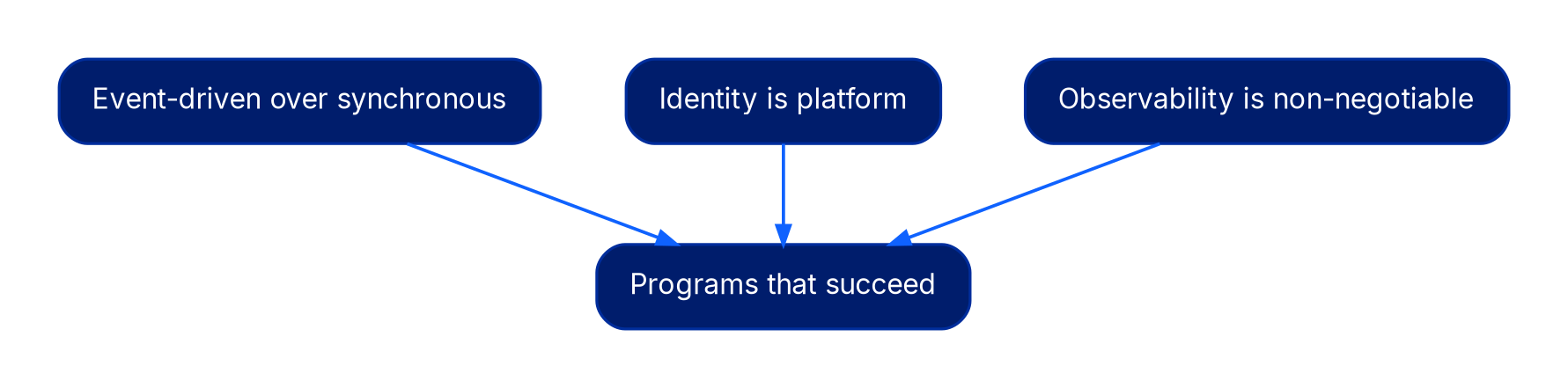
- Event-driven over synchronous. Capabilities communicate via events on a backbone (Kafka, EventBridge, equivalent) rather than synchronous calls. The performance and reliability characteristics are dramatically better at scale. AWS's own reference architecture for event-driven commerce documents the pattern in detail; the practical takeaway is that synchronous chains across four or five vendors compound latency and failure probability multiplicatively, and a single 200ms vendor degradation becomes an 800ms checkout if the calls are serial.
- Identity is platform. A single identity service serves all capabilities. Letting each vendor manage its own identity reproduces the integration sprawl composable was meant to solve. Auth0, Okta CIC, or a self-hosted Keycloak deployment in front of every vendor is non-negotiable; we treat any architecture that defers this decision as on a path to a six-month remediation project two years later.
- Observability is non-negotiable. Distributed tracing across vendors is required, not optional. Without it, every customer-impacting incident becomes a multi-vendor finger-pointing exercise. OpenTelemetry instrumentation at the frontend and at every integration boundary, feeding a single backend (Datadog, Honeycomb, Grafana Tempo), is the floor. Budget 3 to 5 percent of the integration build for this; teams that try to add it later spend three to five times as much.
A fourth principle, often skipped: contract testing between services. Tools like Pact let you assert that vendor API contracts haven't drifted between releases. Vendors update their APIs on their schedule, not yours; without contract tests, the first signal of a breaking change is a production incident.
The economics
A staged composable migration typically costs 60 to 75 percent of a full replatform when measured over five years, delivers measurable customer-experience improvements within 6 months, and reaches functional parity at month 18 to 24. The risk profile is materially better because each stage is independently revertible.
The five-year TCO comparison favors the staged approach for two reasons that aren't always visible in the year-one budget. First, the staged path defers vendor commitments, meaning year-three vendor selection benefits from year-one operational learning, and the composable vendor landscape is changing fast enough that locking in seven vendors at program kickoff usually means owning two regrettable contracts by year three. Second, the staged path lets the team build composable operating capability incrementally rather than acquiring it all at once, which reduces the consulting and contract-engineering spend that dominates big-bang program budgets.
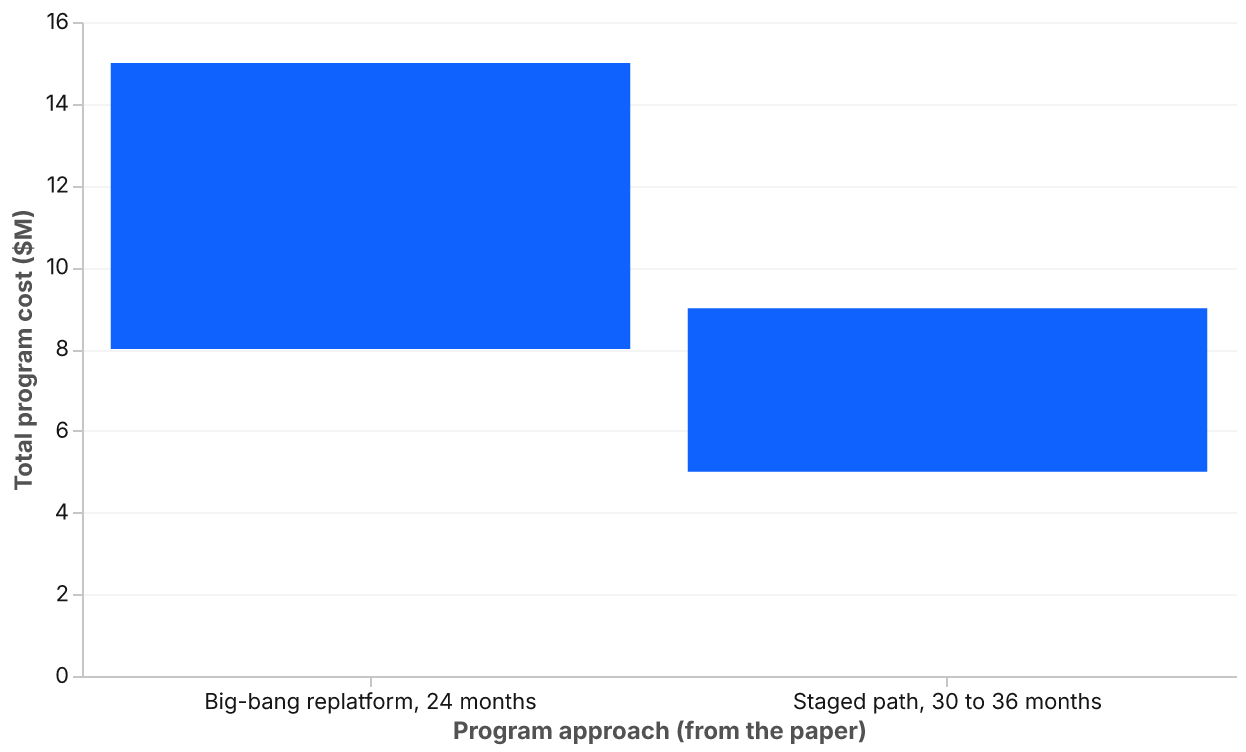
A reasonable yardstick: for a mid-enterprise retailer with $200M to $500M in digital revenue, a full big-bang composable replatform tends to land in the $8M to $15M range over 24 months. The staged path tends to land at $5M to $9M over 30 to 36 months, with the first revenue-affecting improvements shipping inside the first nine months rather than at the end.
The bottom line
Composable commerce is worth the investment for most mid-to-enterprise commerce buyers. The way most organizations approach the migration is not. Sequencing capability extraction by frontend-first, content-second, and commerce-primitives-last gives you the benefits of composable without the financial and execution risk of treating it as a single program.
The harder discipline is resisting the procurement-driven impulse to select all vendors up front, and resisting the architectural-purity impulse to maximize best-of-breed at every layer. The programs that deliver are the ones that treat composable as a sequence of bounded extractions, each justified by a specific business outcome, integrated through a small set of platform decisions made early and held firm: event backbone, identity, observability, and a deliberately small vendor count. The architecture is modular. The discipline that makes it work is not.