

Decommissioning RPA Without Triggering the Outage You Were Trying to Avoid
Almost every enterprise with a mature automation program can list the bots it wants to switch off. Far fewer can turn one off on a Friday and be confident nothing breaks by Monday. That gap is where RPA decommissioning actually lives, and it is not a housekeeping task.
We have unwound aging automation estates for finance, insurance, and healthcare clients, and the same lesson keeps surfacing. The dangerous bot is rarely the one that fails loudly. It is the quiet one that has been running for three years against a process nobody documents anymore, feeding a spreadsheet that feeds a reconciliation that feeds the month-end close. Delete it cleanly and you learn, about nine days later, exactly how load-bearing it was.
Gartner put worldwide RPA software revenue at $3.6 billion in 2024, and much of that spend sits in estates old enough to need pruning. The instinct when a bot looks obsolete is to disable it and reclaim the license. That instinct is the single most common cause of self-inflicted incidents in the automation programs we review, and this paper is about the discipline that replaces it.
Decommissioning is a discovery problem, not a delete problem
Here is the contrarian claim we will defend for the rest of this paper: turning off an RPA bot is a dependency-discovery exercise first and a teardown second. The delete is the last 5 percent of the work. The other 95 percent is finding out what silently depends on the bot before you cut it.
Traditional project thinking treats the bot as the unit of work. You built one bot, so you retire one bot. That framing is wrong, and it is why decommissioning goes sideways. The real unit is the business process the bot participates in, and a single bot often touches several. A bot that copies invoices from a mailbox into the ERP may also be the only thing that timestamps arrival for a service-level clock, the only thing that flags duplicate vendors, and the only writer to a downstream audit table three teams query without knowing a bot populates it. Retire the bot as a bot and those three functions vanish with no error message.
The counter-take we offer is blunt. Do not start decommissioning from the bot inventory. Start from the process map, work outward to every consumer of the bot's output, and treat the bot itself as the last node you touch. An inventory tells you what was built. It tells you almost nothing about what still matters.
What makes a bot hard to turn off
Four properties turn a routine shutoff into an outage. We look for all four before we touch anything.
The first is shadow integration. Many bots became the integration nobody funded. When two systems had no budget for an application programming interface, a bot stitched them together through the screen. That bot is now infrastructure, and infrastructure does not appreciate being deleted.
The second is service-account entanglement. Bots log in as service accounts, and those accounts accumulate. One account frequently runs several bots, holds standing permissions in production systems, and sometimes gets borrowed by a person for a quarterly task. Disable the account when you retire one bot and you can take down four others plus somebody's month-end routine.
The third is trigger coupling. A bot rarely runs in isolation. It fires on a schedule, or on a file landing in a folder, or on an email arriving, and something downstream expects its output on that cadence. Kill the producer and the consumer waits forever, usually without raising an alarm.
The fourth is the silent consumer, and it is the worst of the four because it is invisible from the bot's own code. A report, a dashboard, a partner feed, or another bot reads a table or a file the target bot writes. Nothing in the bot references that reader. You find it only by looking at who touches the output, not the bot.
Volume is not dependency, and conflating the two is the trap. A bot that runs 4 times a month looks trivial next to one that runs 400 times a day. The monthly bot might be the one that closes your quarter. The high-volume bot might be moving data nobody has read since 2022. Frequency measures activity. It says nothing about whether anyone depends on the result.
A classification that decides the disposal path
Two questions sort almost any candidate bot, and the answers set the teardown path.
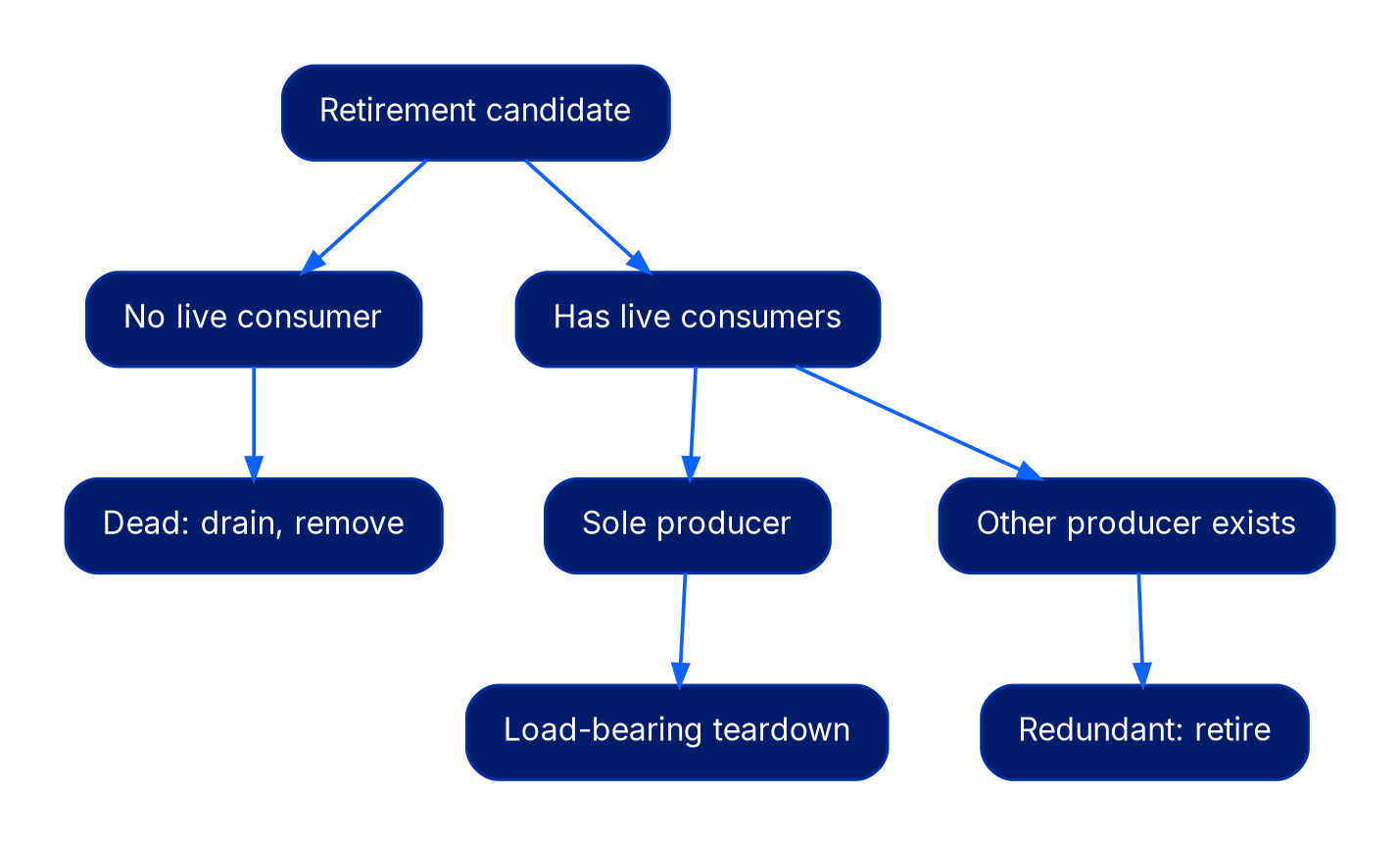
Question one: does the process still produce value anyone consumes? Question two: is the bot the only producer of that value?
Those two answers give four outcomes. A bot producing no consumed value is dead, and dead bots can be drained and removed on a short timeline. A bot whose value is now delivered another way, because someone built the integration or the source system added the feature, is redundant, and redundant bots are the cleanest wins because a replacement already carries the load. A bot whose work should move to a real integration is a replacement candidate, and here the sequence matters: build and verify the integration first, run both in parallel, then retire. A bot that is the sole producer of value people still consume is load-bearing, and load-bearing bots demand the full teardown discipline before they go anywhere.
Most estates split unevenly. In the audits we run, a large share of "obviously retire it" candidates turn out to be load-bearing once we trace the consumers, which is exactly why the classification has to come before the calendar.
The teardown sequence that avoids the silent outage
Once a bot is classified and you have decided it goes, the order of operations is what protects you. We use five moves, and we do not reorder them.
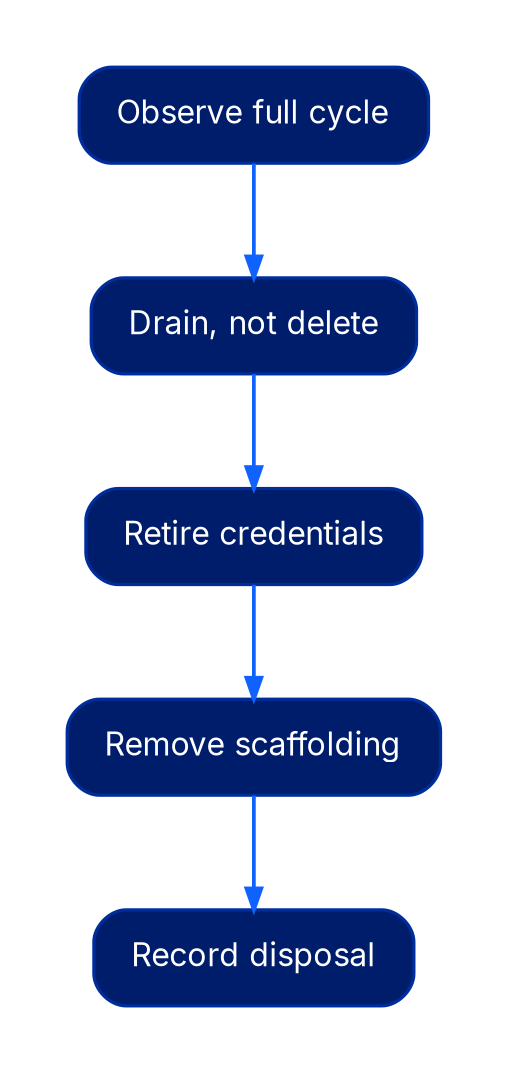
Observe a full business cycle first. Watch the bot across a complete period before you touch it, which for a finance process means at least one full month through close. Bots that look idle for three weeks come alive on the last day. If you have not seen a full cycle, you have not seen the bot.
Drain, do not delete. Disable the bot in a way you can reverse in about 5 minutes rather than deleting the project and its configuration. Pause the schedule, leave the code and credentials intact, and watch for who complains or what breaks. That reversible state turns a risky deletion into a cheap experiment. A drained bot that nobody misses for a full cycle has earned its removal.
Retire credentials deliberately. Only after the drain proves the bot is truly unused do you deprovision its service account, and you do it as its own step, checking first that no other bot or person shares it. Standing credentials that outlive their bot are a live audit finding. NIST Special Publication 800-53 Revision 5 puts account management and the removal of unnecessary accounts among its baseline access controls, and an orphaned bot account is the kind of stale privilege those controls exist to close.
Remove the scaffolding. A bot leaves a trail: scheduled triggers, watched folders, shared drives, orchestrator queues, monitoring alerts, and firewall rules cut to let it reach a system. Leave that behind and the next engineer inherits a maze of rules pointing at nothing. Clean removal includes the plumbing, not just the bot.
Record the disposal. Write down what was retired, what it used to do, which process it served, and who signed off. This is not bureaucracy. When someone asks in eight months why a report stopped, the disposal record is the difference between a five-minute answer and a two-week investigation. The systems-engineering standard ISO/IEC/IEEE 15288:2023 treats disposal as a defined life cycle process with its own records and responsibilities, not an afterthought, and mature automation programs treat it the same way.
The regulated wrinkle
In regulated environments, a bot is not decommissioned when it stops running. It is decommissioned when the control it participated in has been re-tested and shown to work without it. A bot that performed a segregation-of-duties check, reconciled two ledgers, or enforced a four-eyes approval was part of your control environment whether or not anyone wrote that down. Remove it and you have changed a control, which means the control has to be re-validated and the change evidenced for auditors.
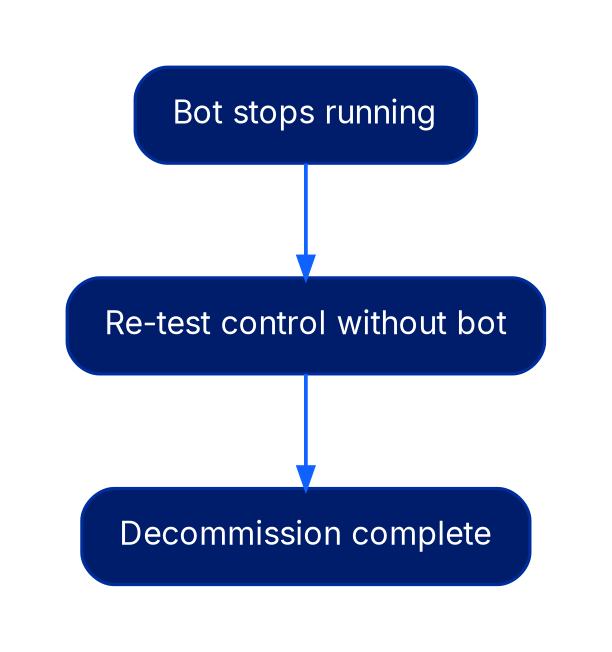
Plan for that to roughly double the effort on control-adjacent bots compared with a bot that only moved data. We tell clients to identify control-participating bots at the start, route them through the same change management any control modification requires, and never let a decommissioning project quietly alter the control environment as a side effect.
How long a clean decommission takes
For a single load-bearing bot, plan on 6 to 10 weeks from first observation to a fully removed footprint, most of it spent watching and tracing rather than coding. The drain window alone should cover one full business cycle, which is 4 to 6 weeks for anything tied to a monthly close. A redundant bot with a proven replacement can be gone in a week. Dead bots, once confirmed dead across a cycle, take a day.
Programs that try to compress the load-bearing path into a single sprint are the ones that generate the outage the whole exercise was meant to prevent. Across the estates we have reviewed, a disciplined program retires 30 to 50 percent of an aging estate over two to three quarters, and the retired bots stay retired because their disposal was evidenced rather than improvised.
What to do this quarter
If you are staring at an automation estate you know is too big, start here.
- Pull the full bot inventory and map each bot to the business process it serves, not just the systems it touches. Bots you cannot map to a live process are your first drain candidates.
- For every retirement candidate, trace the consumers of its output before you read its code. Find the silent reader before you find the off switch.
- Sort candidates into dead, redundant, replaceable, and load-bearing using the two questions above, and schedule the load-bearing ones for a full teardown, not a quick disable.
- Adopt drain-not-delete as policy. No bot goes from running to deleted without a reversible pause that survives one full business cycle.
- Flag every control-participating bot up front and route it through change management, so decommissioning never becomes an unlogged control change.
The programs that decommission well are not the ones that delete the most bots. They are the ones that can turn a bot off and prove, calmly and on the record, that nothing downstream noticed. That is the standard worth holding, and it is reachable once you treat the shutoff as the careful end of a discovery process rather than the press of a button.
Continue reading
The Legacy Modernization Business Case That Survives the CFO
Most modernization proposals lead with cost savings and lose the room. The case that gets funded prices the risk of standing still and the value of mo…
The M&A IT Integration Day-1 Checklist: What Must Work, What Must Not Break
Most Day-1 checklists are a hundred-day plan crushed into a single date. That is why they fail. A checklist built around continuity and control, not i…
Writing a Platform Engineering Team Charter That Holds Up
Almost every large engineering organization now has a platform engineering team. Few have a charter that anyone reads after the kickoff. Gartner proje…