

The Legacy Modernization Business Case That Survives the CFO
Most modernization proposals lead with cost savings and lose the room. The case that gets funded prices the risk of standing still and the value of moving, not a cheaper run rate.
Almost every large enterprise runs a legacy system it has already decided, in principle, to replace. Few carry a business case for that replacement that survives one hard hour with the CFO. The technology argument is usually sound. The financial argument is usually built wrong: it promises a lower run cost two or three years out, funded by certain spend today, and it loses to every project on the list that promises to earn revenue instead of save it. We have watched strong modernization programs die in exactly this way, not because the engineering was doubted, but because the money story could not answer a discount-rate question.
Why the cost-savings case loses
The default modernization business case is a total-cost-of-ownership story. Retire the old platform, drop the license and hosting bill, shed the specialist contractors, and the savings pay back the migration in some number of years. It is an honest story and a weak one. The spend is front-loaded and certain. The savings are back-loaded and speculative. Any CFO who has sat through a migration that slipped will discount those savings heavily, and rightly, because a program that lands its benefits in month 30 instead of month 18 can see its net present value collapse even when every line item eventually comes true.
A deeper problem follows. A pure savings case competes in the wrong category. It sits on the capital plan next to a new product line, a market expansion, a pricing engine, each of them promising growth. Modernization framed as cost reduction is asking to be measured against investments framed as revenue, and it will lose that comparison almost every time. Framed only as a way to spend less, it reads as overhead.
The counter-take we offer is direct. Stop leading with total cost of ownership. A modernization case built on run-cost reduction alone is the weakest version of the argument you can make, and it is the version most decks open with.
Price the counterfactual honestly
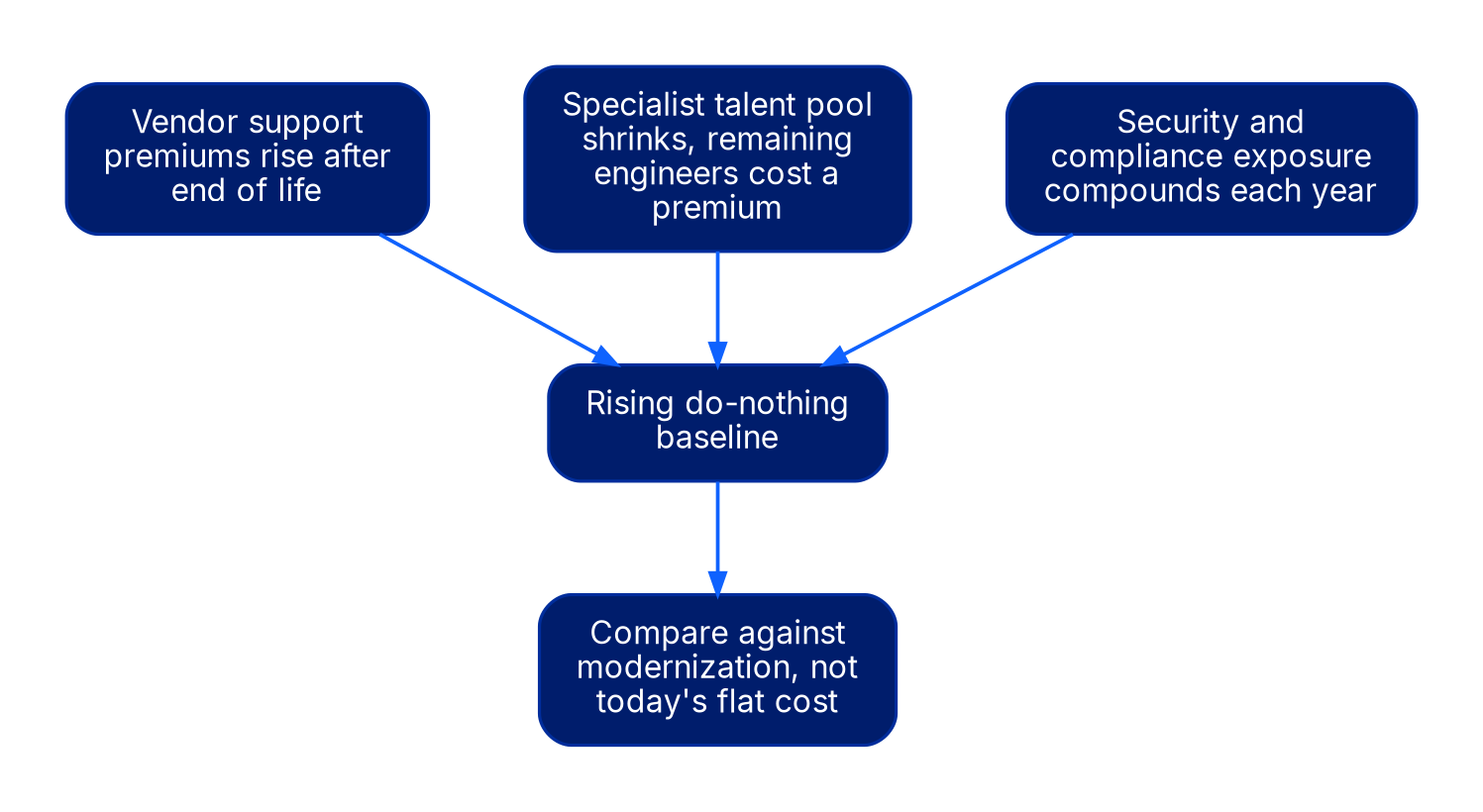
The single most common defect we find is a do-nothing baseline drawn as a flat line. The proposal compares the cost of modernizing against the cost of the legacy system as it runs today, held constant for five years. That baseline is fiction, and a sharp finance team will say so.
The cost of standing still rises, and it rises on schedules you do not control. Vendor support is the clearest example. When mainstream maintenance ends, the same software costs more to keep secure, not less. Microsoft's product lifecycle and Extended Security Updates program prices post-end-of-life patches as a recurring fee that climbs each year you delay, and the pattern repeats across enterprise vendors as major releases reach their maintenance cliffs. The talent line moves the same direction: the pool of engineers who will maintain a decade-old stack shrinks every year, and the ones who remain command a premium precisely because they are scarce. Security and compliance exposure compounds quietly until an auditor or an incident converts it into a large and sudden number.
None of this is hypothetical at the top of the market. The US Government Accountability Office reviewed ten of the federal government's most critical legacy systems in 2019 and found them 8 to 51 years old, several of them costing hundreds of millions of dollars a year to operate, with the ten together running to roughly $337 million a year. The lesson for a private business case is not the absolute figure. It is the shape of the curve: legacy cost bends upward, and a credible baseline draws it that way.
So the real comparison is never modernize-versus-today. It is modernize-versus-the-rising-legacy-curve. Draw both lines. The gap between them, widening over time, is a large part of the value you are actually buying, and it is the part the cost-savings deck leaves on the table.
The four value streams
A defensible case accounts for four distinct streams of value. Most proposals quantify one of them well and wave at the rest.
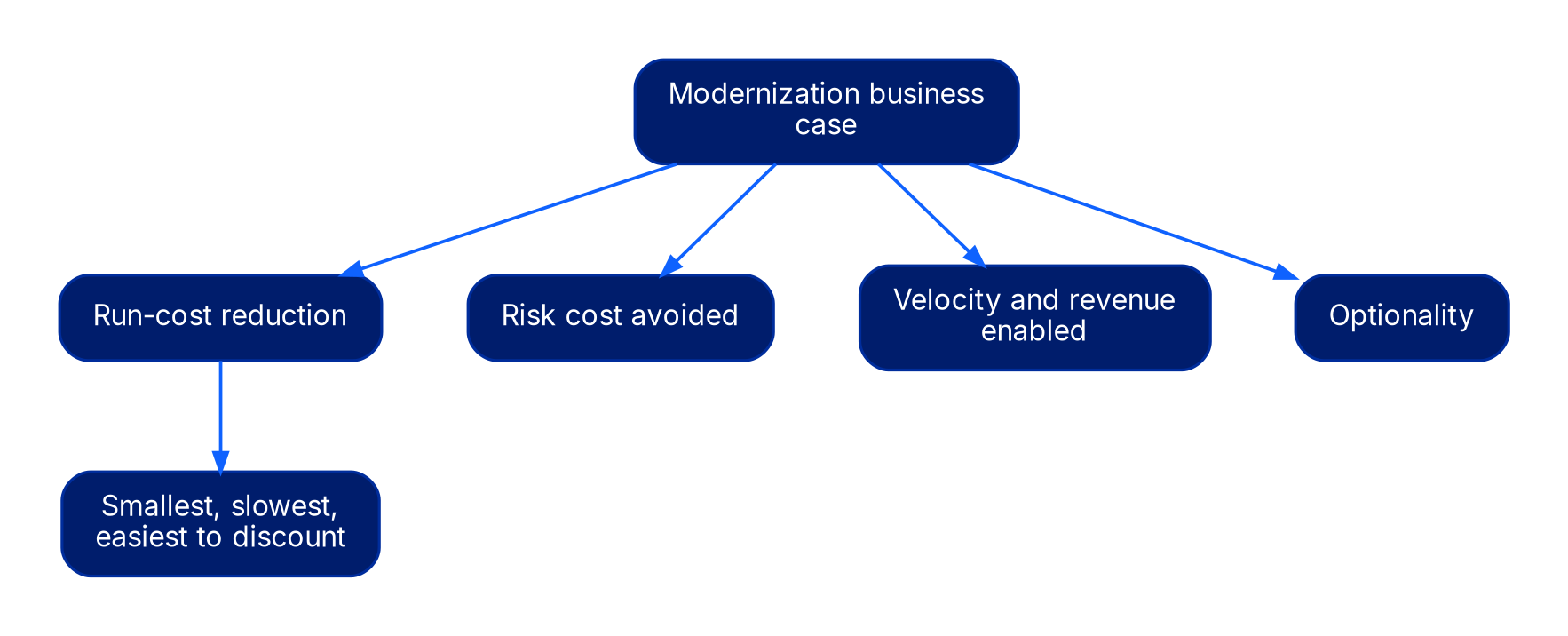
- Run-cost reduction. The license, infrastructure, and support savings everyone leads with. Real, but usually the smallest and slowest stream, and the easiest for finance to discount. Lead with it and you have framed the whole case as overhead.
- Risk cost avoided. The rising support premiums, the key-person exposure when the last engineer who understands the batch job retires, the breach and compliance liability that grows with every unpatched year. This stream is the counterfactual curve, priced. It is frequently the largest number in the model and the one most often missing from it.
- Velocity and revenue enabled. What the business can do on the new platform that the old one made slow or impossible: a feature that shipped in weeks instead of quarters, a channel that could finally be opened, a pricing change the legacy system could not express. This is the stream that lets modernization compete with growth projects on their own terms, because it is a growth argument.
- Optionality. The value of holding a platform you can change. A modern estate lets you adopt a capability, integrate an acquisition, or exit a vendor without a second migration. It behaves like a financial option: you are paying for the right, not the obligation, to move later. Name it explicitly, because a CFO who prices risk for a living understands optionality even when engineers struggle to.
The first stream is the one every deck quantifies. The other three are where the real case lives, and skipping them is why so many technically sound programs never get funded.
Make the numbers move early
Even a case with all four streams can fail on timing. Because the spend lands first and the benefits follow, net present value is acutely sensitive to when the value arrives. A program that promises everything in a single cutover 30 months out carries all of its risk in one number, and finance knows how those numbers behave.
The fix is structural, not rhetorical. Sequence the work so measurable value lands early and keeps landing. A phased approach in the strangler-fig tradition, where you route traffic at a seam and retire legacy paths incrementally, can begin returning business value in month 4 to 6 rather than at a distant big-bang. A realistic modernization of a substantial estate still runs 18 to 30 months end to end, but the cash-flow shape matters as much as the total. Early, repeated proof points do more for a business case than a larger promised payoff at the finish, because each one retires risk the CFO would otherwise price in.
This is also the honest answer to the discount-rate question. You are not asking finance to trust a benefit three years out. You are showing value in the first two quarters and compounding it, which is a story a capital-allocation committee can actually underwrite.
The failure modes we see repeated
Three patterns sink otherwise good cases. The first is the padded savings number, where soft productivity gains and generous headcount reductions are stacked until the payback looks fast. Finance discounts padded numbers to zero the moment one assumption looks aggressive, and the whole case loses credibility with it. Fewer, defensible numbers beat a larger, softer total.
The second is claiming benefits and then not instrumenting them. If the case rests on faster time to market or lower incident rates, the program has to measure those from day one, on the legacy baseline, or the value stream is an assertion no one can audit. We ask every client to capture the baseline metric before the first line of new code ships.
The third is scoping the case as an engineering project rather than a business one. A modernization without a named business owner who will retire features, change processes, and defend the decommissioning budget tends to reimplement the old system faithfully, including the parts no one uses. Standish Group's long-running data on large software efforts, where only about 6% of the biggest projects finish on time, on budget, and on scope, is a standing reminder that the organizational failure modes, not the technical ones, dominate the outcomes.
What to do next
Build the case in this order, and build it to survive the room it will be argued in.
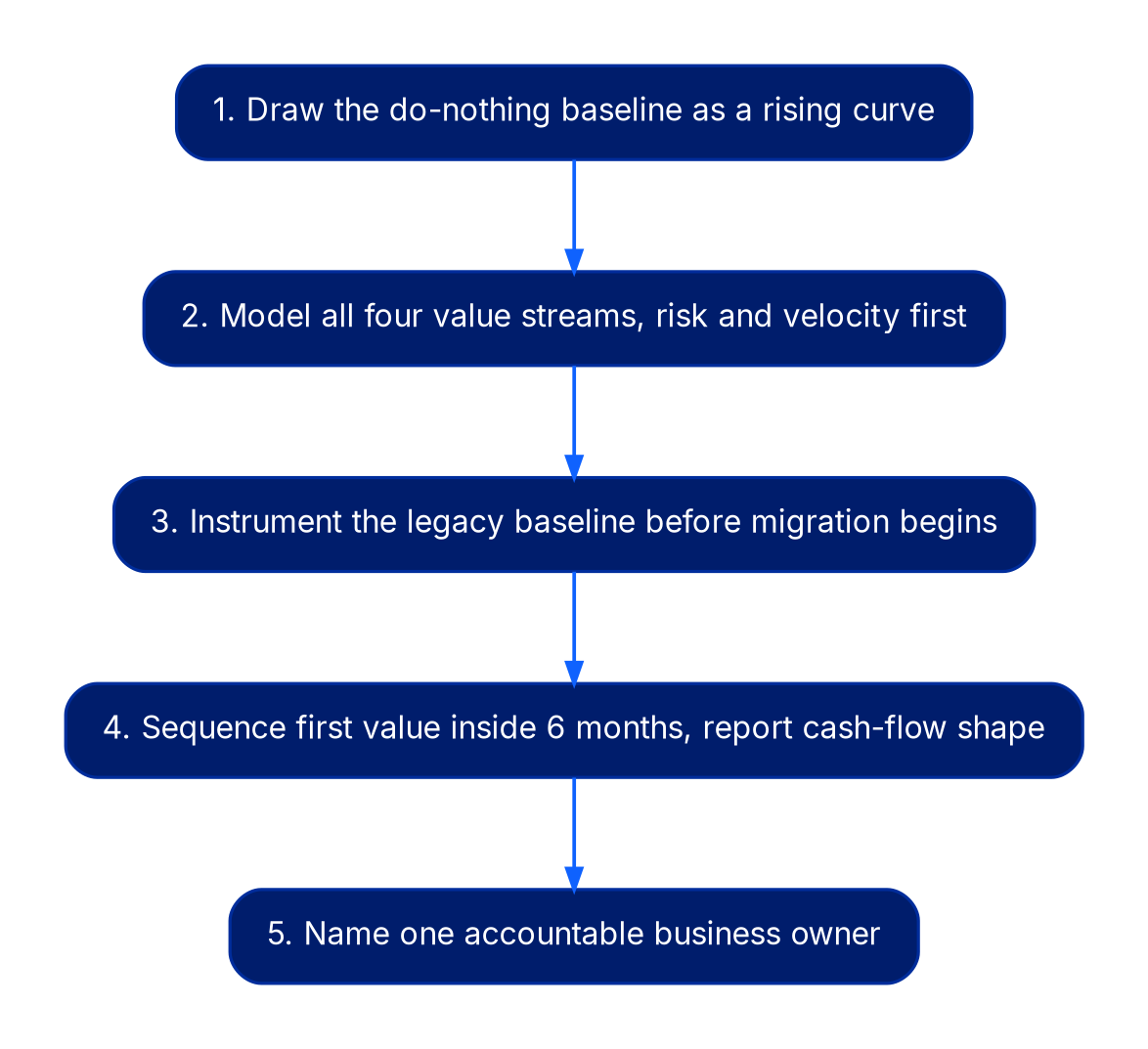
- Draw the do-nothing baseline as a rising curve, and defend the slope with dated vendor end-of-life schedules, talent-market evidence, and named compliance exposures rather than a flat assumption.
- Model all four value streams, and put the risk-avoided and velocity streams in front, where a growth-oriented committee will actually weigh them.
- Instrument the legacy baseline now, before any migration work begins, so every benefit you claim can be measured against a number you captured first.
- Sequence the program so the first measurable value lands inside 6 months, and report cash-flow shape, not just total return, so the case answers the discount-rate question directly.
- Name a single business owner accountable for the benefits, the process changes, and the decommissioning line, and give that owner the authority to delete what the new platform makes unnecessary.
The modernization programs that get funded are not the ones with the cleanest architecture diagrams. They are the ones whose business case treats standing still as the expensive option it has quietly become, and proves it with numbers finance can check.
Continue reading
The M&A IT Integration Day-1 Checklist: What Must Work, What Must Not Break
Most Day-1 checklists are a hundred-day plan crushed into a single date. That is why they fail. A checklist built around continuity and control, not i…
Writing a Platform Engineering Team Charter That Holds Up
Almost every large engineering organization now has a platform engineering team. Few have a charter that anyone reads after the kickoff. Gartner proje…
The real ROI of an internal developer platform
Almost every large engineering organization is now funding an internal developer platform, or about to. Few can tell you what it returns. Gartner proj…