

Fractional CTO vs. Interim CTO: Knowing When Each Model Fits
Here is a pattern we see constantly. A B2B SaaS company loses its CTO to a competitor. The board, watching burn rate, decides a fractional CTO is the responsible move. They hire a well-regarded practitioner, two days per week, for $15,000 a month. Six months later, the engineering team has splintered, three senior engineers have quit, a critical API migration has stalled halfway, and the company is now doing the permanent search it should have started in week one. The fractional CTO was perfectly competent. The model was wrong from the start. And the six months cost far more than the difference between fractional and interim would have.
We've been in enough of these situations to recognize the pattern before it plays out. The choice between fractional and interim CTO is not primarily a budget question. Budget is a constraint. The primary question is what work the company actually needs done, and whether that work requires full presence or not. These are genuinely different jobs wearing the same title. Getting the distinction wrong is expensive in ways that don't show up on the invoice.
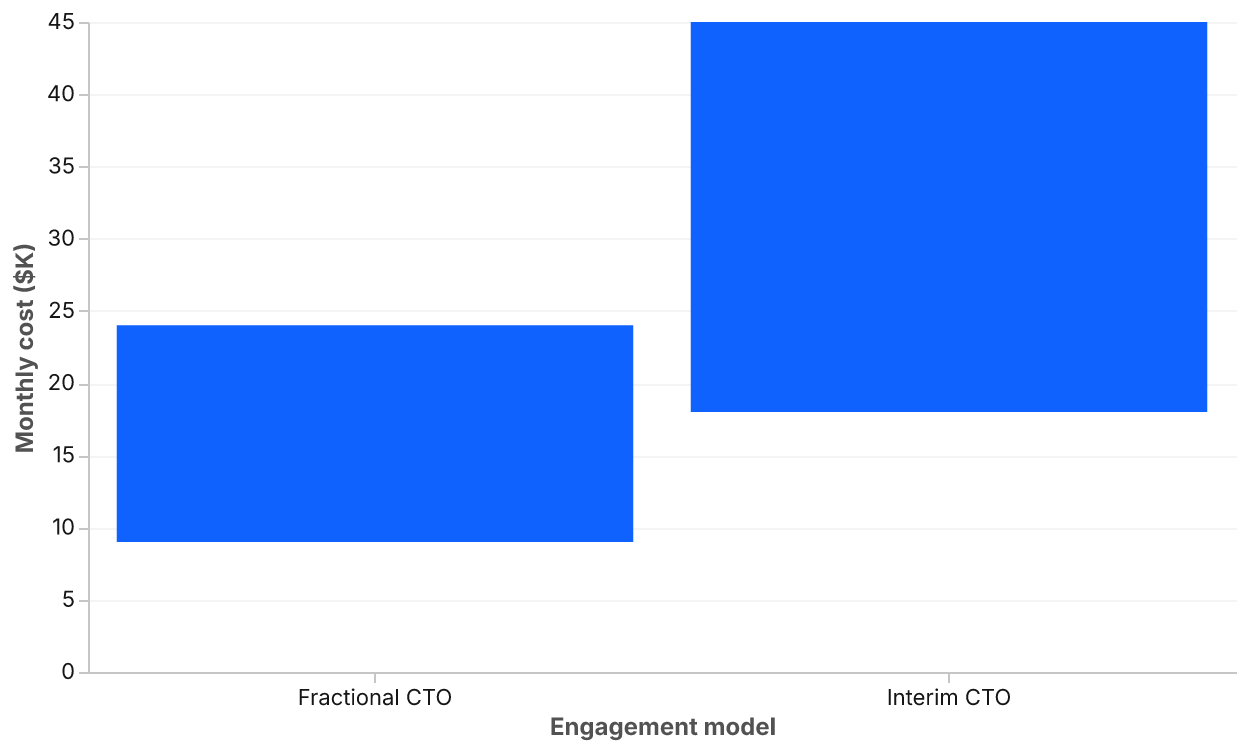
CTO compensation at scaling technology companies runs between $180,000 and $420,000 in total annual cash. The Bureau of Labor Statistics projects 6 percent growth in top executive roles through 2032, which means the supply of available senior technology executives is structurally tight. Fractional engagements typically run $9,000 to $24,000 per month for two to three days of access per week. Full-time interim CTOs cost $18,000 to $45,000 per month. Those numbers look like an easy optimization problem right up until you account for the failure mode.
What the titles actually mean
The market uses these terms loosely, which is half the problem. We use precise definitions and we enforce them in our own engagements.
A fractional CTO is a part-time technology executive, typically 20 to 40 percent of a full working week, engaged on a recurring retainer. They're not on call for production incidents. They won't be available at 2 PM on a Wednesday when a team decision needs to be made. The model works when a company needs sustained senior technology judgment at a cadence the business can actually absorb, but doesn't have the organizational surface area or budget to justify someone full-time.
An interim CTO is a full-time, temporary executive brought in for a defined period, three to twelve months is typical. They own the seat. Roster, roadmap, vendor relationships, the board relationship on the technical side: all of it. They're not advising; they're operating. They're on-site or fully present remotely. They're reachable when the CI/CD pipeline fails at 11 PM before a customer demo. They show up for every stand-up.
Treating these as interchangeable because both have "CTO" in the title is the mistake we see most often. The work is different. The organizational impact is different. And the failure modes when you pick the wrong one differ in kind, not just degree.
Why the budget-first framing keeps failing
Conventional advice positions fractional engagements as the responsible entry-level choice: if you can't afford a full-time CTO, get a fractional one. We've disagreed with this framing for years, and our reasons are operational, not philosophical.
Fractional doesn't fail because the person is less capable. It fails when the work requires continuous presence and the model doesn't provide it. A company running an active platform migration, carrying five unresolved architectural decision threads, managing a team through a layoff, or negotiating a major cloud vendor contract doesn't need executive judgment twice a week. It needs someone in the room, making calls, absorbing friction, and keeping the team oriented. A fractional CTO unavailable when those situations arise isn't a CTO; they're a well-credentialed consultant with a recurring invoice. The team routes around them. Decisions accumulate. Six months later, someone's asking why the engagement didn't deliver, and the answer is that it was never designed to handle what the company actually needed.
The other failure mode runs the opposite direction. An interim CTO placed in a company that only needs 20 percent coverage will expand the engagement to fill the time. They build governance structures the company won't need for three years. They add process where speed matters more. They leave behind an organizational structure that fits a firm twice the size. We've walked into companies 90 days after an interim finished, where a 25-person team had the documentation overhead of a 200-person one, and the incoming permanent CTO spent the first two quarters dismantling what the interim built. The engagement that was supposed to help created a cleanup project.
When interim is the only real answer
CTO tenure at growth-stage technology companies is short. Gartner's research on technology executive leadership has documented that C-suite tenure varies by function, with technology roles turning over faster than other executive positions at high-growth companies. Boards that plan for this do better. Most boards don't, which is why unplanned departures outnumber planned transitions by a wide margin in our experience.
When a CTO leaves suddenly, whether by choice or by force, the vacuum is immediate and the damage is real. The team loses its escalation path overnight. Roadmap decisions stall because no one has the authority to make the call. Senior engineers start taking recruiter calls. A permanent search, done properly, takes four to six months. An interim plugs the gap within days and holds the team together while the search runs. That's not a luxury; at a company where the CTO departure is already known to the engineering team, it's triage.
Beyond gap coverage, the interim model is also right for any engagement where the deliverable is execution rather than advice. A nine-month platform migration needs a technology executive present for every stand-up, every architecture review, and every vendor negotiation. A regulatory remediation project with a hard OCC or FCA deadline needs someone who owns the outcome, not someone who checks in on it twice a week. An enterprise product launch against a signed customer commitment needs a technical leader who can make binding decisions in real time. At the enterprise sales stage, a slipped launch can mean seven figures in deferred revenue. An interim who has done this before, and can show references from comparable situations, earns their rate against that number. The right interim also generates something else that's hard to get any other way: specific data about what the permanent role actually requires. We've watched companies come out of an interim engagement with a revised permanent hire profile, because the interim surfaced what the job actually involved in practice versus what the board thought it involved in theory.
When fractional is the correct model
Fractional isn't a compromise. For the right company at the right stage, it's the structurally correct answer.
A 15-person company with a strong lead engineer and a technical co-founder doesn't need a CTO working 40 hours a week. What it needs is senior judgment on the architectural decisions that will constrain scale at Series B, someone who can represent the technical function credibly in board conversations, and a practitioner who can help recruit the first two senior engineers and calibrate the hiring bar. A fractional engagement at two days per week handles all of that and costs $12,000 to $18,000 per month. The rest of the budget goes to engineering headcount that actually ships. This is not a budget trade-off; it's the right allocation of capital at that stage.
The fractional model also fits companies with an existing CTO who needs specialized coverage in a specific domain. Security posture ahead of a SOC 2 Type II audit, data architecture for a new analytics platform, infrastructure planning for a first production machine learning deployment: these are VP-level workstreams, not CTO-level ones, but they're also beyond what a generalist engineer can own. A fractional engagement for six months on a specific workstream, with a defined deliverable and a defined end date, is cleaner and cheaper than hiring for a role that won't exist in the same form 12 months out.
And then there's the stable, mature company that genuinely doesn't need daily executive technology leadership. A profitable SaaS business with 12 experienced engineers, a stable product roadmap, and no major platform transitions in the plan may need a CTO primarily for quarterly planning, major hire decisions, board technical credibility, and the occasional strategic judgment call. That's a fractional engagement. Paying for 30 hours a week of availability the company can't absorb isn't prudent; it's wasteful.
How to make the call without getting it wrong
We've used a consistent diagnostic approach across dozens of these decisions, and it comes down to three questions, but the order matters.
The first question is whether the work is execution or advisory. Execution means running a team through change, owning delivery commitments, managing incident escalations, and being the technical decision-maker for things that can't wait. Advisory means architecture judgment, strategic prioritization, and external technical credibility. These require fundamentally different engagement structures. Execution requires full presence. Advisory doesn't. The companies that get this wrong are the ones that describe the work as advisory ("we just need strategic guidance") when the day-to-day reality is execution ("our team can't make decisions without escalating to the CTO").
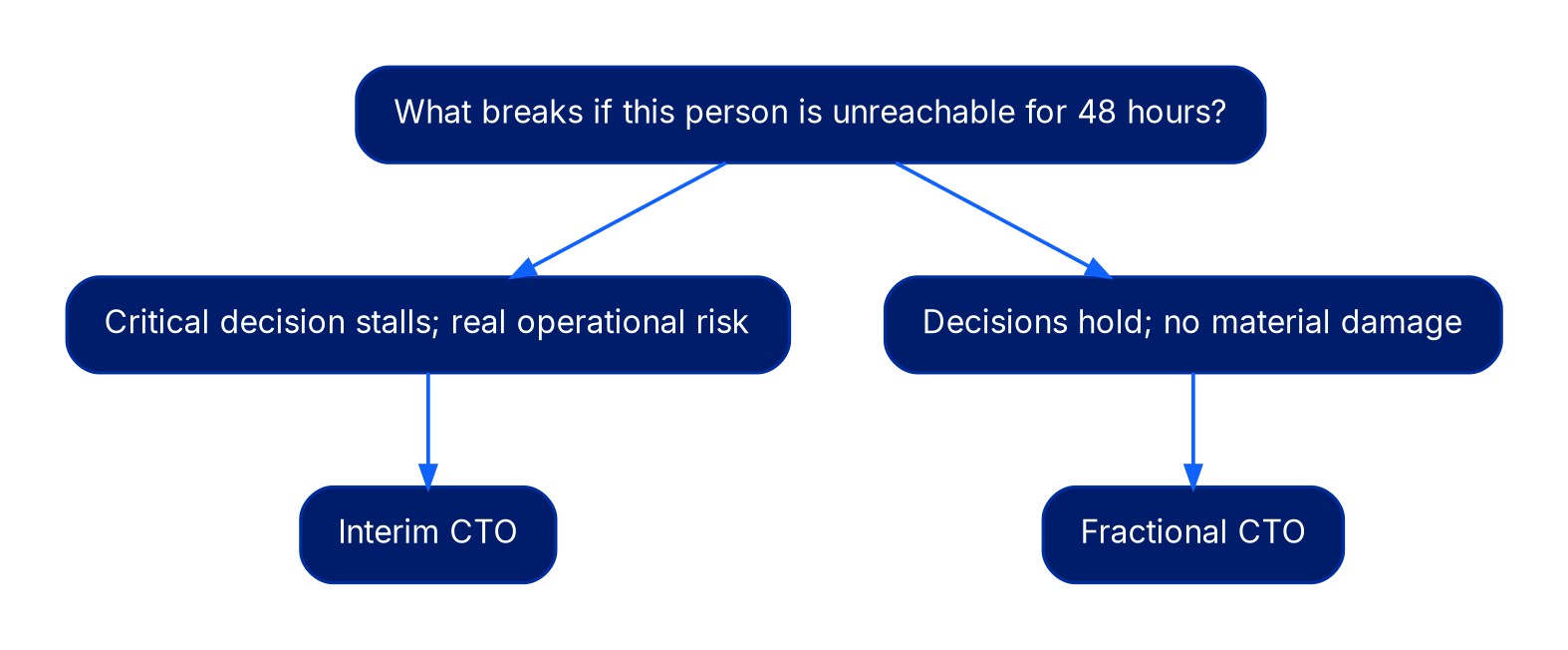
The second question is what breaks when this person is unreachable for 48 hours. If a critical decision stalls over a long weekend and that creates real operational risk, an interim is the right model. If decisions hold until the next scheduled session without material damage, fractional coverage is adequate. The honest answer to this question is diagnostic in a way that the aspirational job description rarely is.
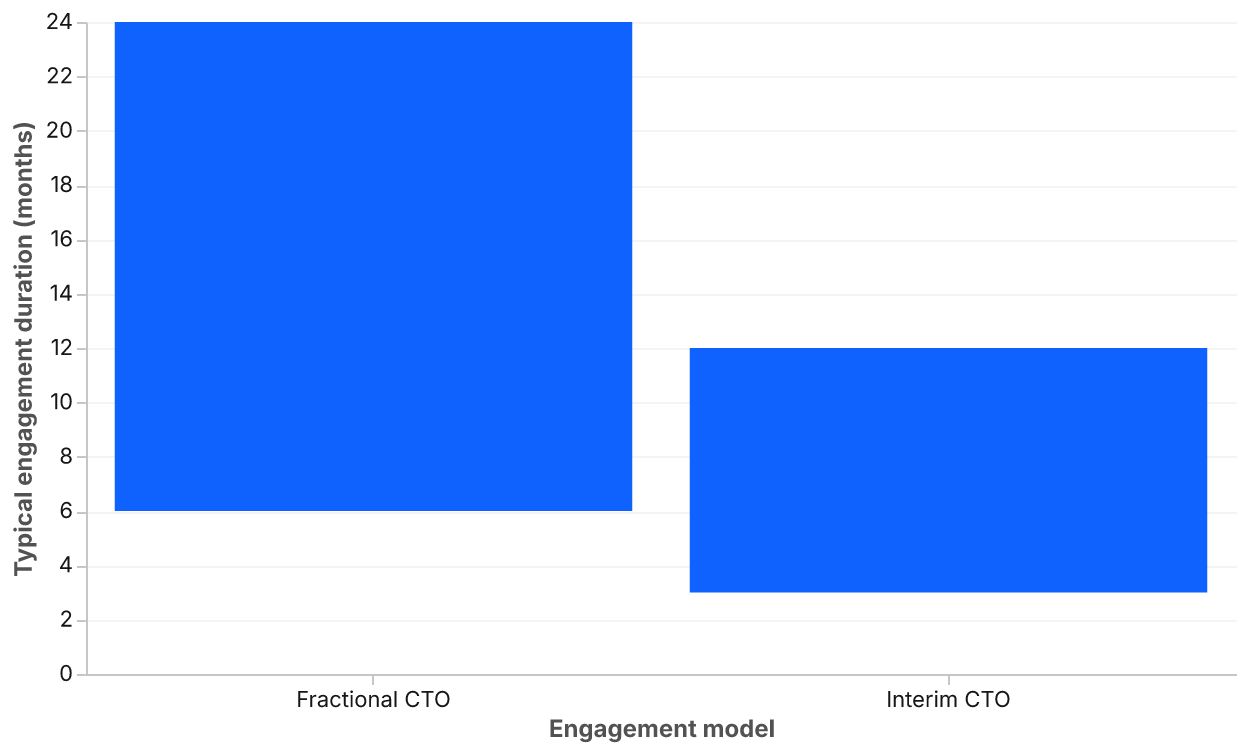
Third is the end state. Fractional relationships work best over six to 24 months with a clear repeating rhythm. Interim engagements run three to twelve months with a defined handoff milestone. An engagement that can't articulate its end state will drift. Both models. We ask every client to describe what "done" looks like before we agree on the structure, and the answers are frequently more clarifying than the initial brief.
The stress-test we've found most useful: if your CTO were unreachable for a full week because of another commitment, what stops? If the honest answer is that the team can't advance critical technical decisions without them, you have a full-time dependency with part-time coverage. That gap shows up in delivery velocity first, then in engineering attrition.
Red flags in the selection process
A few signals reliably predict a bad engagement regardless of which model you choose.
The candidate proposes a model before asking about your situation. Any practitioner who leads with "I do fractional work" before asking about your team structure, decision cadence, and current pain points is selling a product, not diagnosing a problem. This happens more often than it should, particularly on the fractional side where the market has become crowded.
The statement of work doesn't include a decision authority matrix. Who can this person hire, let people go, approve budget for, and commit the company externally? Vague authority is the single most common reason both models underdeliver. A fractional CTO who can't approve a $50,000 vendor contract without escalating to the CEO isn't really the technology executive; they're a senior advisor with a title. The authority question needs to be explicit before the contract is signed.
There's no defined end state. Interim engagements need a handoff milestone. Fractional engagements need success criteria that the company can assess against. An open-ended retainer for executive time, with no defined objective and no defined exit, reliably benefits one party.
What to do in the next 30 to 90 days
If you're making this decision now, three exercises sharpen it faster than any interview process.
-
List every technology decision that has been stalling. Count them and classify each as execution (requires authority and presence) or advisory (requires judgment and expertise). Three or fewer advisory decisions means fractional is almost certainly adequate. Ten or more decisions, especially if multiple require managerial authority, means an interim.
-
Price both failure scenarios before you price the engagement. A fractional engagement that fails after four months leaves you where you started, minus the fee and the four months. An interim who finishes in seven months with the team intact, the roadmap credible, and board confidence restored is worth more than they cost. Model the failure cases. Both of them.
-
Run a reference check specifically on availability and model fit. Ask prior clients how the executive handled weeks when they were unavailable, and what happened to decisions that needed to be made during those gaps. Ask whether anything got deferred in ways that caused downstream problems. Those answers are more diagnostic than anything in an interview.
The wrong model, even with the right person, produces the wrong outcome. Get the model right first, and work the rest of the problem from there.